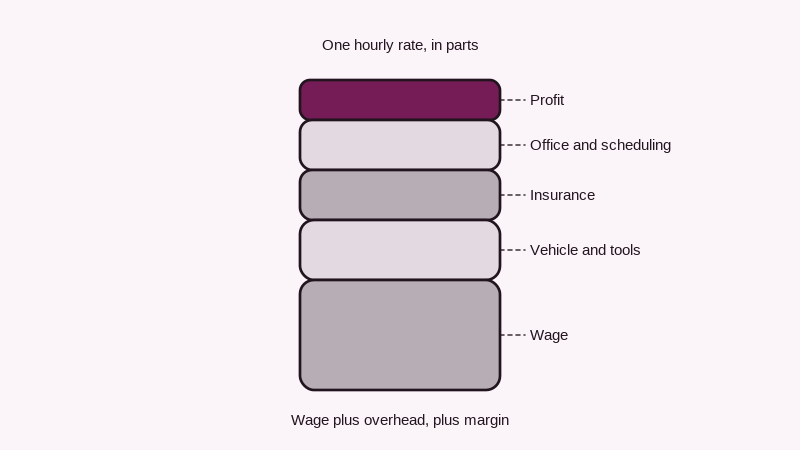
A commercial plumber's hourly charge pays for one hour of labor plus a share of the truck, tools, insurance, office and profit, and it moves with the job and the hour of the day. No figure is printed here, since any single number would be a guess. It is better to grasp what sits inside the rate and compare written quotes that cover identical scope.
Anyone who runs a shop, restaurant, office or rental building in the north Valley can send the quote form via Mission Point Plumbing; it is forwarded to a nearby plumbing business that takes on commercial jobs and arranges a site visit.
What makes up an hourly rate for commercial work?
An hourly rate bundles the plumber's wage with the costs of staying in business: the truck, fuel, tools, insurance, workers compensation, scheduling and permits, plus a margin. That is why a one-person shop and a firm with a dispatch office quote different rates for what looks like the same hour. The rate describes the business as much as the work.
A plumbing hourly rate calculator, if you find one online, works by adding those items and dividing by the billable hours in a year. Treat the output as a guide to how a business thinks, not a price for your job. Billable hours are fewer than hours worked, because driving, ordering parts and paperwork are not charged line by line.
How do commercial rates differ from home plumbing rates?
Per hour, commercial work normally runs higher than a simple home call, because the equipment is larger, the systems are more complex and the schedule is tighter. A restaurant grease trap, a riser serving several units or a backflow assembly is a bigger job than one house faucet, and the plumber needs the right tools, parts and often a second person.
The access is also different. Commercial work often happens after hours so your business keeps running, and that can change the rate. Ask whether the rate depends on the hours, and for the terms in writing. For homes, the broader guide on plumber cost by the hour in Sylmar applies.
What does it cost to start a plumbing business?
It varies with the size of the business, and no honest number fits all. The main costs are the contractor license process, the contractor's bond and insurance, a vehicle, tools and equipment, software and marketing. California generally requires a contractor license for plumbing work above a modest value, and for any permitted job.
The California Contractors State License Board, found at cslb.ca.gov, lists the requirements, fees and exam steps, and it is the only source to trust on them. Costs and rules change, so read the board's own pages. If you are asking because you want to understand where a plumber's rate comes from, the overhead above is the answer. If you are planning a business, plan for the months before the first invoice is paid.
What is a typical plumber rate in Sylmar?
There is no honest single "typical" figure, because rates depend on the kind of work, the plumber's size, the hour of the visit and the minimum charge. Published rates from the internet mix cities, years and job types. A number from 2022 or from another country says little about a job in the north San Fernando Valley today.
Instead of looking for a headline rate, put the same questions to each plumber: what does the visit cost, what rate applies after the opening hour, what is the minimum, are there after-hours terms and are parts marked up? Then compare in writing. Our overall plumber cost guide shows what a good quote should itemize.
What is the difference between master and journeyman plumber rates?
The grade of the worker affects the rate. A master or senior plumber usually carries more experience and responsibility than a journeyman, so the hourly price is often higher. A journeyman is a trained worker who is not yet at the top grade. A contractor may send either one, depending on the job.
In California, the license that matters for the customer is the contractor license, which belongs to the business or the owner, not the worker's grade. Terms such as master and journeyman are used by trade groups and employers and are not a guide to price on their own. Learn who will actually attend, whether the job needs a permit and who is accountable for it. Ask about labor and parts warranties, and have them on paper.
When is an hourly plumbing rate fair?
A fair rate matches the scope, the hour and the plumber's overhead, and is written down before work starts. It is not simply the lowest number on a page. A rate that looks low can come with a high visit charge, a minimum of several hours or marked-up parts, so the total, not the rate, is what you compare.
On small jobs the visit charge and the minimum can outweigh the hourly rate. On longer jobs, the rate and the estimate of hours count for more. Ask the plumber to show an estimate of hours and the unit rate separately, then multiply. If a quote is one flat price, find out which items it includes and which events would change it.
What should a commercial plumbing quote include?
A commercial quote should name the site, the scope of work, the permit plan, the materials, the labor basis (hourly or flat), the schedule, how warranties apply and the payment terms. For a business, the quote should also say when the work will happen so your customers are not affected, and who restores the area afterwards.
Where a permit is required, the City of Los Angeles Department of Building and Safety issues it, and its Valley office is in Van Nuys. Confirm with LADBS before you visit. Ask who obtains the permit and whether an inspection is part of the price. Deposits on home improvement contracts are limited in California, and the CSLB sets out the current rules. For a commercial job, ask your own advisor about contract terms.
How can I compare hourly quotes from two commercial plumbers?
Set both quotes beside one scope of work. List the visit charge, the hourly rate, the estimate of hours, the parts and markup, after-hours terms, the permit, the warranty and the payment schedule. A plumber who quotes lower per hour but longer overall may cost more than one with a higher rate and a faster job.
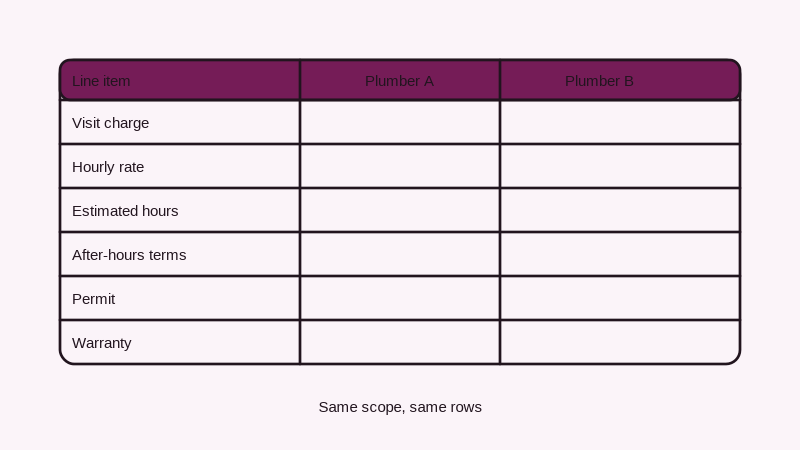
Ask each plumber to visit and quote on site. A figure quoted without seeing the site is a guess. The sources worth trusting are the plumber's written quote, the CSLB license page and the permit office, not a price table on a website. If the quotes still differ widely, ask each plumber to explain the gap.
Common questions
Is the hourly rate the same for every kind of commercial plumbing?
No. Routine repairs, drain clearing, backflow work, water heater replacement and new installations are priced differently, and some are quoted as flat jobs. A plumber who works on larger systems may charge more per hour for specialist equipment. Ask for the basis of the price in the quote, not a general rate.
Is travel time billed on commercial jobs?
Sometimes. Travel can be built into a visit charge, billed as time or left out for local jobs. Ask which. For a Sylmar or north Valley address, a plumber based nearby usually has less to add, but it is still worth asking in writing before the visit.
How does a minimum charge work?
Plenty of plumbers apply a minimum, often covering the first hour or a fixed visit. Ask what the minimum covers, whether parts are extra and how it changes after hours. On a short job the minimum can outweigh the hourly rate.
Do rates from other countries apply here?
No. Rates published for other countries, such as New Zealand, reflect different wages, costs and rules, so they do not transfer to California, and the same goes for older years. Use quotes for your address and your job from plumbers in the north San Fernando Valley.
Are warranties included in an hourly rate?
Not automatically. The quote should state, in writing, a warranty covering labor and parts, how long it lasts and what voids it. Manufacturers also warrant their own parts, which is separate. If it is not written down, do not assume it exists.