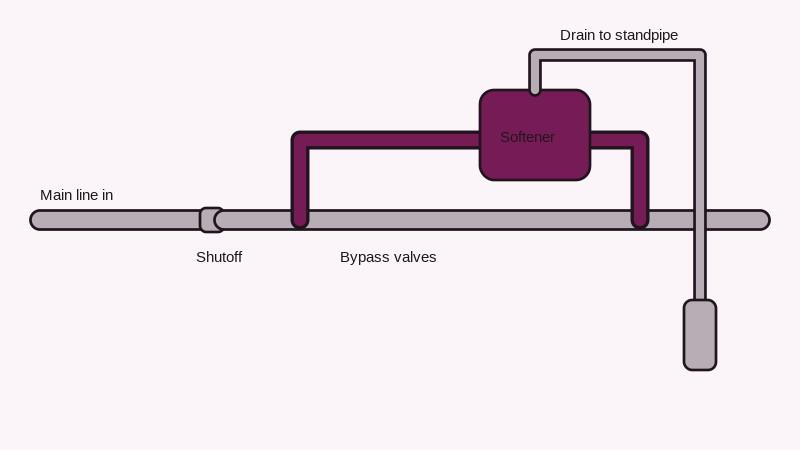
Softeners swap the minerals that cause scale for sodium or potassium, which leaves less crust behind as water moves through your pipes. Installing one is a plumbing task: the unit is tied into the main supply, piped to a drain for its flushing cycle, and plugged in. You can buy the tank anywhere, but the connections decide how well it works. Your request goes to a nearby plumbing business, and one of its plumbers visits, inspects the setup and writes the price down before starting.
For a stage-by-stage account, read the walkthrough of a softener installation. To understand pricing, see what drives water softener installation cost. You can also send a request right away, describing the house and the model you are considering.
What work goes into fitting a softener?
After the shutoff, the plumber opens the main line and fits a bypass valve, which lets water keep flowing while the unit is isolated or being serviced. Pipes for incoming and outgoing water then attach to the softener head. A drain hose takes away the rinse water from regeneration, and the brine tank gets its own overflow hose. Power and settings follow, matched to local hardness. Good work also keeps hose bibs on untreated water.
Order matters. Typically the main is closed and the pipe emptied first, then the bypass goes in, fittings are joined, and each joint is checked for seepage before the valve opens slowly. Next the softener is rinsed to wash out packing dust, and a hardness figure is entered so it regenerates at the proper interval. A careful installer also confirms the salt storage fits, since brine tanks are heavy and need a level base.
Where should the softener sit in a Sylmar house?
Place it on the supply pipe just after the point where water enters the property, so every indoor outlet receives softened water. Common locations include the garage, a utility closet or a side-yard enclosure. It needs level ground, a drain close by and a power outlet. Garden taps and irrigation should branch off ahead of the unit so that lawns avoid sodium.
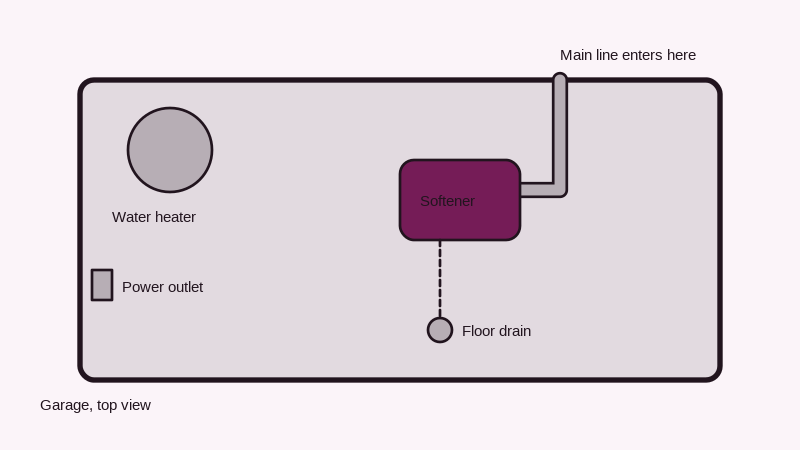
Plenty of north Valley tract houses built between the 1950s and 1970s have a tight garage with the water heater in a corner, and the water enters along a rear or side wall. That arrangement works well for a softener, although you should measure the space around the heater, since both appliances need servicing room. On hillsides like the Hubbard Street terraces, pipes can arrive at other heights than on flat lots, so a plumber should check the route in person.
Is a softener loop already in my home?
A loop is a prebuilt arrangement of pipes and valves, often behind a wall or in the garage, with a bypass and a gap where the unit will sit. When a house has one, installation is quick because the cutting is finished. When it lacks one, the plumber constructs it. Newer houses, such as those in Porter Ranch, frequently come with a builder-fitted loop, but confirm it.
A loop is only plumbing, not the softener itself. It lets you add, service or remove the unit while water continues to flow elsewhere in the house. Even if you purchase the tank first and install later, the loop can be added by itself.
What pushes the price up or down?
Three things set the cost: the unit, the pipe layout and the extras. Easy copper beside a drain in the garage makes a modest job. Rusted pipe, a drain far from the unit, a new outlet, a loop that must be built, copper-to-plastic transitions or a wall that needs repair each add time and materials. This site shows no dollar figures, so the checklist below helps you compare quotes.
A good quote spells out:
- The softener model and capacity, or a note that you are supplying it.
- Whether the bypass, connectors, drain hose and overflow line are part of the price.
- Whether hose bibs stay on untreated water.
- If electrical work is in or out of scope.
- How the old equipment and packaging leave the property.
- The labor covered, plus any manufacturer warranty terms.
Work that needs a permit belongs to a contractor holding a California license, and the state usually expects a license once a job exceeds the value limit set by the contractor board. Check with that board before signing.
Does the softener brand alter the job?
Plumbing is mostly the same across makes, yet every brand has its own valve head, bypass design and setup menu, and some warranties demand a trained dealer. Culligan, Kinetico, Whirlpool, Rheem and Aquasana each post their own instructions, so read your manual and tell the plumber which model you own.
Certain brands, Kinetico among them, run without electricity, so no outlet is needed. Others need power and a control board. Water-driven units may use more water per cycle, while electric ones can suffer board failure. None of that argues for a brand here; it is a reason to ask the person quoting how your model is set up, what it sends to the drain, and who services it.
If only showers matter to you, a filtering shower head can slow scale at the nozzle, yet it treats a single fixture and leaves the water heater and pipes unprotected. Treat it as a small measure, not a substitute for a unit on the main.
Could I fit one on my own?
If cutting and joining pipe is familiar to you, it can be done. The risks are genuine, though: a joint seeping inside a wall, a drain connection that lets wastewater flow backwards, or a unit hooked up in the wrong direction. Water damage costs more than the labor you would save. First ask the Los Angeles Department of Building and Safety whether the work needs a permit.
If you proceed, close the main, add the bypass, keep an air gap at the drain and test gradually. Many owners hire the plumbing out and manage the salt and settings themselves.
What signs say I need a softener?
White crust on taps and glass shower doors, spotted dishes, rough laundry, soap that will not foam and kettle scale all suggest hard water. Scale also collects inside heaters and pipes. Before buying, read LADWP's annual Drinking Water Quality Report, or the one from your own district, because hardness differs by street and source. Two guides help first: stopping scale from forming and getting rid of existing deposits.
Not every home needs one. If the only complaint is a cloudy shower door, regular cleaning may do. If scale is cutting the life of your appliances, a quote on a whole-house unit is worthwhile. Whole-house pricing notes live on the page on whole-house softener cost.
Common questions
How many hours does fitting take?
If a loop is already installed, a basic job can wrap up within a few hours, while altered pipework, an additional drain or a fresh outlet run stretches it. The plumber gives a time window when the visit is booked, and the water is shut for part of that time. Ask what to expect on the day so you can plan showers and laundry around the shutoff.
Must someone be home while the plumber works?
Yes. An adult has to open the door, show where the main shutoff is and agree to any change in the quote. You do not have to watch the work. Mention pets, gates and parking beforehand, and leave a clear route to the garage or utility space so the plumber can reach the pipes and carry the unit in without delay.
Which questions should I put to a plumber before hiring?
Ask for a written quote naming the model, connections, drain method, electrical work and warranty. Find out who obtains any permit, and whether the plumber holds a California contractor license, which the state board's website lets you look up. Also ask what happens if a joint leaks after the visit, and who you contact.
Does a softener make the water bill rise?
Each regeneration cycle uses a bit of water, so a small rise can occur, but a big jump suggests a fault. Learn more in softeners and high water bills. If the bill climbs after the install, ask the plumber to review the regeneration settings, which are often set too frequently at the start.
Do you visit my part of town?
Visits are arranged around the north Valley and foothills, and the service areas page lists neighborhoods by name. Messages from the form are read Monday to Friday, 9am to 5pm, in the order received. For every service we cover, start from Mission Point Plumbing, where each topic has its own page.
Guides in this section
- Water softeners and treatment
Can a water softener raise your water bill?
- Hard water scale prevention
Stop limescale before it clogs fixtures and cooks your water heater.
- Water softeners and treatment
Thinking of fitting a water softener yourself in the north Valley?
- Removing hard water scale
How to remove hard water scale from faucets, shower heads, glass and a water heater, what not to use, and when a softener is worth quoting.
- Costs
What decides a water softener installation price in Sylmar, how brand and loop work change a bid, and how to compare quotes line by line…
- Plumber
What a water softener installation service covers in Sylmar: whole-house hookup, drain and air gap, electrical, bypass, permits, manuals…
- Water softeners
What decides the cost of installing a whole-house water softener in Sylmar: hardness, sizing, plumbing, drain and salt choice, plus how to…