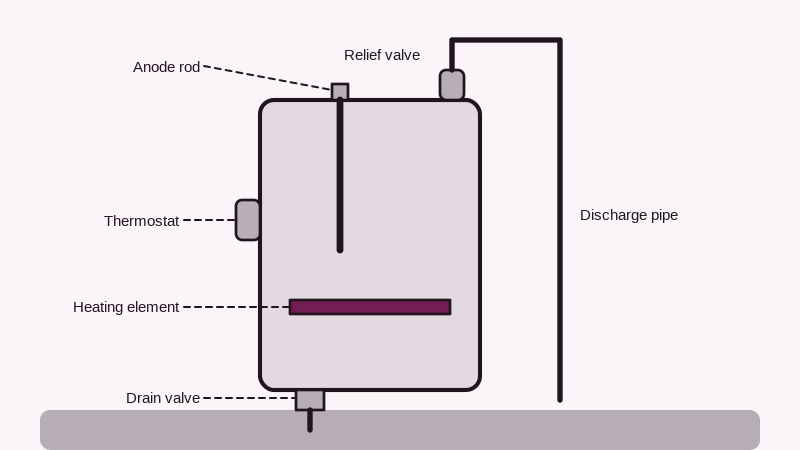
When hot water vanishes, fades, drips or smells odd, the repair plumber traces the fault and then either fits a new part or says plainly that the heater has reached its end. In Sylmar and the wider Mission Point Plumbing service area that typically means a single trip: diagnosis, a written quote, and the fix itself when the part is a common one. Use the quote form to describe the fault, and a plumber based nearby contacts you to arrange a visit.
What does a water heater repair visit involve?
Diagnosis starts from the symptom you report. The plumber then tests each component that could be responsible: heating element or burner, thermostat or gas control, safety valves, tank and connections. A written quote is handed over before any work starts. Many jobs wrap up the same day when the needed part is already in the van.
Fuel type changes the checklist. With an electric tank, expect tests on the power supply, both thermostats and both elements, because a tripped high-limit switch or a burnt element commonly explains lukewarm or absent hot water. With gas, attention goes to the pilot or igniter, thermocouple, gas control valve, flue and combustion air. Tankless units are read first by error code, then by flame sensor, flow sensor, exhaust path and scale inside the heat exchanger.
Questions will come up. How old is the heater? When did the problem start? Does it hit during every shower, or only once two people have used the hot water? Do some taps stay cold while others run hot? Answers like these narrow the suspect list before a tool is picked up. Snap a picture of the data label on the side of the tank; model, serial number and fuel type are printed there.
Read the quote line by line. It should itemize the part, the labor and extras such as a new shutoff valve or a vent correction. A tank that is itself leaking cannot be patched, so a replacement quote follows; what a replacement costs here is laid out in plain terms.
Which water heater faults come up most?
Six symptoms account for most calls: no hot water, too little hot water, scalding water, leaks, noise and smells. A dead electric heater usually points to an element, a thermostat or a tripped breaker. A dead gas heater points to the pilot, thermocouple or igniter. Water escaping through the tank wall cannot be repaired.
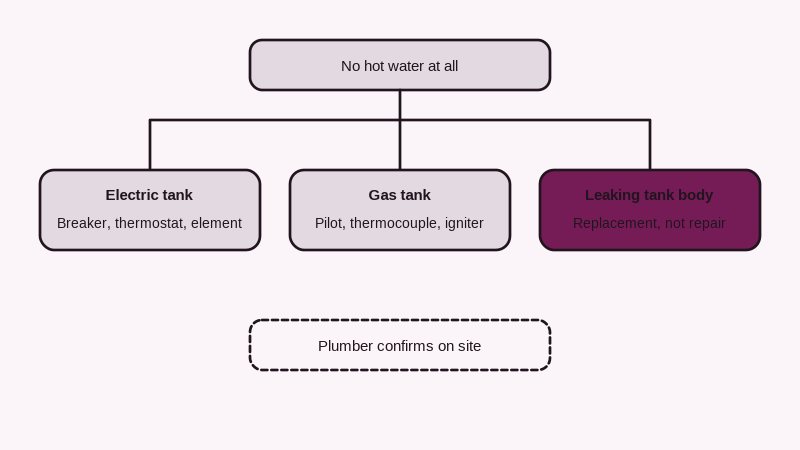
Here is a rough pairing of symptoms and likely causes. Treat it as a loose guide rather than a verdict; the plumber confirms the real cause at the house.
No hot water at all. Electric: a tripped breaker, a failed thermostat or high-limit switch, or a burned element. Gas: a flame that has blown out, a worn thermocouple or thermopile, a dead igniter, a faulty gas control valve, or an interrupted gas supply. Checks you can safely try yourself are listed in the no hot water guide.
Heat that fades within minutes. A cracked dip tube sends cold inlet water straight into the upper tank, where it blends with the hot; a dead lower element leaves the lower half cold; sediment may also blanket the burner. Related pages: dip tube replacement and element replacement.
Water that comes out too hot. Either the thermostat dial sits too high, or the part has failed. Scalding is a real hazard, so act on it: turn the setting down, and if the water stays hot, have a plumber look.
Rumbling, popping or hissing. This is usually hardened sediment sitting on the tank bottom, or scale stuck to an element. The supply mixes several sources that differ from street to street, so your supplier's annual report is the place to see what is in the water.
Wetness at the base. The source could be a loose fitting, a dripping relief valve or a tank that has reached the end of its service. Read through water heater leaks before you decide anything.
Rotten-egg smell. The anode rod is often reacting with the water, and swapping the anode rod is the usual remedy.
Is it better to fix the heater or replace it?
A repair is the sensible choice when a single component has failed, the tank holds water and the heater has years left. Replacement wins when the tank has started leaking, repairs keep stacking up, or the unit is old enough that another failure is only a matter of time. A good written quote lists a repair price and a replacement price together, which makes the comparison easy.
Weigh three things. First the tank: a heater whose body is weeping water is finished. Second, age: manufacturers state expected lifespans in their literature, and the model plate dates your unit; the replacement interval guide goes deeper. Third, the pattern: an element last year, a valve this year, a thermostat today, and the heater is telling you something.
Pouring money into a failing tank is wasteful, and so is buying a whole new heater when only a thermostat died. Ask the plumber which parts were tested and how they reached their verdict. If you want a second opinion, request an itemized written quote and set the two next to each other.
How much time does replacing a water heater need?
A plain like-for-like swap usually takes a few hours: the old tank is drained, disconnected and hauled off, then the new one is set, connected, vented and tested. Moving the heater, switching fuel, changing the venting, adding an expansion tank or updating old connections makes the job longer. The quote includes a time estimate.
Several things stretch the visit. A gas heater needs proper venting and a leak test on the gas connection, and changing a gas line is regulated work. Permits are common, so ask the plumber who files one, and confirm details with LADBS, the city's building department; we have not verified the permit rule for every address. An old heater jammed into a cramped closet or garage corner can be slow to pull out. Switching to tankless may need new gas sizing, a vent and an electrical supply, which makes it a bigger project.
Expect hot water to be unavailable for some hours, and shift stored items away from the heater beforehand. The sequence of work is described on the replacement plumber page.
Which makes and types of heater can a plumber work on?
Most common tank brands, electric or gas, and the main tankless makers are within a local plumber's range, though parts supply and the unit's age decide what is realistic. Put the brand and model in the form. Rheem, Whirlpool and A. O. Smith build tanks, while Navien, Rinnai and Noritz are familiar tankless names.
Rheem and Whirlpool tanks. Their faults are mostly the standard ones above: elements, thermostats, gas valves, thermocouples and igniters. Parts for current models are easy to source. Older units may need a substitute, or may no longer be worth fixing.
Navien, Rinnai and Noritz tankless. These display error codes, and many faults come from a dirty flame sensor, a flow sensor, vent trouble or limescale in the heat exchanger. Brand pages: Navien units, Rinnai units, Noritz units and Rheem units. For the same material in everyday language, read instant water heater repair.
Heat pump water heaters. They pull warmth from the surrounding air and move it into the tank, so besides the usual parts they include a compressor, fan and condensate drain. Service is more specialized; ask whether the plumber has worked on that model before.
Thermostat and igniter work. Swapping a thermostat on an electric tank is routine, and so is replacing an igniter on a gas unit. Neither is a good DIY job when electricity or gas is involved.
Is a 40 gallon tank enough for five people?
Often it falls short at peak hour. Forty gallons works for a small household, yet five people showering in a morning rush with a dishwasher or laundry running can empty it. Compare the first-hour number on the model plate with what you really use at your busiest time. The plumber can check both and recommend a size.
Whether it is enough depends on routine. If the five of you stagger showers, wash clothes in cold water and share a single bathroom, a smaller tank may cope. If showers come back to back, a larger tank, a high-recovery model or a tankless unit with plenty of flow fits better. Plan around the busiest hour, never an average day.
The label alone misleads. Gas tanks recover faster than electric ones of equal volume, so identical gallon counts can yield different hot water per hour. In your quote request, mention household size, bathroom count and whatever runs simultaneously.
Will a 20 gallon water heater do the job?
A 20 gallon tank suits very small jobs: a studio, one bathroom sink, a utility room, or a single occupant who uses little. For a whole house it is usually too small, because one long shower can drain most of it. Think of it as a point-of-use size, and talk to the plumber first if you are weighing one for an entire home.
Small tanks also show up as a second heater, placed near a distant bathroom or kitchen so hot water arrives sooner. In a long house that can make sense, though it adds another appliance to maintain and another place for a leak to start. If you already own a 20 gallon unit and the hot water keeps fading, the plumber may suggest a bigger tank or a different layout.
What is the first move when a heater leaks or bursts?
Close the cold water supply to the heater. Then switch the breaker off for an electric unit, or turn the gas control to its off position for gas, and keep everybody away from the water, which may be scalding. Never touch wet electrical connections. Have a plumber inspect the heater before anyone restarts it.
Gas odor means leave first: exit the house at once, and only from outdoors reach the gas utility or 911. Gas piping in California is regulated work, so repairs belong to a contractor with the proper license classification; never attempt to mend gas lines yourself.
The leak repair guide for water heaters separates safe steps from unsafe ones. When the leak is part of a larger emergency, the emergency heater page lists the first moves.
Which parts of a water heater break down most?
Worn heating parts lead the list: a burned-out element or thermostat on an electric tank, and a pilot, thermocouple or igniter problem on a gas model. Sediment, a used-up anode rod and a leaky relief valve follow. What you notice is no hot water, a weak flow, strange noises or a drip.
Heating parts wear because they sit in water that leaves mineral deposits. Sediment lets elements overheat and crusts over burners. An anode rod is designed to corrode so the tank will not; when it is spent, the steel begins rusting instead. Two of the most-asked repairs have their own pages: relief valve replacement and thermocouple replacement.
What size water heater suits a household?
Capacity follows how much hot water the household draws in its peak hour, not the square footage. Tanks carry a gallon figure and a first-hour rating, meaning hot water delivered across the first hour from a full tank. Match that rating to your busiest hour, and let the plumber size the unit from real habits.
For a tank, count the people, bathrooms and heavy draws: a deep soaking tub, an oversized rain showerhead, a washing machine and a dishwasher all use hot water. A couple sharing one bathroom needs far less than a house with teenagers. A tank that is too small turns cold mid-shower, while one that is too big costs more up front and more to keep warm.
Tankless units are rated by flow: the gallons per minute they can heat from your incoming water temperature. Two showers and a faucet at once demand more flow than a single shower, and sizing differs between gas and electric models. For the trade-offs, see tank or tankless; for what moves the price, see tankless installation costs.
Common questions
What is the usual lifespan of a water heater?
It varies with type, water quality and upkeep, and manufacturers print their own figures in the owner's manual. Tank heaters generally run around ten years or a bit longer, while tankless units often go further when they are descaled. The model plate shows the manufacture date, so check it first. No figure here has been checked against your exact model, so ask the plumber.
Which element in an electric heater fails first?
With two elements, the lower one tends to go first, since it sits down in the sediment and does most of the heating. When it dies, the hot water lasts only briefly before turning cold. The upper element and its thermostat can fail too, which is why the plumber tests both elements before replacing either one.
How do I react when my water heater bursts?
Shut the heater's cold-water inlet valve, then cut the electricity or gas. Open a hot tap elsewhere in the house to ease pressure, keep away from hot water, and lift belongings out of its path. Do not wade through water near outlets. Afterward, send the quote form and a local plumber can inspect the damage and the heater.
Is it safe to shower while the heater leaks?
Better to hold off. A leaking heater can still be live with electricity, can release scalding water if the thermostat has failed, and a leak may worsen fast. For a small leak, first cut the power, shut off the gas and close the cold inlet valve on the heater, and only then use other taps if the plumber agrees.
How long can a water heater leak before it explodes?
No waiting period is safe, and leaks follow no timetable. The rare dangerous failure involves a blocked relief valve or a faulty thermostat that lets pressure climb, which is why a dripping valve needs prompt attention. Treat every leak as urgent: shut off the water supply, power or gas, and arrange for a plumber.
Do you cover areas outside the north San Fernando Valley?
No. We arrange visits for Sylmar, Granada Hills, Porter Ranch, Pacoima, Panorama City, Mission Hills, Arleta, Sun Valley and nearby north Valley and foothill neighborhoods listed on our service areas page. Requests from elsewhere fall outside what we cover, and a search for a repair plumber in another city will not find us there.
Guides in this section
- Anode rod replacement
What an anode rod does, how to tell when it is spent, how it is swapped, and when a Sylmar homeowner should hire a plumber instead of…
- Cost hot water heater
How to read a hot water heater replacement quote in Sylmar: the line items, what pushes the price up, what to compare and what to question…
- Water heaters
What counts as an emergency water heater repair in Sylmar, what to shut off first, and how to send a request for a visit and a written…
- Gas tankless installation
What a gas tankless water heater installation involves in Sylmar: gas line size, venting, permits, the earthquake valve rules and what to…
- Hot water heater repair
Hot water heater not working? Symptom-by-symptom checks for gas, electric and tankless units in Sylmar, what is safe to try and when a…
- Hot water pressure low
Strong cold water but weak hot water? Is the cause scale, a valve, an old pipe or the water heater?
- Water heater repair
Does hot water need its own pressure regulator?
- Water heaters
Water heater lifespan: how long tank and tankless units tend to last, and which warning signs in a Sylmar home mean it is time to plan a…
- Water heaters
Find where a water heater leaks, fix the parts that can be fixed, and learn why a leaking tank means replacement.
- Costs
What drives tankless water heater installation cost in Sylmar: gas line size, venting, electrical, the old tank removal and permits.
- Instant water heater repair
Instant water heater repair means fixing a tankless unit that has stopped heating.
- Water heater repair
What drives the cost of replacing a water heater in a mobile or manufactured home, why the unit differs from a house heater, and how to…
- Navien tankless water heater
Planning a Navien tankless install in Sylmar?
- Water heater repair
A Navien tankless unit throwing an error, running cold or short-cycling: what you can check safely, what needs a plumber and how to…
- No hot water kitchen
Hot water everywhere except the kitchen sink usually points to the faucet, a valve or a supply line, not the heater.
- Water heaters
Noritz tankless water heater not working in Sylmar?
- Plumber for water heater
Water heater leaking in Sylmar? What to shut off first, whether the leak is repairable, what permits and code rules apply, and how to…
- Water heaters
Hiring a plumber for water heater replacement in Sylmar: what the job involves from drain to test, what to prepare, what to check on the…
- Replacement water heater element
When an electric water heater element has failed, how to test it, what a replacement involves and why gas heaters have no element at all.
- Plumber
Rheem tankless water heater not heating or showing an error?
- Water heater repair
What installing a Rinnai tankless water heater involves in a Sylmar home: gas line, venting, permit, sizing and the questions to put in a…
- Rinnai tankless water heater
Rinnai tankless heater showing an error code or running cold?
- Water heaters
Shower running cold while other taps run hot?
- Water heaters
Tank or tankless water heater for a Sylmar home?
- Tankless gas water heater
Gas tankless or gas tank heater for your Sylmar home?
- Tankless water heater replacement
What sets the cost of replacing a tankless water heater in Sylmar, from venting and gas line size to labor and permits, and how to read a…
- Thermocouple water heater replacement
A pilot that keeps dying usually points at a worn thermocouple.
- Water heater dip tube
A failed dip tube makes a tank run out of hot water fast.
- Plumber
Expansion tank on your water heater failing?
- Water heaters
When a water heater relief valve needs replacing in Sylmar, the signs it has failed, why you must never cap it, and what a plumber does…
- Water heater replacement cost
What decides the bill for a 50-gallon water heater replacement in Sylmar, from fuel type and venting to earthquake strapping, plus how to…
- Costs
What drives water heater replacement cost in Sylmar, what a written quote should itemize, and how to compare quotes for repair, tank and…
- Water heater repair
The heater runs, the tank is warm, yet taps stay cold or lukewarm.
- Water heaters
No hot water at home in Sylmar? The common causes for gas, electric and tankless heaters, what you can check safely, and when a plumber…