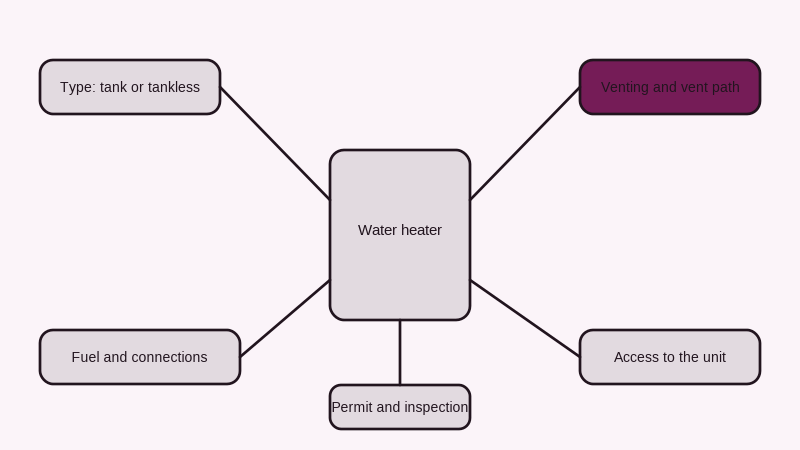
Four things add up to the price of a new water heater: the unit you choose, the labor to pull out the old one and set the new one, the gas or power, water and vent connections, and any corrections the existing installation needs. This site explains those drivers in words and shows no dollar figures. Start with the water heater repair overview, then send the quote form to receive a written quote.
What does a water heater repair usually involve cost-wise?
No single average is useful, because a repair could be a thermostat, an element, a thermocouple, a valve, or a leak that finishes the tank, and each is priced differently. Fitting one minor component during a brief visit costs far less than a replacement, while a leaking tank cannot be mended. Ask for the diagnosis first and the written price second.
A repair quote has three pieces. The part: thermostats and elements are modest, but a tankless circuit board or gas control valve is pricey. The labor: time for a plumber to test, remove and refit. And the visit: travel plus minimum time on site. If the quote lists several faults, ask which one is the cause and which is only a suggestion.
Repairing rarely pays in three situations. One, the tank leaks. Two, the unit is old and the part would eat up much of the price of a new one. Three, the same heater has broken down several times in a short span. In those cases ask the plumber for one written price to mend and another to swap, so the difference is visible. On age, see how long a water heater lasts before replacement.
What pushes a replacement quote higher?
The main drivers are the heater type, its size, a switch of fuel, the condition of vent, gas and water connections, how easy the unit is to reach, and any permit. A plain tank-for-tank exchange sits at the low end, while moving from tank to tankless, or from electric to gas, sits at the high end.
Type. A storage tank is the baseline. A tankless unit is dearer to purchase and to fit, since it needs a larger gas line or heavier electrical supply, a special vent and often a condensate drain. A heat pump water heater costs more again and adds space and drain needs. These are discussed in the pages on tankless installation costs, tankless replacement costs and tank versus tankless.
Size. Capacity affects the price of the unit and sometimes whether it fits. Judge it by your peak hour of use, not the size of the house. For 40 and 50 gallon tanks, see the 50 gallon replacement page.
Fuel and connections. Changing from electric to gas, or back, means fresh piping or wiring. In some cases, such as a property sale or certain larger jobs, the Los Angeles city building code may require an approved seismic or excess-flow gas shutoff valve; ask the plumber if it applies. Earthquake gas shutoff valves have a page of their own. Gas piping is regulated work, so the work is reserved for a contractor with a state license.
Condition of the old setup. Corroded shutoff valves that fail when touched, aged flexible connectors, a vent that falls short of current practice, no drain pan, or a temperature and pressure relief line that does not end somewhere safe all add labor. So does a missing expansion tank, often required when the supply line runs through a check valve or a regulator. See the expansion tank replacement page for detail.
Access. A heater in an attic, a narrow closet or at the top of stairs takes more labor than one in an open garage. A steep hillside home in upper Sylmar can add time as well.
Permits. Water heater swaps frequently need a permit, and in California any job that does must go to a contractor with the proper state license. All services arranged through this site are listed on the Mission Point Plumbing home page. For north Valley areas inside the city, permits are issued by LADBS, the city's building department. Ask who files the paperwork and if its fee sits inside the quote.
What belongs in a written replacement quote?
A good quote names the heater's make, model and capacity, then itemizes labor, removal and disposal of the old unit, each new part (valves, connectors, the expansion tank), venting, any gas or electrical work, the permit and inspection, and payment terms. Ask for any missing item before signing.
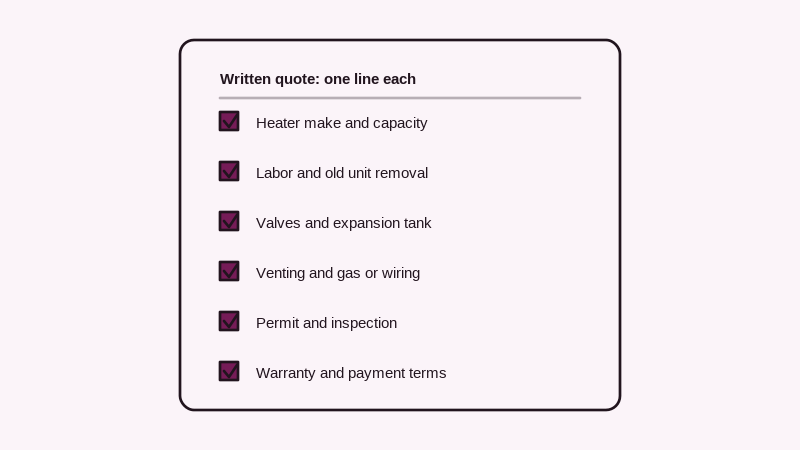
Look closely at specifics. Is the heater a named model with a published first-hour rating, or merely "40 gallon"? Does the manufacturer back the heater warranty, and does the quote say who stands behind the labor? We cannot say what any plumber promises, so read it on the page. Does the crew take the old heater away? Are a new relief valve and discharge pipe, fresh water connectors, a new gas connector and, for gas heaters, a sediment trap included?
Payment terms count as well. A newsletter from the state licensing board says California limits a home improvement deposit to a small portion of the contract price, so be wary of a request for a large payment up front. Current rules are posted in notices from the Contractors State License Board.
How do I weigh two replacement quotes against each other?
Put the two quotes side by side and match the scope line by line before reading any total. Both should name the same size, type and efficiency, include the same valves, venting and permit, and carry the same warranty. A lower total with fewer lines is not truly lower; ask each plumber to account for any difference you cannot explain.
A simple method: list every item in the first quote. Tick them off against the second. Anything on one list and missing from the other is extra work or a gap, so ask why. Then compare warranty terms, which are part of the real price. Finally, check each license number through the state board's online lookup; California generally requires a license for this kind of work, and permitted work in particular.
Does heater capacity change the price?
Yes, though less than the type. Larger tanks cost more to buy and are heavier to move, and one too big for the old space can force changes to the closet, stand or platform. A better question is what size suits your household, since a tank that is too small has a cost of its own.
Size by your busiest hour, reading the first-hour rating off the model plate rather than gallons alone. A family of five sharing one bathroom and a couple in a house with two bathrooms need different things. Have the plumber size the heater from the headcount, bathroom count and which appliances run together. A 40 gallon tank is a common middle size, and whether it suits five people depends on how they use water, as the water heater repair page discusses. A 30 gallon tank fits a small household with modest demand.
Which add-ons tend to show up on a heater quote?
Frequent extras are thermostat, thermopile, burner or element work found during the visit, a new relief valve, a new expansion tank, a vent repair, a drain pan, a new shutoff valve and a same-day or emergency call. Have each one listed separately so you can decide if it is worth doing now.
Thermostat and thermopile work. Replacing either is a standard repair, priced as a part plus labor. A burner replacement on a gas tank is a larger line. When several of these appear on an old heater, ask whether replacement would be the wiser spend.
Tank replacement. Some people request a "tank replacement" when they mean the whole heater. The tank is the heater. If a plumber quotes a tank alone, ask what exactly is being swapped.
Emergency replacement. An urgent or after-hours visit may cost extra because the plumber is rearranging a day. Someone reads form messages on working days between 9am and 5pm, and this site runs no emergency line. See emergency water heater repair.
Labor. Check whether the quote is one flat price for the job or an hourly rate with an estimate, and what happens if the work runs long.
Common questions
How long does a heater swap take?
An even exchange of one tank for another often fills a few hours. Moving to tankless, changing fuel, relocating the unit or fixing the vent takes longer, sometimes with a second inspection visit. The plumber gives a time estimate in the quote, and the taps run cold for part of that stretch, so plan your day around it.
What questions come first before a heater is replaced?
Ask for an itemized written quote, the license number, the name of whoever pulls the permit, what the manufacturer's warranty covers, whether the old heater leaves with the crew and whether a new relief valve and expansion tank are included. Also ask how the job changes if corroded pipes or a bad vent turn up once the old unit is out.
Does someone need to stay home during the swap?
Ideally yes: at the start, to agree on the work, and near the end, to see the heater tested. The plumber needs a clear path to the heater and shutoff valves, and the supply of hot water is shut for part of the visit. If nobody can be there, settle access and scope by message beforehand so nothing is a surprise.
Is mending cheaper than swapping?
In the short run, yes, when a single part failed and the tank is sound; with a leaking tank or an old unit that keeps breaking, it wastes money. Put both options on the written quote, and think about how many more years you expect to stay in the house before choosing which route to take.
Why do quotes for the same job differ?
Scopes differ: the model, valves, venting, permit, warranty, disposal and each plumber's overhead. Compare the items one at a time instead of the final figure. When a quote is far lower than the rest, find out what has been left out. For general advice on reading quotes, see what a plumber costs.