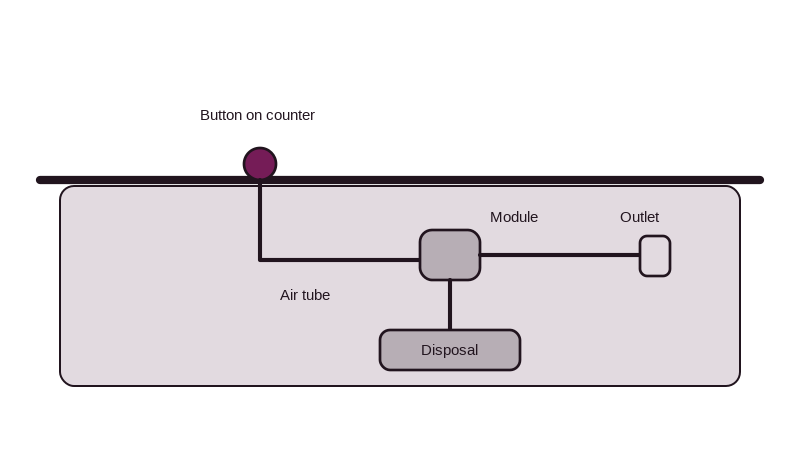
That small button on the sink deck or countertop, which runs the disposal without a wall switch, is an air switch. A press sends a puff of air along a thin tube to a module under the sink, which closes the electrical circuit. Installing one takes a hole in the countertop and a module near an outlet, and it sits alongside the rest of our garbage disposal repair guidance. To get a local plumber arranged, send the quote form.
What happens inside an air switch?
Pressing the counter button pushes air down a sealed tube. At the far end, beneath the sink, an air-pressure module senses the pulse and closes an electrical switch, which feeds power to the disposal. A second press opens it. The button carries no electricity itself, which explains its popularity near a wet sink.
Pieces of the system:
- The button. Chrome, brushed nickel, black or white, sized to fit a hole drilled into the countertop or a spare faucet hole in the sink.
- The tube. A thin plastic air line, a few feet long, that runs from the button to the module.
- The module. A small box under the sink that plugs into an outlet. The disposal's cord plugs into the module.
- The disposal. Any standard model that plugs in rather than being hardwired can be used with a plug-in module.
Because the button is air-driven, a wet hand on the countertop cannot shock you through the switch. That is the main safety appeal, along with the convenience of switching it on at the sink and the clean look of removing a wall switch that nobody can find in the dark. It is also useful for people who find a wall switch hard to reach.
What do you need before installing an air switch?
You need a free electrical outlet under the sink, a disposal with a plug or a place to splice one in, a spot for the button, and tools for drilling the countertop. The countertop material decides the difficulty. Granite, quartz and tile can crack if they are drilled with the wrong bit, so many people hire the drilling out.
Check these before you start:
- Outlet. The module needs an outlet, often the one that powers the disposal. If there is only a hardwired connection, the wiring must be changed, and that step is electrical work.
- Button location. Pick a spot within the tube's reach, and a place where a pan will not knock it. A spare faucet hole in the sink is the easiest choice, since it needs no drilling.
- Countertop. Check the thickness and the material. Laminate and solid surface take a standard hole saw, while stone needs a diamond bit and slow, cool cutting.
- Space below. The module needs a dry spot, away from water lines, and out of the way of the cabinet door.
- Disposal. Confirm the disposal is a plug-in type and the circuit is not overloaded.
On a stainless steel top-mount sink, a faucet knockout hole may be free. The disposal itself has its own page, installing a garbage disposal.
What is the installation procedure?
Pick the spot, drill if needed, pass the button through and fasten it from below, route the tube to the module, connect the module to the outlet and the disposal to the module, then test. Once the hole exists, the mechanical work takes under an hour.
A typical order:
- Unplug the disposal and switch off the circuit if you are going to touch wiring.
- Mark the button location and drill the hole to the size on the instructions, or use a spare sink hole.
- Drop the button through, fit the nut and washer under the counter and tighten by hand.
- Run the air tube down to the module without tight bends, and press the ends on firmly.
- Mount the module with its screws or bracket in a dry spot. Plug it in.
- Connect the disposal to the module's outlet, and the module to the wall outlet.
- Restore power and test the button several times, with a little water running.
- Look along the tube for kinks, and check the connections for leaks or loose pieces.
A button that sticks, a weak puff or a tube with a pinhole all mean the disposal does not start. Clear any obstruction and check the tube.
When is an air switch a job for an electrician or plumber?
Bring in a contractor when the disposal is hardwired, a new outlet is needed, the countertop is stone, or the sink and plumbing underneath are in poor shape. State law demands a contractor license once work passes the threshold, and electrical work follows separate rules, so settle who does what.
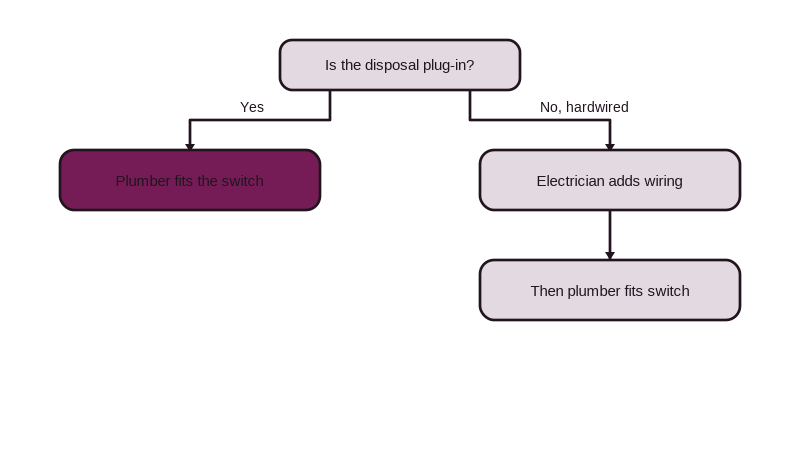
The CSLB, the California Contractors State License Board, says a contractor license is generally needed once labor and materials reach $1,000, and a permitted job always needs one. A simple plug-in air switch falls under that, but a new circuit or hardwiring is electrical work, with rules this page does not cover. We have not checked what the City of Los Angeles requires for it, so ask LADBS or the business.
A plumber can set the disposal and the button. An electrician is the right person for new wiring. Some businesses do both, so ask when you request a quote. The role of a plumber is described under garbage disposal repair by a plumber.
Why would you choose an air switch over a wall switch?
Owners pick an air switch for safety near water, convenience at the sink and a tidier look. It drops a wall switch, keeps electricity off a wet counter and can be pressed with a wrist when your hands are full. It will not make the disposal stronger or quieter.
Reasons it may not suit you:
- Stone countertops make the hole more difficult.
- The air tube can pinhole or kink over time, and a failed button is annoying to trace.
- A wall switch is simpler and has nothing to wear out under the counter.
- Rental kitchens may not allow drilling, so check your lease and tell the landlord.
Many north Valley kitchens built in the 1950s to the 1970s have older wiring and a wall switch in an odd spot, so an air switch can solve a real nuisance. It will not fix an undersized circuit, a sluggish drain or a leaking trap.
What fixtures and faucet details matter around the sink?
The sink deck decides where the button goes. A spare faucet hole, a soap dispenser hole or a sprayer hole can hold the button without new drilling. If the faucet is being replaced anyway, add the air switch to that visit, since the countertop is already cleared.
Combine jobs where you can. A new faucet, a new disposal and an air switch all share one cabinet, so a single visit covers all three and saves a trip. For the faucet, see what faucet replacement costs involve and fixing a leaky faucet. If the sink drains slowly, read unclogging a kitchen sink before blaming the disposal.
How do I ask for a quote on this job?
Fill in the quote form with your address, sink and countertop type, and whether the disposal is plug-in or hardwired. A nearby plumbing business receives it and then contacts you. This site publishes no dollar figures. A written quote itemizes the switch, the labor, any drilling and any electrical work.
Ask the business what its quote includes: the button and module, a new disposal if needed, drilling the countertop, wiring, hauling off the old unit and any minimum charge. Form requests are handled Monday through Friday, 9am to 5pm. Other services we arrange appear on the Mission Point Plumbing home page.
Common questions
Is an electrician required for an air switch?
Not when the disposal is a plug-in model and an outlet already sits under the sink. A hardwired disposal, a missing outlet or a new circuit counts as electrical work, and an electrician is the right choice there. When requesting a quote, ask which parts the business handles.
Can an air switch be added to any garbage disposal?
Most plug-in disposals work with a plug-in air switch module. A hardwired unit needs wiring changes first. Check the disposal's cord, the outlet under the sink and the module's rating, which should cover the disposal's motor. If unsure, have the model number ready when requesting a quote.
What if my air switch does not turn the disposal on?
Check that the module is plugged in and the outlet has power, then see that the air tube is pushed fully onto both ends and is not kinked or cracked. Press the button firmly. If nothing happens, test the disposal's reset button. A failed module is a cheap part to replace.
Can I put an air switch on a granite countertop?
You can, but drilling stone is risky, and a crack ruins the countertop. Many people use a spare sink hole instead, or hire a stone fabricator to drill it. Do not use a regular bit. If the sink has no spare hole, ask about alternatives before you drill.
Does an air switch beat a wall switch on safety?
In one respect it does: the button on the counter carries no current. The module and outlet under the sink still carry power, so keep them dry and off the cabinet floor. Neither switch protects against a jammed disposal, so keep hands and tools out of the drain.