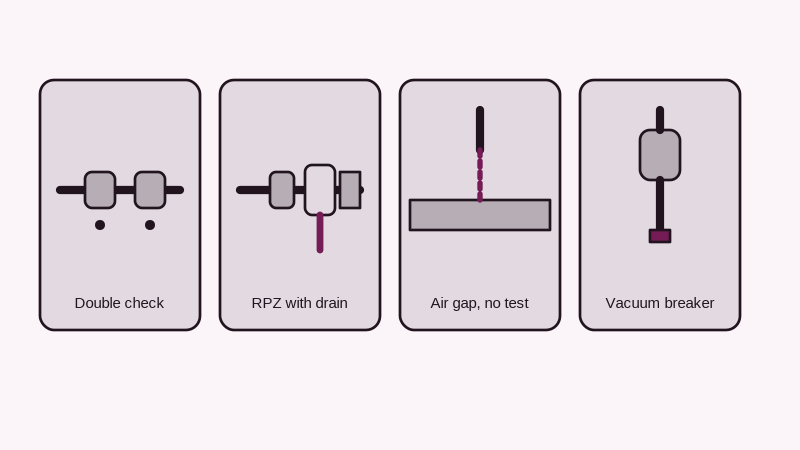
Every year, a device on your water line has to be checked to confirm it still stops water flowing the wrong way. That check is backflow prevention testing. A trained tester shuts off the water, connects a gauge kit, runs the test, writes the readings on a report and sends it to the water supplier. If an assembly sits on your property, ask your supplier for its schedule. Mission Point Plumbing can help you send a request.
Why does backflow happen, and why is testing needed?
Backflow means water moving backward through a plumbing system, from your pipes toward the public supply. It happens when pressure inside the system climbs above the supply pressure (back pressure) or when the supply pressure drops (back siphonage). A preventer valve blocks it, and testing proves the valve still seals.
Why it matters: a hose left sitting in a bucket of fertilizer, a pool fill line, an irrigation system with chemicals, or a fire sprinkler loop can all push or draw contaminated water into the pipes the neighborhood drinks from. Building codes require prevention devices for exactly this reason.
The device wears out. Rubber seats harden, springs weaken, debris lodges in a check valve, and a device that passed last year can leak this year. A failing valve gives no warning. Only a test shows it.
Types you may meet include the double check valve, the reduced pressure zone assembly, often called an RPZ, and the air gap. A double check valve puts two check valves in series. An RPZ adds a vented chamber between them that releases water if something fails, which is why one may drip. The air gap is simply a physical space and needs no test.
Is backflow testing required at my property?
The answer hinges on what your water line feeds. Commercial buildings, fire sprinkler lines, irrigation systems, pools and some larger residential lots often have an assembly, and those usually need testing. A typical single-family home with no irrigation backflow device and no special connection may have nothing to test. Check with your water supplier.
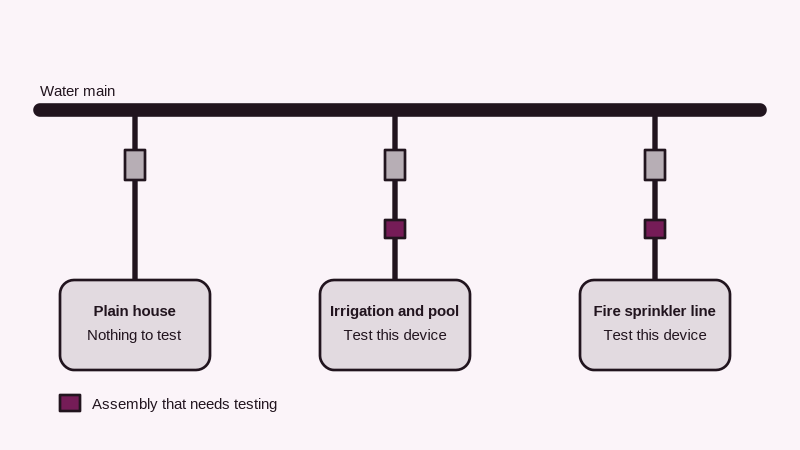
Los Angeles County Public Works says California law makes yearly testing mandatory for backflow prevention devices, done by a tester who meets the county's requirements, and LADWP's rule on protecting the public water supply requires approved assemblies to be tested by a qualified tester. Wording and details differ between suppliers, and the supplier's current rule is the one that counts, so confirm it with them.
The supplier is named on your water bill. According to LADWP's 2025 water quality report, it serves the City of Los Angeles neighborhoods in this area, including Sylmar, Granada Hills, Porter Ranch, Pacoima, Panorama City, Mission Hills, Arleta and Sun Valley. The City of San Fernando runs its own water department, and La Crescenta is served by a separate district, so an address near those borders needs a look at the bill.
Common places an assembly turns up:
- a lawn or landscape irrigation system, especially on larger hillside lots
- a spa or swimming pool filling line
- a connection feeding fire sprinklers
- commercial kitchens, car washes and other businesses
- a second meter or dedicated landscape meter
Unsure? Search near the meter or where the building's line enters, often above ground along the water line, for a brass or bronze device that has two shutoff handles and test cocks. Photograph it, since the label gives the model and size.
What does a tester do on the day?
The tester closes the assembly's shutoffs, hooks a gauge that reads differential pressure up to the test cocks, takes a series of readings to learn whether each check valve holds, and records the result. Water is off at the assembly for a short time. A brief visit usually covers it, and the report is sent to the water supplier.
A device that passes has its readings recorded and its report filed. If one fails, the tester names the failed part, and the usual cure is replacing the worn internal parts or the whole device, then a retest. Hold on to the report, because the supplier can request it.
Expect the water to be off for a while. Warn tenants or staff, run irrigation beforehand, and clear space around the device. If the assembly is buried in a box, a landscape crew should remove soil and plants before the tester arrives.
Testers are not always general plumbers. Many plumbing businesses offer testing, while some testers do nothing but backflow. Ask which you are getting.
Who may test and repair a backflow device?
A tester needs the qualification that the county and water supplier call for. Repairs and replacements go to a contractor holding the proper California license. Verify both. Ask the tester for a credential and confirm it with LA County Public Works or LADWP before paying for the test.
A qualified tester is not necessarily a contractor, and the reverse is also true, so ask. A plumbing business can often handle both test and repair. Should a device fail, have a written quote in hand before any work begins, and ask which part will be replaced and whether a retest is included.
California requires a contractor license once a job passes a small-job value limit, and also for anything needing a permit. A new assembly or a moved main line may need one, so find out who applies for it. Before agreeing, look up the license on the CSLB website.
See how to do backflow testing for the detailed step-by-step sequence, and backflow testing services for what to expect when you book.
What should I send when I want a backflow test?
Put these in the quote form: your address, what the device protects (irrigation, pool, fire line, business), how many assemblies you have, the size and brand if the label can be read, and the due date the supplier gave for the test. A nearby plumbing business can then say whether it does testing.
Photos help: the device, its label, the shutoffs, the surroundings. Mention any notice from the supplier, and the deadline on it.
The form is checked Monday to Friday, 9am to 5pm. There is no emergency line here, and a due notice is no emergency. Send yours early, because a tester may need a few days and a failed test needs repair and a retest before the deadline.
Use the quote form, or go back to the plumbing guides for related topics.
Common questions
How often does a backflow device need testing?
According to Los Angeles County Public Works, California law calls for each backflow prevention device to be tested annually. Your water supplier may set its own schedule and sends notices for devices it tracks, so read yours. A failed device must be repaired and retested. Keep each year's report, since the supplier may ask for a copy.
Who can test a backflow prevention assembly?
Anyone who has the qualification the county and your water supplier recognize. Sources differ on which credentials count, so confirm with the supplier before booking. Request evidence from the tester and check it. Repairs and replacement go to a contractor holding the proper California license, who may or may not be the same business.
What does a failed test mean?
One or both check valves did not hold pressure as required. Worn rubber seats or debris are the usual cause. The tester can tell you what failed. Most often the internal parts are replaced, or the device is swapped, and a retest follows. You typically get a short window to fix it, so read the notice.
What will a backflow test cost?
This site publishes no dollar figures. Price depends on the number of assemblies, their size, access and whether repairs are needed. Get a written quote stating what is covered, such as the test, the report to the supplier and the retest after a repair. Compare the scope, not only the total.
Can a mobile home plumbing inspection stand in for a backflow test?
No. A mobile home plumbing inspection is a broad look at supply lines, drains, fixtures, shutoffs and the water heater, often at a sale. A backflow test checks one device. Mobile homes have their own pipe layouts, usually under the floor. A plumber can inspect both on request. For the layout, read about plumbing under a mobile home.