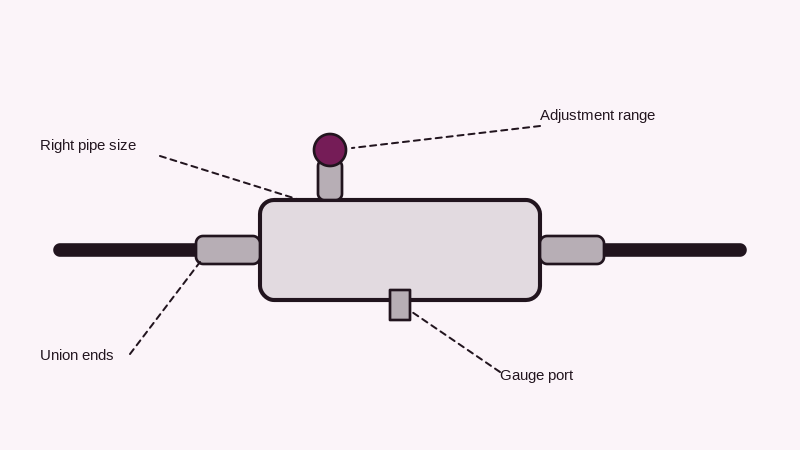
For a given house, "best" means a regulator whose size fits the main line, which holds a drinking water rating, adjusts over a useful range, is built from durable materials and goes in with a plumber taking pressure readings before and after. No brand is crowned here, because none was tested and a fair ranking requires testing. For background, the water pressure and valves overview is the place to start; the Mission Point Plumbing front page lists the other services.
What separates a sound regulator from a weak one?
A sound unit has a pipe size and connection style that fit the main, a solid metal body, an adjustable setting whose range suits your home, a gauge port, a visible flow arrow and internals that can be replaced. It should also match the maker's documents for your supply, and it has to be installed correctly.
Size and fitting. The regulator has to match the main line's pipe, normally described by diameter. These pages on half-inch, three-quarter-inch, one-inch and quarter-inch units show which belong where. A unit that is too small chokes flow and can drop pressure whenever several fixtures run together.
End style. Threaded, union and sweat (soldered) ends are common. Union ends make a later swap easier, since the old unit unscrews without cutting pipe.
Materials. Brass bodies are widespread and long-lived. Ask the plumber whether the unit carries a drinking water rating. California sets its own rules on materials in drinking water plumbing, which are unverified here, so ask the plumber to verify that this unit is approved for potable water.
Adjustability. An adjustable regulator lets the plumber set pressure to suit your fixtures. Its range needs to include the setting you want. Ask for a reading before and after, written on the invoice.
Gauge port. A port beside the regulator lets you test pressure later without removing anything. It is a small feature that pays off.
Internal parts. Inside sit a diaphragm and a spring or cartridge. Certain models can be rebuilt with a kit, others are replaced entirely. Find out which yours is and whether parts are stocked nearby.
Warranty and paperwork. Manufacturer documents list the pressure range, flow capacity and warranty. Read and keep them. We cannot say what any specific warranty covers.
Does my house even need one?
Only if the pressure arriving is higher than your fixtures, appliances and pipes are designed to handle, or if it swings up and down. A plumber settles this by reading pressure on a gauge. When pressure is already steady and moderate, a regulator may add little. Hold off buying until the reading is in.
Signs of too much pressure include pipes that bang, relief valves that drip, toilets that are noisy or run constantly, faucet seals that leak and appliances that wear out early. The EPA puts yearly leak losses for a typical household above 9,300 gallons, and high pressure makes leaks more likely.
A regulator will not cure weak flow at one fixture, which usually comes from a clogged aerator or a local valve fault, or low pressure across the house, which may mean a partly closed main, a failing regulator or a supply issue. Start with sudden low water pressure and low pressure at the kitchen sink.
Pressure in the north Valley depends on elevation and the supply network, and LADWP's published reporting says the water is a blend of sources that varies by street. Houses high in the foothills and houses on the valley floor can read quite differently. A gauge on a hose bibb shows your position.
Main line or single fixture: where should it go?
Fitted at the main, a unit protects every pipe downstream, which suits most homes. A point-of-use unit serves a single appliance or fixture, such as a washing machine, shower valve or irrigation line, and helps when only that item needs special handling. For most households, begin at the main.
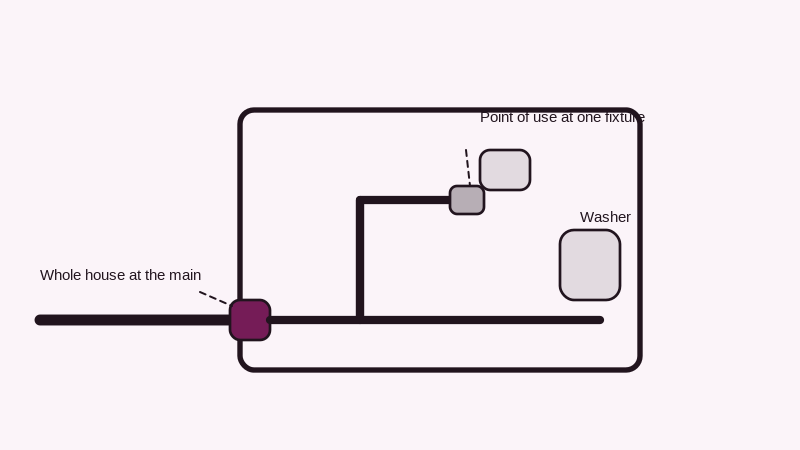
Separate pages cover whole-house water pressure regulators, main-line regulators, water line regulators, regulators for the shower and regulators for washing machines. A hot water pressure regulator is a distinct subject, because a regulator on the main shields the hot side too.
Fitting one on the main can create a closed system, where thermal expansion has nowhere to go while the heater runs. For that reason an expansion tank often accompanies either a regulator or a supply-side check valve, as explained under water heater expansion tanks. This page cites no code section, so ask the plumber which rules govern your house.
What does the installation involve, and what goes in the quote?
The work runs in order: a pressure reading, shutting and draining the main, cutting in the regulator with suitable fittings, setting the pressure, a second reading, a leak check and a record of the setting. The quote should name the model, pipe size, labor and extras such as unions, shutoffs or an expansion tank.
Lines to look for in the quote:
- The regulator's maker, model and size.
- Whether new shutoff valves or unions come with it.
- Whether the plumber recommends an expansion tank, and whether it is priced.
- Pressure readings, taken before and after.
- Any permit the job needs. Permit work has to go to a California contractor with a license.
- Who hauls away the old unit.
- The warranty covering the part, and the one covering labor.
Work on the main supply is regulated and not a DIY task. The pressure regulator replacement page covers swapping one, and price drivers, with no dollar figures, are on water pressure regulator cost. To locate yours, see where the regulator is located. Put your pipe size, any pressure reading and your questions into the quote form.
Common questions
How long does replacing a regulator take?
Often one to two hours, which covers shutting off the water, cutting in the new unit, setting pressure and testing. Corroded fittings, cramped spaces or added valves stretch that. Any time estimate comes from the plumber in the written quote, and the whole house is without water during the swap, so plan around it.
What should I ask before someone installs one?
Ask which model and size the plumber suggests and why, whether the quote is itemized on paper, whether pressure gets read before and after, and whether an expansion tank is required. Permit work calls for a California contractor, so ask to see the license number before the job starts.
Does an adult need to be in the house during the work?
Yes. Someone should be present at the start to point out the main shutoff and at the finish to test taps and fixtures, since water to the entire house is off for a while. If nobody can be there, agree access, pets and scope in writing beforehand so the day holds no surprises.
What is a regulator's usual lifespan?
It varies with the water, the model and the pressure, and manufacturers print their own figures in their documents. Regulators wear because they work nonstop, and mineral deposits and debris affect the diaphragm and seat. If pressure creeps up or fixtures begin to leak, have the regulator tested by a plumber.
May I supply the regulator myself?
Often, but check first. Some plumbers offer no warranty on parts they did not provide, and a wrong size or type causes trouble. A plumber who supplies the unit takes responsibility for the fit. Request both options on the written quote and compare them before you decide which route to take.