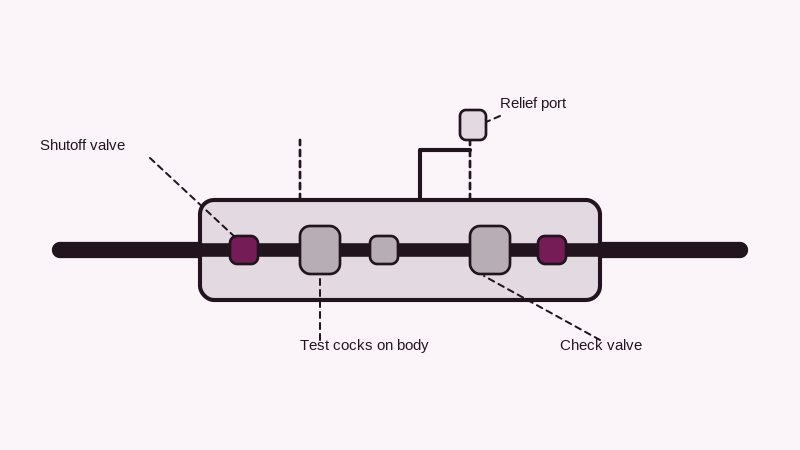
In a backflow test, the tester attaches a gauge kit to the prevention assembly, shuts its valves in a set order and notes whether the internal checks hold. It is not realistically a do-it-yourself job: the kit is specialized, results are filed, and your water supplier decides who may submit them. Start from the home page or send a question through the quote form.
Why is backflow testing done in the first place?
Backflow is water moving backward through a pipe, which can pull irrigation water, boiler chemicals or other tainted water toward the public supply. A backflow preventer is the one-way device that stops this, and the test proves that its internal valves and springs still seal. Wikipedia notes that reduced pressure zone assemblies need annual checks.
The hazard is genuine. If street main pressure drops, for example in a main break or heavy firefighting demand, a hose resting in a pool or a sprinkler head buried in soil can become a reverse path. The device is a one-time purchase that works unnoticed, which is why it needs checking: springs weaken, rubber seats harden and debris lodges in the seat.
Owners typically meet backflow testing in one of three settings: a lawn irrigation system, a commercial building with a fire line or boiler, or a property with a pool, fountain or auxiliary water source. A letter from the water supplier is the usual trigger.
Which backflow assemblies might I find at a house or business?
Three types are common: the reduced pressure principle assembly, the double check valve assembly and the pressure vacuum breaker. They differ in the level of protection and in where they are allowed. Simple vacuum breakers on hose bibs and sprinkler valves also exist but are usually tested differently.
How to identify them:
- Reduced pressure principle assembly (RP): two check valves with a relief valve sandwiched between, often with a small drain port. It stands above ground on commercial service lines and some high-hazard residential systems.
- Double check valve assembly (DC): a pair of check valves in line with test cocks on the body. Typical on fire sprinkler feeds and lower-hazard commercial connections.
- Pressure vacuum breaker (PVB): an upright device on irrigation lines, mounted higher than the highest sprinkler head.
- Atmospheric vacuum breaker: a small hose bib or valve-top device that cannot be tested and suits low-risk spots.
Look for a tag or label on the body. Type and size set the test procedure. If you cannot tell what you have, photograph it from two sides and send the pictures with your request.
Who may carry out a backflow test?
In California a backflow test is generally performed by a tester your water supplier recognizes, and the supplier receives the report. So the tester must be on its list, not simply anyone with a gauge. First, reach out to the company named on your water bill and ask who is approved.
Across most of the north San Fernando Valley, including Sylmar, Granada Hills, Porter Ranch, Pacoima, Panorama City, Mission Hills, Arleta, Sun Valley, Sunland, Tujunga, Reseda, West Hills and Canoga Park, LADWP is the supplier, per its 2025 Drinking Water Quality Report. La Crescenta falls under Crescenta Valley Water District, and the City of San Fernando runs its own water department. Your own bill shows which one serves you.
Do not attempt your own test for a report someone else must file. A tester trained on these assemblies also knows what the numbers should read for each type, which a general gauge reader does not.
How does the test itself proceed?
First the downstream valve is shut, then a gauge is connected to the test cocks and pressure is released in a fixed sequence while the tester watches each check valve and the moment the relief valve opens. A leaking check or an out-of-range reading means a fail, and the device needs repair or replacement.
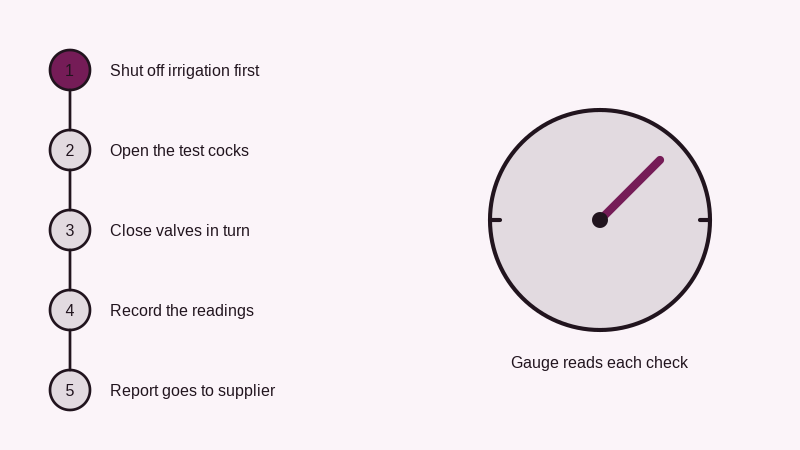
What you will see on the day:
- The tester asks you to shut off outdoor water or irrigation, because the line is briefly interrupted.
- Test cocks are opened and hoses and the differential gauge connected.
- Each valve is closed and opened in turn while the gauge is read.
- Readings are written on a form, usually alongside the assembly's manufacturer, model, size and serial number.
- A pass sends the form to the supplier. A fail brings an explanation of the likely repair.
A test usually takes a short visit. Most failures are cured with a rebuild kit replacing springs, seats and rubber parts. A cracked body or an obsolete model means a new assembly is installed instead, which is more involved and may need a permit.
What if my assembly does not pass?
A failed test means the device cannot be trusted to protect the water supply, so it must be repaired or replaced and then retested. Many failures stem from fouled seats or worn rubber and are fixed with a kit. Ask the tester what failed, whether a rebuild or a replacement is being quoted, and who files the passing report.
Keep a copy of every test report. The supplier may ask for it, and so may a future buyer or inspector. If the assembly is replaced, ask whether a permit applies; inside the City of Los Angeles that goes through the Los Angeles Department of Building and Safety. Permitted work needs a contractor with the proper California license, and the state generally expects a contractor license once labor and materials pass a small dollar threshold. Check the license on the CSLB site before agreeing to any work.
Related reading: backflow prevention testing explains what the supplier looks for, and backflow testing services covers hiring one.
How do I prepare for the test and avoid a failure?
Clear the space around the assembly, make sure it is reachable, tell the tester which valves feed which lines and switch off irrigation timers beforehand. Keep the device free of weeds, mud and covers, and drain it if freezing weather is possible. An open, accessible assembly is less likely to fail and faster to test.
Habits that help:
- Keep a photo of the assembly tag, the last report and the water account number together.
- Do not bury the valve box in mulch or gravel.
- If it sits below grade, keep the pit from filling with water. A submerged test cock can pull dirty water into the line.
- Replace damaged covers, and have the unit tested after any freeze, impact or relocation.
Hillside lots in upper Sylmar can have assemblies installed on steps or terraces, so show the access route in your photos.
Common questions
How frequently must an assembly be tested?
Many suppliers require a yearly test, and Wikipedia mentions annual checks for reduced pressure zone assemblies. Your supplier sets the rule for your account, so read its notice or ask. New or repaired assemblies are normally retested before they return to service.
May I test my own preventer?
You can buy a gauge kit, but a passing result your supplier will not accept is just a number. Most suppliers want a report from a recognized tester trained to read the assembly correctly. Ask the supplier first and use the tester it approves.
How much time does a backflow test need?
The test is typically a short visit, with most of the time going to access, turning off water and writing the report. A failed test adds repair work, so ask the tester to bring a rebuild kit. Replacing an assembly is a separate, longer job.
Does a home sprinkler system need a backflow device?
Many do. A pressure vacuum breaker or similar device is normally fitted on irrigation lines to keep soil water out of the supply. Whether yours needs annual testing depends on its type and your supplier. Put the question to the supplier named on your bill.
What is the difference between backflow and low water pressure?
They are unrelated problems with different causes. Backflow is water moving backward in a pipe, a contamination matter. Low pressure is weak forward flow, a supply or valve matter. If weak flow is your complaint, read about the regulator and valve causes instead.