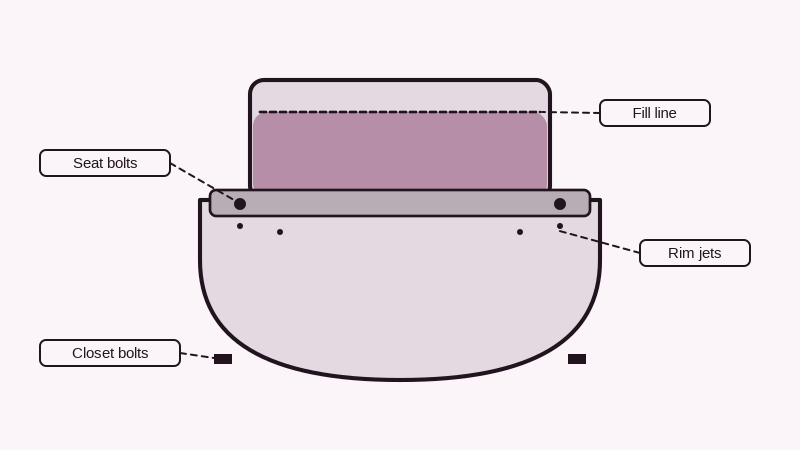
Begin with the cheapest problem. A seat slides sideways because its two hinge bolts have worked loose or the rubber bumpers under it have flattened. A screwdriver fixes both, with pliers for stubborn bolts. This page, last checked in Nov 2026, then moves down the toilet: the flush button, the slow flush, the handle, the flapper and finally the bowl-to-floor connection. If you are new here, Mission Point Plumbing shows how the site works.
How do I tighten a wobbly toilet seat?
Locate the two plastic caps at the back of the seat, flip them open and tighten the bolts beneath while holding the nut under the bowl by hand or with pliers. Line the seat up over the bowl before the final turn. Bolts that spin freely need the nut held from below, or a fresh hardware set from the store.
Seats shift for three reasons. Bolts loosen with use, the nuts below can strip, and the rubber bumpers compress. Brass hardware lasts longer than plastic. Plastic bolts snap if you overtighten them, so snug is enough.
A seat that still moves after tightening usually has a stripped nut or a worn hinge. Replacing the whole seat is inexpensive, and a bolt kit alone often fixes it. Measure the distance between the bolt holes before buying; round and elongated bowls need different seats.
Do not use super glue. It makes the next replacement a chore and does not stop the movement.
How do I fix a flapper or replace a flush valve?
If water keeps seeping into the bowl, suspect the flapper first: close the supply valve, flush the tank empty, unhook the old flapper from its ears, put in an identical one and adjust the chain. A pitted seat or a cracked overflow tube calls for replacing the entire flush valve.
A flush valve swap requires removing the tank. Close the supply, flush, mop up the remaining water, disconnect the supply line, undo the tank bolts, lift the tank off and take out the old valve's large nut. Fit the new valve with its gasket, then reassemble using new tank-to-bowl bolts and a tank gasket.
Take your time with the bolts. Alternate between them and tighten gently, because porcelain cracks. The tank should sit level and not rock.
Hardware stores sell universal flush valves, but check the drain hole size, typically two or three inches, and the tank model. A running toilet also hits the bill; according to the EPA, a typical home loses more than 9,300 gallons of water a year to leaks, so see toilet keeps running.
When does a toilet repair need a plumber?
Hand it over for a cracked bowl or tank, a leaking base, a damaged flange, a repair that has failed twice, or a toilet too heavy to lift safely. Photos and a short description sent through the request a quote form let a local plumbing business follow up, and how a job runs shows the process.
In California, work beyond a small job size, and anything that needs a permit, calls for a contractor license, so ask for a license number if the job grows. Planning to swap the whole toilet? Replacing a toilet explains how that work is structured, without prices.
What if the toilet rocks on the floor?
Rocking comes from loose closet bolts, an uneven floor or a failed wax ring. Snug the nuts on both bolts gently, alternating sides. If it still shifts, slip plastic shims under the base and caulk around it; water or a sewer smell at the base means the wax ring has failed, and the toilet has to be lifted off and reset.
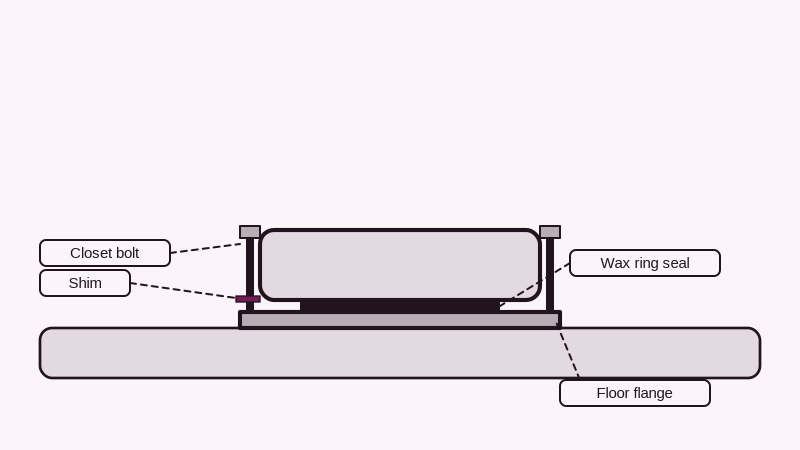
Overtightening is the usual mistake, so go a quarter turn at a time. When the toilet is pulled, the wax ring and bolts get replaced, and the flange must be sound; a broken flange is a separate job.
A sewer gas smell, dampness around the base and a spongy floor all signal something bigger. A plumber should inspect the flange and the subfloor. Tenants should tell the landlord.
What do I do about a sticky flush button or loose handle?
A sticky button or slack handle normally means the lift mechanism inside the tank has slipped. Take off the lid, watch how the arm or button rod moves, and adjust the chain length or the handle nut. Replacement handles come in front-mount, side-mount and angled styles, so match the mounting position and finish.
On a chain-type handle, leave roughly half an inch of slack with the flapper closed. If it is too tight the flapper never seals; if too loose the flush is weak. Remove the old handle by undoing its mounting nut, which turns the opposite way from what you might expect, and fit the new handle in the same manner.
Some designs skip the chain and use a lever, rod or push-button linkage. Dual-flush buttons mount through the tank lid on a plastic assembly. Check the packaging for tank hole size and rod length, because the fitting must reach the flush valve cleanly.
When the part is hard to find, a plumber can often match it. For deeper fixes, see toilet flapper repair.
Why does my toilet flush slowly, and what fixes it?
A weak flush usually points to a partial clog, plugged rim jets or too little water in the tank. Plunge first, then confirm the tank refills to the marked line inside, and clean the holes under the rim using a small mirror and a wire or brush. Hard water scale in those holes weakens the swirl.
Pour a bucket of water into the bowl quickly. If it drains fast, the trap is fine and the tank's flow is the issue. If it drains slowly, the drain is partly blocked and a plunger or auger comes next.
Mineral crust is the usual reason jets close up, since hard water leaves calcium behind wherever it dries. Pour vinegar down the overflow tube, leave it overnight, and the crust softens. Keep bleach and other cleaners out of the mix.
If every toilet in the house is sluggish, the trouble sits further down the line. See how to repair a blocked toilet and toilet flush repair.
Common questions
How long do these toilet repairs take?
A seat takes minutes, or half an hour with new hardware. A handle or flapper runs about thirty minutes, a flush valve an hour or two, and resetting the toilet a couple of hours. Keep towels near for stray water.
Can I handle a slow flush myself?
Often. Plunge, check the tank level, clear the rim jets and look for a plain blockage. If every toilet flushes sluggishly, the trouble is deeper in the drain, and if vinegar and a plunger change nothing, a plumber can test the line.
Do showerheads and toilets clog for the same reason?
Often. Hard water leaves mineral crust in small openings, whether that is a toilet's rim jets or the nozzles of a showerhead. A vinegar soak loosens light buildup in both. Heavy crust may call for a softener or a professional descale of the fixture.
Are dual-flush buttons harder to repair?
Slightly. Dual-flush systems use a push-button linkage and their own flush valve. The logic matches a standard toilet, but parts are model-specific, so note the make and model before shopping and follow the instructions printed on the packaging, so the new part fits the first time.