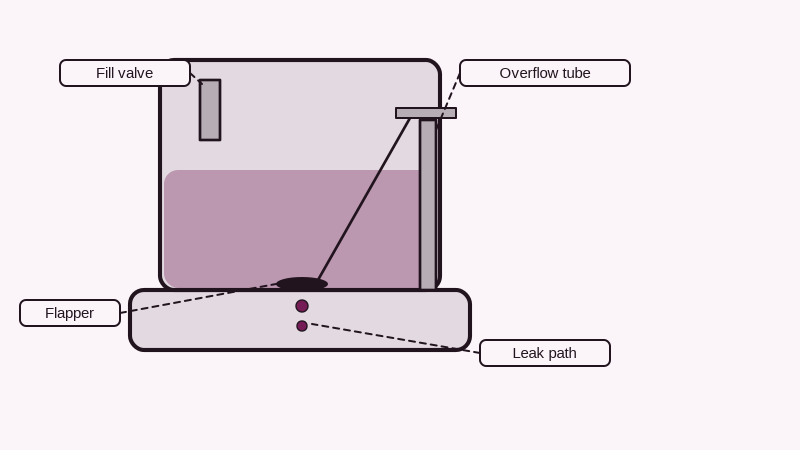
Inside the tank, over the drain hole, a rubber disc called the flapper lifts as you flush and drops to close the outlet. Over the years it softens, warps or picks up scale, and water seeps into the bowl without any sound. A replacement is roughly a ten-minute job using a part from any hardware store in the Valley. This page helps you confirm the cause; the Mission Point Plumbing home page lists other repairs we can arrange. To reach a local plumber, use the quote form.
How do I test whether the flapper leaks?
Add several drops of food coloring to the tank water and leave it alone, with no flushing. The EPA suggests this check: coloring that turns up in the bowl inside 10 minutes proves a leak. Flush straight away afterward, because the dye can stain the tank if left.
Other signs of a failing flapper:
- The tank tops itself up now and then, a "ghost flush" you can hear from another room.
- The fill valve hisses, or keeps running long after the flush ends.
- Emptying the tank needs a held handle or a jiggle before the flow stops.
- Water in the tank slowly sinks under the fill line.
- Pressing the rubber shows it slimy, swollen, cracked or curled along the edge.
A water bill that rises with no visible reason is a hint too. According to the EPA, an average home loses more than 9,300 gallons of water yearly to leaks, and a worn flapper is one of the easiest to track down. For a wider hunt, read a high water bill with no visible leak.
Which flapper size and style should I buy?
Begin with the size of the flush valve, then pick the style. Most toilets have an opening of either 2 inches or 3 inches, and a flapper that is the wrong size will leak. Look for a brand and model printed inside the tank, and if in doubt, carry the old flapper into the shop to compare.
What to match:
- Size. Measure the opening where the flapper sits, or the old part's diameter. A 3 inch model is much larger than a 2 inch one.
- Attachment. Certain flappers clip onto two pegs by the overflow pipe; others loop around it like a ring. Look at how yours is held.
- Make. The large toilet manufacturers sell flappers for their own models, and universal ones exist, though a model-specific part tends to seal best.
- Adjustable types. A dial on some sets how long the flapper stays lifted, for fine tuning the flush. On a low-flow toilet the valve and flapper act as a pair, so an adjustable one fitted without checking the manual can weaken the flush.
Take a picture of the tank interior before going to buy, and bring it along. That one habit avoids most trips for the wrong part.
What are the steps for installing a new flapper?
Shut the supply valve, empty the tank by flushing, remove the old flapper, set the new one on the pegs of the overflow pipe, hook the chain to the arm with a little slack, then turn the water on and test. The whole job takes about ten minutes.
The steps:
- Turn the valve behind the toilet clockwise until it stops.
- Flush while holding the handle down so the tank empties. A sponge takes up the last water.
- Unhook the chain from the handle arm. Slip the old flapper's ears off the pegs, or lift its ring off the overflow pipe.
- Clean the valve seat, the rim the new flapper will rest on, with a rag or non-scratch pad. Scale and slime there can stop even a brand new flapper from closing tight.
- Put the new one on, pushing the ears over the pegs or sliding the ring down.
- Clip the chain to the arm with about a half inch of slack. A tight chain holds the flapper slightly open.
- Reopen the valve, let the tank fill, then flush a few times while watching the flapper drop.
- Run the dye test again after an hour to be sure the leak is gone.
Avoid tank cleaning tablets, since the chlorine in them can break down rubber parts, and a bleach tablet in the tank is a frequent reason flappers fail early. This is widely reported, though no source was checked for this page, so see the flapper maker's care note if you want it confirmed.
The toilet still runs with a new flapper. What now?
If water keeps running after the swap, check the chain slack, the seat, the fill valve and the water level. A dirty or pitted seat lets water by any flapper, and an overfull tank spills down the overflow pipe, which looks exactly the same from outside.
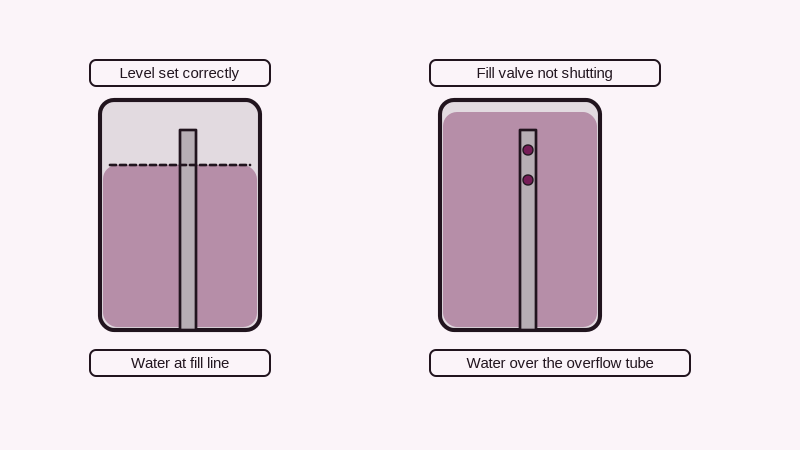
Check each in turn:
- Seat. Trace the valve rim with a fingertip. A rough feel means wear, so it needs a repair kit or replacement.
- Chain. One that is too short prevents closing; one too long may snag beneath the edge.
- Water level. Water reaching the top of the overflow pipe means the fill valve never shuts off. Related pages: fixing the toilet fill valve and the overflow tube.
- Float. One that sits too high or sticks keeps the fill valve open.
More causes are covered on the page on why a toilet keeps running. If the trouble is a weak or partial flush instead of a leak, use toilet flush repair.
Can hard water wear out a flapper sooner?
Possibly. Mineral scale roughens the seat and may stiffen rubber, and chlorine and chloramine in tap water slowly eat away at it. The pace varies with your supply. Check the annual Drinking Water Quality Report from your water supplier, and ask the plumber what the water on your street is like.
LADWP serves Sylmar and the City of Los Angeles parts of the north Valley and issues a Drinking Water Quality Report every year, but the hardness figures we looked for sat in table images we could not read, so no number appears here. Your bill names the supplier for your address. A home in the City of San Fernando or in La Crescenta has a different one. If scale grows in the tank fast, removing hard water scale lists what you can do.
When should a plumber take over?
Call in a plumber when water leaks around the toilet base, the tank is cracked, the shutoff valve will not close, the flush valve itself is damaged, or the toilet keeps running despite a new flapper and fill valve. These faults reach beyond a rubber part.
Examples:
- The shutoff valve behind the toilet is seized, or drips after it is turned. See toilet shutoff valve repair.
- Water appears on the floor, or on the ceiling below.
- Tank bolts weep, or the porcelain has a crack.
- The toilet uses a proprietary pressure system.
Toilets in north Valley houses from the 1950s to 1970s have often been repaired many times. If yours is one, a plumber can advise whether one more part is worthwhile or a new toilet makes better sense. See what toilet replacement involves. To arrange a visit, fill in the form with your address, the toilet's age if known, and what you tried. A local plumbing business gets the message and replies to you. Weekday checks happen between 9am and 5pm.
Common questions
How long does a flapper last before it needs replacing?
There is no set interval. Some homes get many years from one flapper, others see it fail within a year or two, depending on the water and any tank cleaners. Change it when the dye test shows a leak, when the toilet runs on, or when the rubber turns soft, cracked or warped. The part costs little compared with the water a bad one wastes.
Will a universal flapper work?
Frequently, as long as it matches the flush valve size and the way it mounts. A model-specific flapper normally fits and seals better. Photograph the tank, write down the brand, and measure the valve opening before purchase. If a universal part keeps leaking, switch to one made for your exact model, which often settles the problem for good.
How do I tell a bad flapper from a bad fill valve?
Add dye to the tank. Color showing in the bowl means the flapper leaks. If the bowl stays clear but water pours down the overflow pipe, then the fill valve fails to shut. Normally just one of the two is faulty, yet it pays to inspect both before buying any parts, since the repairs are different.
Why will my flapper not seal?
The usual reasons are a tight or tangled chain, a dirty or pitted seat, a warped rubber edge, or a wrong size. Wipe the seat clean, give the chain half an inch of slack and test once more. If water still escapes, the flush valve seat itself may need to be replaced, which is more involved than the flapper.
Does a running toilet really waste that much?
It can. The EPA states that an average home loses over 9,300 gallons of water per year through leaks, and a toilet that runs on is a common source. Your own loss depends on how large the leak is. A dye test followed by a short repair stops the waste, and the bill usually shows the difference by the next cycle.