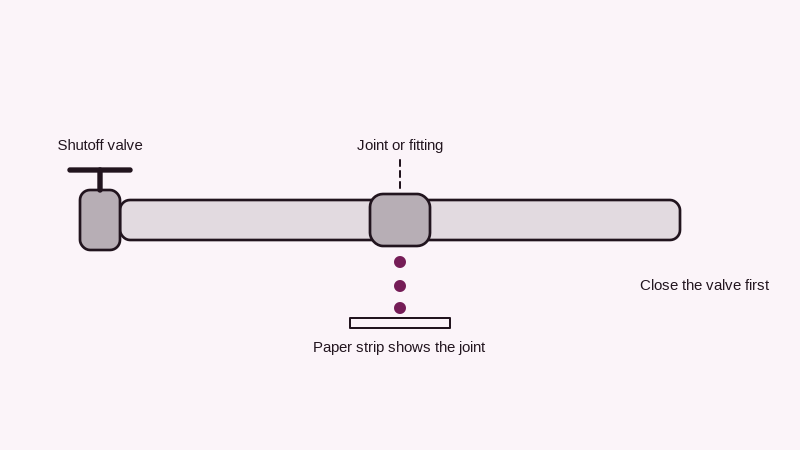
Turn off the valve closest to the leak, falling back on the main if you cannot find another. Wipe the pipe dry and wait a minute: wherever moisture returns first is the escape point, and on plastic that is nearly always a joint, not the pipe wall. Describe the problem in the quote form to line up a nearby plumber, or follow the steps below. Other jobs we arrange are shown on the Mission Point home page.
What do I do the instant plastic pipe begins to leak?
Shut the closest valve, open a faucet lower down to relieve pressure, and dry the pipe. Tuck a strip of dry paper towel beneath each joint, because the first to darken is the source. Only then decide between a stopgap and a proper repair.
Photograph the leak, and also the lettering printed along the pipe. Plastic often has a stamp giving material and diameter, and when the plumber is told it is half-inch CPVC, the right coupling can be on the truck and a second trip avoided.
Spraying water, a leak inside a wall or a trickle heading toward an outlet changes the picture: keep the valve shut, switch that area off at the breaker provided the panel is dry and easy to reach, and stay out of the wet zone.
One more check costs nothing. The EPA suggests noting your water meter reading, leaving every tap unused for two hours, then reading it once more. A dial that has moved means water is escaping somewhere. A pipe that stays damp after the valve is closed might be sweating, or might belong to a neighboring line.
Why would plastic pipe leak when it never rusts?
Rust is not the problem. Joints fail first: a glued fitting made on damp, unprimed pipe, a threaded adapter overtightened, a clamp that slipped, or a section struck by a shovel or baked by sun. Plastic also turns brittle after decades of heat and pressure, and cracks at stress points.
How the usual suspects tend to fail:
- PVC, white or gray, common for drains and irrigation: impact cracks, sun damage, a solvent weld that never fully set.
- CPVC, cream colored, found on many hot and cold supplies: can embrittle with age and split at overtightened fittings.
- PEX, bendable tubing sold in red, blue or white: fails mostly at crimp rings and clamps, or at a kink.
- Polybutylene, gray flexible supply pipe that went into some houses between about 1978 and 1997: known for fitting failures. Read polybutylene pipe replacement if yours looks like this.
A weeping fitting and a long split down the pipe are separate problems with separate fixes.
Is there a short-term way to slow a plastic pipe leak?
Yes. Provided the pipe is drained, dry and within reach, a small split can be held off with a rubber-lined clamp, a repair sleeve, or self-fusing silicone tape. They are bridges, not repairs. A pipe under steady pressure will eventually push past tape or putty, so book the real repair while the stopgap lasts.
For a small split within reach:
- Close the valve and drain the line.
- Clean the surface and dry it completely.
- Stretch silicone tape while winding it, overlapping each turn by half, or seat a clamp over a rubber pad sized for that pipe.
- Open the valve gradually and observe the repair for a good while, bucket underneath.
Epoxy putty struggles on wet or moving joints, and nothing reverses brittleness. An old cracked pipe with a patch simply has two weak spots rather than one.
What actually fixes a plastic pipe leak permanently?
Remove the damaged length and splice in new pipe. PVC and CPVC are joined using primer or cleaner plus matching solvent cement, PEX using crimp, clamp or push-to-connect fittings. Slip couplings allow a short replacement without disturbing pipe on either side, which is how most small repairs go.
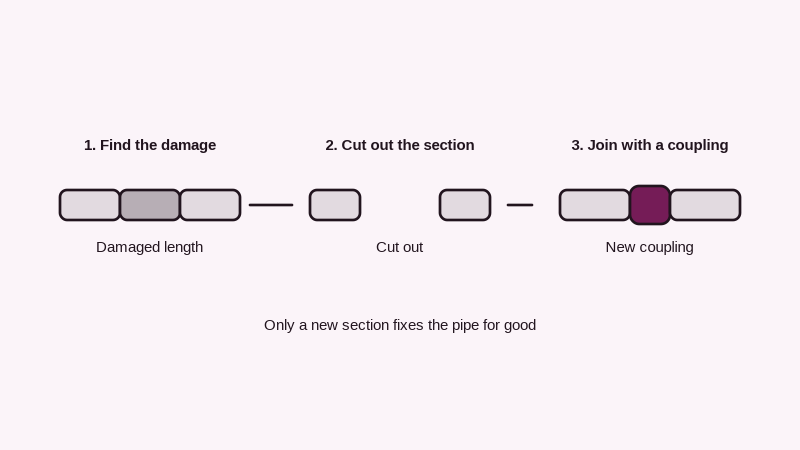
Know where the boundary lies. The main, gas piping and permit work all belong to a California contractor, and the state usually requires a license for any job above a small value threshold. Look any contractor up on the CSLB website before you agree terms.
For addresses in the City of Los Angeles, permits come from the Los Angeles Department of Building and Safety; ask each quote which permit and inspection it assumes. In a 1950s to 1970s tract house, have the plumber examine neighboring pipe while the wall is open. One failure often has relatives.
What if plastic pipe is leaking outdoors?
Close the supply to the outdoor line, typically at a valve near the meter or just inside the house. Outdoor plastic leaks at buried joints, hose bib threads and sun-baked sections. Careful digging down to the wet ground shows whether a fitting or a split is to blame, and either way the repair is a cut and a coupling.
Signs of an underground leak:
- soil that remains boggy during dry spells
- a meter dial turning while the house is off
- weak flow at hose bibs or sprinkler heads
- a water bill climbing with no change in habits
Do not assume the pipe is guilty: sprinkler valve boxes, roof drains and air conditioner condensate lines also puddle. Irrigation leaks tend to sit at a fitting beside a head and are cheap to fix. The line feeding the house is a different animal, so treat it as a main line, and remember that digging near buried utilities has its own rules. More on that in leaking water pipe repair.
Why is my tap leaking and how do I stop it?
A tap drip is nearly always a tired part inside the faucet, not the plumbing behind it. Turn off the small stop valve under the sink, open the tap to bleed off pressure, then replace the washer, cartridge or seal that matches your handle style. Water pooling under the sink suggests a loose or cracked supply line instead.
Match the symptom to the cause:
- Drip from the spout: the washer, seat or cartridge has worn.
- Seepage around the handle base: the O-ring is worn or the packing nut is loose.
- Wet cabinet floor: a loose nut, a cracked braided or plastic supply line, or a weeping stop valve.
Photograph the faucet before you begin, lay the parts out in the order they came off, and bring the worn cartridge along to the hardware store. A whole new faucet is the wiser buy if the stop valve refuses to close or the faucet is so old that parts are discontinued. Walkthroughs are in our guides to fixing a leaky faucet and leaky outdoor faucets.
When should I hand a leak to a plumber instead of fixing it myself?
Any time the leak is in a wall, on the main, beside the water heater or on gas piping. The same applies to a joint that drips again after you redid it, and to a leak that has already soaked drywall or flooring. A plumber can also inspect the neighboring pipe, which a patch never does.
Water meeting electricity calls for the most caution: if outlets are wet or a ceiling light is soaked, keep the breaker off and touch nothing. Slow leaks do quiet damage too. By the EPA's estimate, an average household wastes over 9,300 gallons of water yearly through leaks, even before rot and mold are counted.
Ready to proceed? Enter the pipe type, its location and any photos in the quote form. Staff look at submissions Monday through Friday, 9am to 5pm.
Common questions
Is it possible to patch plastic pipe with the supply running?
No. Cement will not bond to a wet pipe, and neither tape nor putty can seal against flowing pressure. Shut the valve, empty the line and wipe the surface dry first. If the valve itself will not turn, count that as a second repair, since a working shutoff is needed before the next emergency.
Will plumber's tape or epoxy hold a cracked plastic pipe?
Only for a short time, and only on small splits in clean, dry pipe. Silicone tape and putty are built as stopgaps, not for lines under constant pressure. Use them to last until morning, then have the damaged length cut out and replaced with a coupling or new pipe so the leak stays gone.
How can I find a leak inside a wall?
Look for stained or bubbling drywall, a musty odor, or a spot that feels cool or warm to the hand, and see whether the meter creeps with every fixture off. A plumber can pinpoint the spot with a moisture meter before opening anything. Photos of stains plus a meter reading make your request far more useful.
How should plumbing in an old house be replaced?
Start by identifying what runs inside the walls, since copper, galvanized steel and polybutylene age differently. Then compare swapping only the failing run with redoing the whole system, and have the plumber describe the remaining pipe. The choices are laid out in repiping a house and PEX versus copper.
Is a leak in plastic pipe ever an emergency?
Yes, if it sprays, is concealed in a wall or ceiling, or sits close to electrical equipment. Shut the valve at once. A slow weep at a fitting can wait for a scheduled repair. If gas is ever noticed, get out of the building and contact 911 or your gas utility from outside.