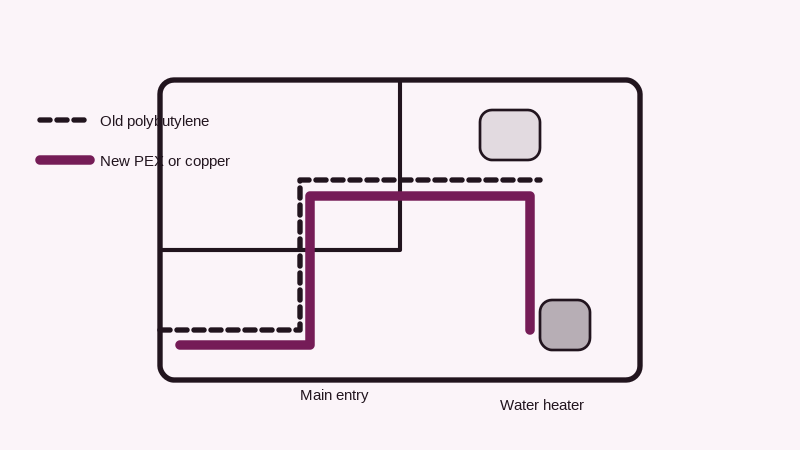
Getting rid of polybutylene means removing the old polybutylene supply lines and putting in new ones, generally PEX or copper, throughout the house. A partial fix leaves old pipe behind, and leaks can appear anywhere along it. The wider job is described in our repiping overview; this page explains how to confirm you have the pipe and what a replacement entails.
Why does polybutylene pipe fail, and what exactly is it?
Often shortened to poly-B, polybutylene is a bendable plastic water supply pipe installed in several million US and Canadian houses from roughly 1978 to 1997. Chlorine and chloramine in public water attack the plastic and its fittings from within, which explains the failures. None of that damage shows on the outside.
Wikipedia links the leaks to polybutylene breaking down in chlorinated water, with the worst harm where fittings, sharp bends and kinks occur. A failure may take a few years or several decades, so a system that has held up for years can still burst without warning. Major class action litigation followed. The same source states that the one lasting remedy is to replace the plumbing across the whole building.
Plumbers in the field say the same thing: a pinhole or split may open at any point, and mending one spot does nothing for the pipe around it.
How do I check if my house has polybutylene?
Inspect the pipes at the spot they come into the house, near the water heater, beneath sinks and around the main shutoff. Polybutylene is flexible plastic, typically gray, sometimes blue or black, and often printed with letters such as PB along the side. A plumber can confirm it. Houses built or replumbed from about 1978 to 1997 are the ones to inspect.
A brief checklist:
- find the water heater and look at the pipes entering its top
- open the cabinet below a bathroom or kitchen sink and examine the supply lines
- look beside the shutoff valve and the meter for plastic pipe leaving the house
- inspect the crawlspace or attic, if you can reach them safely
- hunt for markings on the pipe, though not every length carries one
- examine the fittings, which may be plastic or metal crimp rings
Many tract homes in the north San Fernando Valley go back to the 1950s through the 1970s, so a house built then would lack polybutylene unless replumbed afterward. Later houses, such as those in newer parts of Granada Hills and Porter Ranch, are likelier to fall inside the window. A house repiped in the 1980s or 1990s might have it as well. Ask the seller or former owner, read inspection reports and search for permits.
Do not guess. Some other pipe types are gray too, and some polybutylene looks like newer plastic. On site, a plumber can tell within a minute.
Is replacing polybutylene mandatory?
We have found no law requiring a homeowner to replace it, yet the pipe has a leak record and can burst with no warning, and sources call replacement the lasting fix. If you have it, schedule the work and keep watching for leaks meanwhile. Insurance and sale terms may also drive the decision.
Be wary of what the internet says. Some sites claim a given insurer will not cover it or that buyers insist on replacement. Policies and buyers differ, and we cannot predict yours. Ask your insurer in writing what it demands. If you plan to sell, ask a real estate professional how it will affect the sale.
Leak damage frequently costs more than the pipe. Water seeping inside a wall can rot framing and drywall and breed mold before anyone notices. Try the meter test in spotting a burst pipe underground, and watch your bill for unexplained rises. According to the EPA, leaks drain over 9,300 gallons a year from the typical household.
Find your main shutoff now. Residents lost water and gas for a time after the 1971 San Fernando and 1994 Northridge earthquakes, and a shaken house with aging plastic pipe is a place where a leak can start unseen. Knowing the shutoff costs nothing.
What happens during a polybutylene replacement?
First the plumber maps the system and closes the water. New pipe then runs to each fixture, mostly through the attic and walls, and the fixtures and water heater are hooked up. After a pressure test of the whole system, the walls are patched. The old pipe is abandoned or taken out. Expect no water for much of a day or more.
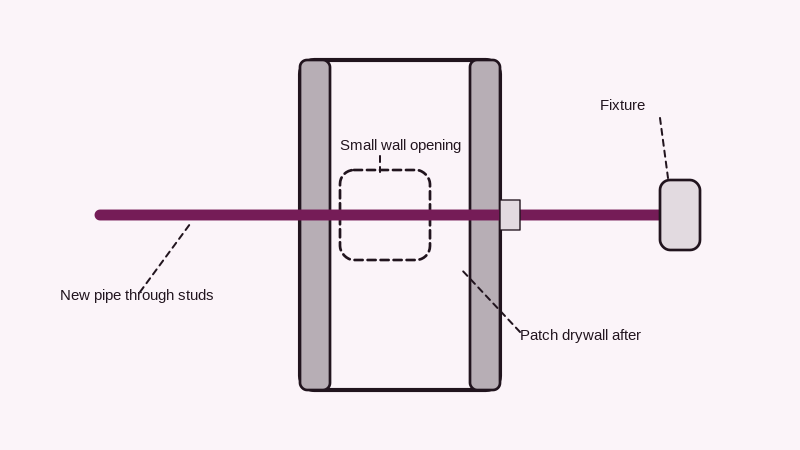
The main stages:
- Inspection and plan. The plumber counts fixtures, checks access and chooses the route.
- Permit. A repipe normally needs one. For a house in Los Angeles city limits, the Los Angeles Department of Building and Safety handles it. Ask who obtains it, as we cannot say what applies at your address.
- Rough-in. New lines go in, often across attic space, with small wall openings at each fixture.
- Connection. Every fixture, hose bib and the water heater is tied into the new lines.
- Testing and inspection. The plumbing is pressure tested and inspected.
- Patch and cleanup. Drywall is patched. Texture and paint are often excluded, so ask.
Our guide to how to repipe a house gives the whole process, and why people repipe a house covers reasons beyond failure.
Should the new pipe be PEX or copper?
Replacements mostly use PEX or copper. PEX bends, installs faster and needs fewer wall openings. Copper is rigid, long proven and slower to install. Either can be a good pick; which is right varies with the building, the supply water and the plumber. Our page on PEX versus copper sets them side by side.
Ask the plumber why one is preferred, which fittings will be used and what the manufacturer's warranty covers. Do not choose on one factor alone. Where the water comes from several sources, read LADWP's yearly drinking water quality report, or your own district's, because water chemistry affects pipe over time.
A mixed system keeps old pipe in service, and the old pipe is the hazard. If a plumber proposes a partial job, request a written account of which pipe stays and which goes.
For what a quote rests on, in words, read what sets repiping cost.
Where do I find a plumber to do the work?
Fill in the quote form and a nearby plumbing business can inspect the house and write a quote. Include when the house was built, where you saw the pipe, photos of the pipe and fittings, the number of bathrooms, and slab or raised floor. The form is read on weekdays, 9am to 5pm.
California requires a contractor license once a job exceeds a small-job cost threshold, and for any work needing a permit. Check the license on the CSLB website before you agree. Deposits are generally capped at the lower of 10 percent of the contract price or a fixed ceiling. Get the quote written, covering pipe type, fixture count, openings, wall repair, permit and warranty.
Use the quote form or begin at Mission Point Plumbing.
Common questions
How long does polybutylene pipe last?
No fixed lifespan exists. Wikipedia says failure may take a few years or several decades, and the damage sits inside the pipe, out of view. Some systems lasted long while others failed early. Since failure can come unannounced, treat the pipe as a risk and plan its replacement.
May polybutylene still be installed?
No official source we found settles current installation rules, so none is stated here. Plumbers no longer choose it, and replacement lines are normally PEX or copper. What applies at your address is a question for a plumber and for the Los Angeles Department of Building and Safety.
Can I swap out only the section that leaks?
You can, but the remaining pipe stays in service and may be next to leak. A spot repair is short-term, while sources name replacement throughout the building as the long-term answer. Have the plumber record the condition of the pipe that remains.
Does insurance pay for replacing polybutylene?
Possibly not. Policies differ, and many cover damage from a sudden leak yet exclude the cost of new pipe itself. Some insurers also ask questions about it. Study your policy and put the question to the insurer in writing before work begins. See insurance and burst pipes.
What separates polybutylene from PEX?
They can look alike, as both are flexible plastic. Colors and markings vary with maker and era, so color alone proves nothing. Better clues are the text printed on the pipe and the style of fittings. A plumber can tell by eye and explain each marking.