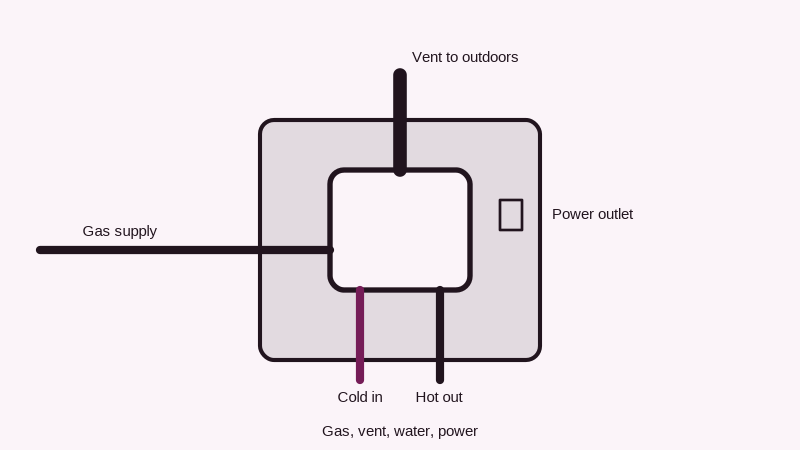
Before a Rinnai tankless unit goes in, five things need a look: the gas supply, the vent, a power outlet, the water flow and the permit. Most jobs also add flushing valves, and a condensing model also needs a drain for its acidic condensate. The plumber does the work, and the exact details come from the Rinnai manual for your model. If the old tank has just given out, the water heater repair page helps you judge whether fixing it still makes sense.
What does the installation day actually involve?
First the old heater comes out. The plumber then mounts the new unit on a wall, indoors or outdoors, connects gas, water and power, runs the exhaust, adds a condensate line where the model calls for one, fits isolation valves and tests everything. Before the unit is lit for the first time, the permit, the inspection and a check of the gas pipe size all have to be settled.
A plain swap usually fills about a day. Expect longer if the gas pipe or vent has to be rerun, or if the heater moves to a different wall. A tankless unit hangs on a wall, so it rarely sits where the tank did. Ask where it will go, where the vent exits the house and which surfaces get cut and patched. Clearances and vent type are set by your model's manual.
Does going tankless mean a larger gas line?
Often, yes. A tankless heater fires at full strength and pulls much more gas at once than a tank does, so the pipe already in place can prove too small. The plumber checks the pipe's size and length against the unit's rating in the manual, and may replace or widen a section.
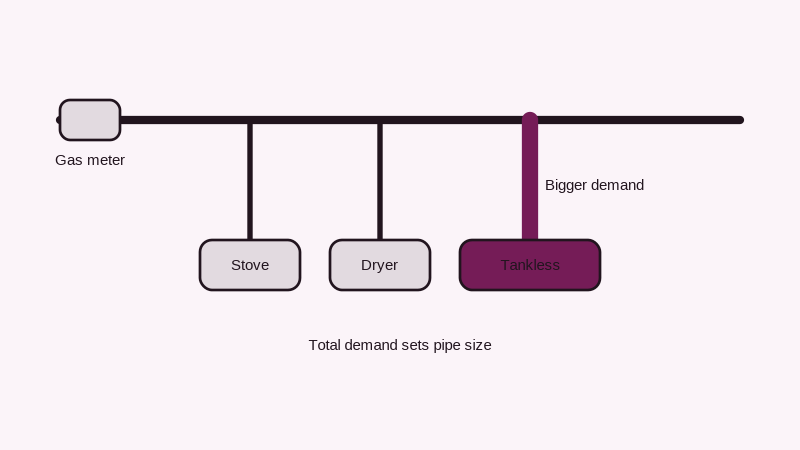
In California, gas piping must be handled by a contractor and needs a permit, so never alter it yourself. A flexible connector does not get around the sizing question; the guide to the flexible 1/2 inch gas line explains why its size matters. Should you smell gas at any point, walk out at once, avoid touching switches, and reach your gas utility or 911 from outside.
What about the vent and the electrical supply?
Exhaust needs a route out, and which vent pipe applies varies with the model. Condensing units use plastic vent pipe; non-condensing ones need metal pipe rated for the heater. All of them need an outlet close by to power the fan and controls. Stick to the manual, because it limits vent length and the number of bends.
A good plan shows the point where the vent leaves via wall or roof, its distance from windows and how it is supported. Ask the plumber to write this on the quote. Plenty of older north Valley houses, built between the 1950s and the 1970s, put the heater in a garage closet with a single flue, so a wall-mounted unit may need a new route. Outdoor models avoid indoor venting but need protection from cold weather.
How big a Rinnai does my house need?
Sizing turns on how much hot water you want flowing simultaneously and how far the incoming water must be warmed. The plumber adds up the flow of fixtures used together, for example a shower plus a dishwasher, and the temperature rise from supply to setpoint. At that rise, the heater's gallons-per-minute rating must cover your busiest moment.
Incoming water is colder in winter, so any given heater gives less flow then. A home with several bathrooms and overlapping use may want a bigger unit, or a pair. The plumber should record the peak flow behind the choice and the model's rating at your rise. To weigh the two designs, read the guide on tank versus tankless water heaters.
Do I need a permit in Los Angeles to install one?
Replacing a gas water heater, or moving its gas and vent lines, normally counts as permit work. Inside the City of Los Angeles, the Department of Building and Safety (LADBS) issues those permits, so check LADBS for the rules that apply at your address. The plumber typically files the permit and schedules the inspection.
Jobs beyond a modest value, and any job needing a permit, call for a California contractor license. The plumber's license number should be on the quote, and the CSLB site lets you check it. If a plumber suggests skipping the permit, walk away. An unpermitted install may cause trouble with your insurer and when you sell.
Do air quality rules touch gas water heaters?
Local air rules limit nitrogen oxide emissions from new gas water heaters, and the units sold here are built to meet them. The regional air board decided in June 2025 against amending Rules 1111 and 1121, so today's rules stay in force and no zero-NOx mandate is waiting.
Have the plumber confirm that the quoted Rinnai model is legal to sell and install at your address. You do not have to study the rule yourself, though it is a reasonable question for anyone pricing the job. Look at the air board's own page now and then, since rules can change.
What should the written quote list for a Rinnai job?
Look for the model, gas pipe work, vent type and route, electrical work, isolation valves, a condensate drain if one is needed, permit and inspection, removal of the old heater, wall repair and warranty terms. It should also say who files the permit and list anything the price excludes.
Warranties differ between models, commonly depend on installation by a qualified contractor and often require registration, so ask which terms apply. Check that service valves are included, otherwise the unit cannot be flushed later. Compare quotes on scope rather than the headline number. The guide to tankless replacement costs lists what tends to move the price.
How do I look after a Rinnai once it is in?
Plan on a yearly or regular flush to clear scale, a clean inlet filter, and periodic checks of the vent and the condensate drain. Keep the manual somewhere handy. Hard water builds scale faster, so read the yearly LADWP water quality report for your supply.
At handover, have the plumber point out the service valves, the filter, how to read the display and what error codes mean on your model. If the house has a recirculation loop, it should be set up during the install. To set up a visit and get a quote on paper, use the quote form at Mission Point Plumbing. Someone reads requests Monday to Friday, 9am to 5pm.
Common questions
Can a tankless unit go where my tank stands now?
Sometimes, but a tankless heater hangs on a wall and its vent and gas supply often change. A tank sits on the floor, whereas a tankless unit needs wall space and clearances. The plumber looks at the closet or garage and tells you exactly which parts have to move.
Will I need a different gas meter for tankless?
Not always, but the meter has to deliver enough gas for every appliance in the house together with the new unit. Ask the plumber to add up the load. When the meter or supply line is too small, the gas utility is brought in, and the plumber can explain how that process starts.
Is it possible for a tankless heater to run short of hot water?
It does not drain like a tank, yet it can fall short if too many fixtures run together or the incoming water is very cold. Right-sizing fixes this. Tell the plumber how many people live in the house and when they shower, so the unit suits how you actually use water.
How long does a tankless unit last?
Manufacturers publish an expected life for their products, and the real figure depends on your water, how much you use it and its upkeep. Scale does the most harm, and flushing slows it. Read the warranty for the quoted model and keep your flush records instead of trusting a general number from a website.
Is an outdoor Rinnai a better choice than an indoor one?
An outdoor unit avoids indoor vent runs and frees up space inside, but it is exposed to weather and needs freeze protection in cold areas. An indoor unit stays sheltered yet needs a vent route. The better pick hinges on your property, so put the question to the plumber who inspects it.