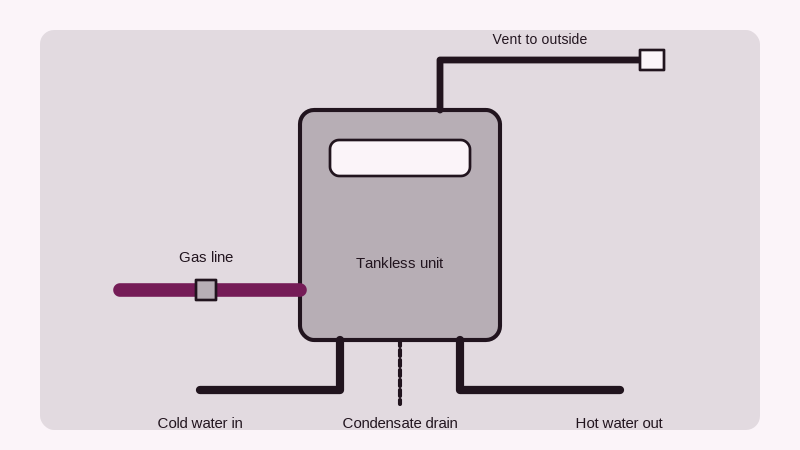
The price of a tankless installation depends on the unit, but even more on what the house needs around it: a gas line big enough, a vent path, an electrical outlet, a drain for condensate, and a permit. The prices themselves are left off this site, so what follows is the structure of a good quote. For repair help, start from water heater repair.
What goes into a tankless installation quote?
A complete tankless quote has seven parts: the unit, gas piping, venting, electrical, water-side fittings and valves, condensate drain, and permit plus haul-away. Labor sits across all of them. Two quotes with the same unit can differ widely if one leaves out a new gas line or venting.
Ask for each part to be on its own line:
- The heater itself: brand, model, flow rating and whether it is condensing.
- Gas piping: tankless heaters burn a lot of gas for a short time, so an older line may be undersized.
- Venting: the exhaust path out of the wall or roof, with the right vent material.
- Electrical: most gas units need power for the fan and controls.
- Water fittings: flush-ready isolation valves, a pressure-relief valve and sometimes a recirculation setup.
- Condensate drain: condensing models produce acidic water that needs a drain and sometimes a neutralizer.
- Permit, removal and disposal: the old tank has to go somewhere.
A quote showing a single number cannot be compared with another.
Why does gas line size change the price?
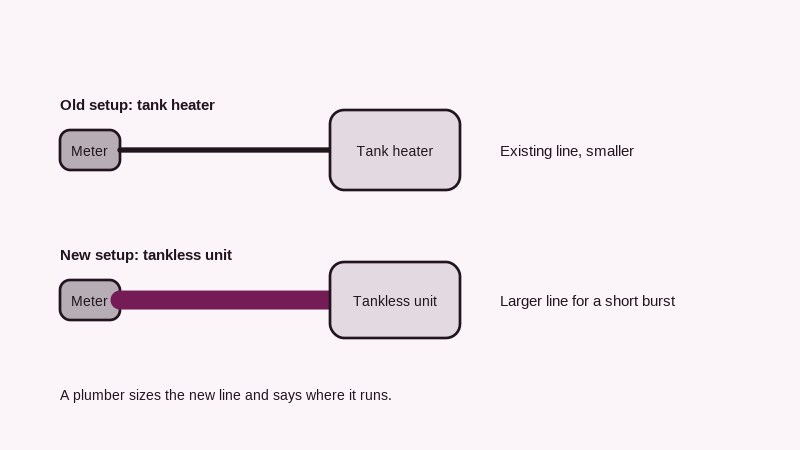
Tankless heaters burn gas at a high rate while running, so the pipe feeding them must carry enough. When the existing gas line was built for a tank heater, the plumber may have to run a bigger line from the meter. That adds material, labor and a pressure test. Gas work is reserved for a contractor with a California license, and it usually needs a permit.
Where your street has gas service, the gas utility is SoCalGas, which serves most of Southern California, though the company's published list of cities served has not been checked here for each neighborhood. Your bill names the provider. One safety rule applies to every gas job: if you ever smell gas, leave the building first, then reach 911 or your gas utility from outside.
Have the plumber state the new line size and its route. Related reading: how a gas tankless installation goes and natural gas line cost factors.
How do venting and electrical affect the cost?
Venting and power are the two surprises in many tankless quotes. A tankless unit needs an exhaust path in an approved material, and the path may pass through the roof, an attic or a wall. Power is needed for the fan and controls. Longer or more complex routing means more material and more labor.
Key points:
- A garage or exterior-wall location makes venting simpler than an interior closet.
- Plastic pipe and a drain go with condensing models, while non-condensing models, which exhaust hotter, take a metal vent.
- Electric tankless units draw a heavy current, so a new breaker, thicker wire or even a panel upgrade may be needed.
- Even if the old heater sat in a closet that already had a vent, the new vent still has to match the new unit.
Work at the panel can require an electrician. Find out whether it is part of the quote or invoiced separately.
How much of the cost is labor, and what about removal?
Labor is a large share of any water heater job, and tankless installs take longer than tank swaps because of the gas, vent and wall mounting work. Ask for labor in hours or as a flat job price, and check whether hauling off the old tank, a new shutoff valve and a permit are included.
A simple tank swap has its labor explained in the water heater replacement cost guide, and the tankless version is handled in our tankless replacement cost guide. A tankless job also adds relocating the unit, new vent holes, a condensate line and flushing valves.
Inside Los Angeles city limits, water heater work generally goes through the Department of Building and Safety, and the plumber should say which permit applies. Find out who files it and who attends the inspection.
What about the cost of parts such as anode rods, valves and elements?
Small parts are priced by the part plus the visit. A heating element, an anode rod, a relief valve or a gas valve costs little as a part, yet the labor and the trip add to it. Ask whether a plumber will swap them at the same time as another repair to save a second visit.
Here is what each part does and why it comes up in quotes:
- Anode rod: a sacrificial rod that corrodes instead of the tank. Replacement can extend a tank's life but does not apply to tankless units.
- Gas valve: controls gas to the burner and is a safety part. Replacement is gas work.
- Temperature and pressure relief valve: opens when pressure or heat gets too high. A dripping one needs attention.
- Heating element: the part in an electric tank that heats the water.
Details: anode rod swaps, relief valve swaps and heating element swaps. A tank that is old and leaking is a replacement, not a repair.
What about a 40 or 50 gallon replacement, and free estimates?
Tank size changes the unit price a little but rarely the labor. A 40 gallon gas tank, a 50 gallon electric tank and a 75 gallon unit are quoted against the same checklist: unit, venting or wiring, valves, permit and disposal. For a comparison with tankless, read tank versus tankless.
Requests for a free estimate are common. A real written quote requires some information, so give the plumber the following in the form:
- fuel type and unit location
- size and age of the existing heater, plus photos of its label
- number of bathrooms and household size
- whether the garage, closet or attic is the install location
Photos let a plumber give a firmer written quote than a rough guess from afar, though some jobs still need a site visit.
How do I compare tankless installation quotes?
Compare what is included, not the total. A fair comparison names the same unit or equivalent flow rate, the same gas line size, the same venting and electrical work, and the same permit and removal. Then compare the written warranty terms and when payment is due.
State rules help you here. California caps the deposit on home improvement work, generally at the lesser of a fixed sum or one tenth of the price. Jobs above a modest size, and any work that needs a permit, call for a contractor license. Look the contractor up on the CSLB website. To collect quotes, send your details through the quote form.
Common questions
Is tankless worth what the installation costs?
It can be when your home uses plenty of hot water and you want a long-lived unit that takes less space. The installation may run higher than a tank swap because of gas, venting and electrical needs. Weigh it against your house, not a generic average.
How long does a tankless installation take?
A simple swap at the same spot takes most of a day, while moving the unit, running new gas pipe or cutting new vent routes can stretch it into a second visit. Have the plumber estimate the duration and say when the house will be without hot water.
Do I need a permit for a tankless water heater?
Usually yes, because the job involves gas or electrical work and a vent. Los Angeles city permits come from the Department of Building and Safety. Have the plumber identify the permit and say who files it. Permit rules for a specific address are worth confirming with that office before work starts.
Can I install a tankless heater myself?
Gas piping, venting and permitted work are for a contractor with a California license, so even a handy owner should not plan to do the gas side alone. Ask which parts of the job only a contractor may do and which small steps, such as clearing the space, you can handle beforehand.
Does a tankless heater need yearly service?
Many manufacturers recommend periodic flushing to remove scale, especially where water is hard, and isolation valves make that flush easier. Look up the interval in the manual, and see LADWP's annual report on water quality in your area. See Rheem tankless repair for common faults.
The rest of our guides start from plumber sylmar.