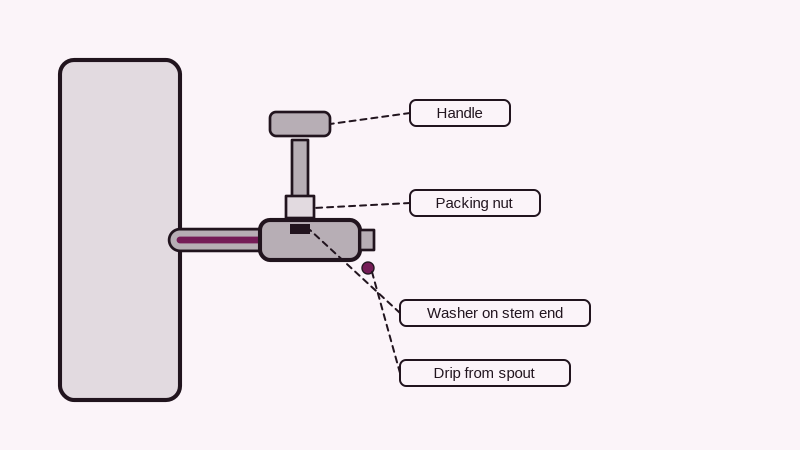
Repair begins with noticing where the moisture shows. A drip at the spout is typically a worn washer or seat, whereas seepage around the handle stem suggests a loose packing nut or tired packing. Water inside the wall or under the house means the pipe behind the faucet is suspect. Most fixes need only a wrench and a repair kit, much like the sink fixtures in the garbage disposal repair plumber guide. For help, send the quote form.
Which tools and shutoffs come first?
Turn off the supply to the outdoor faucet at the shutoff valve inside the house, or at the main if none exists, then open the faucet so it drains. Collect plumber's tape, a rag, a screwdriver, an adjustable wrench and a replacement washer kit or packing. Photograph the faucet before dismantling it.
Gather:
- Adjustable wrench and pliers.
- Screwdriver set.
- Replacement washer, packing and seat, or a new faucet.
- Plumber's tape.
- A rag or small container for drips.
Where the faucet has its own interior shutoff (generally a small-stemmed valve in the garage or beneath the house), close it. Some houses lack a separate valve, so the main gets shut for the job. Then open the outdoor faucet to empty what remains. Disconnect any hose first, then identify the type: a standard faucet has a short body, while a frost-free one has a long stem running back into the wall.
Fixtures differ by age. Many north Valley houses built between the 1950s and the 1970s have older compression-style hose bibs, which are simple to repair, but older parts can be seized with scale, so work gently and do not force them.
What makes an outdoor faucet drip at the spout?
A dripping spout usually means the stem's end washer is worn or the brass seat is rough, so the faucet no longer closes against water pressure. Replacing the washer, and smoothing or replacing the seat, stops most spout drips. A frost-free spigot can also drip if its stem washer has worn.
What to do:
- Turn off the water supply, then open the faucet to let it drain.
- Loosen the packing nut with a wrench, counterclockwise, then back the stem out.
- Examine the rubber washer on the stem's tip. If it is flat, cracked or hardened, replace it with the same size.
- Slide a fingertip over the seat in the faucet body. A rough seat can be removed with a seat wrench and replaced, or you can swap the whole faucet.
- Reassemble, open the water gradually, and check for drips.
A small screw secures the washer; if it is damaged, replace the entire stem. A hose left attached all year keeps the faucet pressurized and wears the washer faster. Related situations appear in the pages on repairing a leaky exterior faucet and fixing a dripping outdoor tap.
What causes leaking around the handle?
Leaks behind the handle come from the packing, a small ring or string inside the packing nut that seals around the stem. A quarter turn on the nut may be all it needs; if the leak stops, you are done. If not, install a new packing washer or packing string, or replace the entire stem.
Steps:
- With the water on, turn the packing nut a quarter turn using a wrench. Avoid overtightening, since the handle must still turn.
- If water still escapes, shut off the supply and leave the faucet open to drain.
- Remove the handle screw, lift off the handle, then undo the packing nut and slip it off.
- Wrap fresh packing string around the stem, or seat a new packing washer.
- Put everything back and test.
If the handle is stiff or stripped, the stem is worn, and replacing it is easier than patching it. Water that dribbles down the wall under the faucet needs a look from inside the house if the wall is shared with a garage or utility room.
What if a frost-free faucet leaks from the wall or the vacuum breaker?
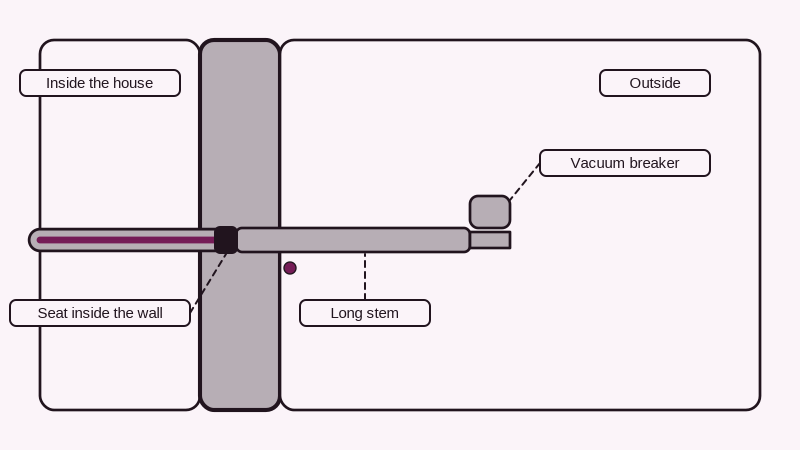
A frost-free model has a long stem, with the valve seat set deep inside the wall. Water from the vacuum breaker (the small cap on top) is normal if it spits as you shut off the flow, but constant leaking means a worn part. Water inside the wall points to a failed stem washer or pipe.
Notes:
- Vacuum breaker. It is a backflow device that keeps hose water from running back into the house supply. A bit of water at shutoff is typical. Steady leaking means the breaker or the stem seat is worn. Replace the breaker or the whole faucet.
- Stem washer. On a frost-free model, the seat is at the inner end of the stem. Replacing the stem and washer is a repair kit job.
- Hose connected in winter. Water left in the stem and a hose attached can freeze and split the pipe. Remove hoses when cold weather is forecast.
- Backflow rules. Larger backflow devices on irrigation systems have test rules. See backflow prevention testing.
Should water show in the wall, on a wet garage wall or as a drip indoors, close the supply and have a plumber look, since the pipe may be damaged. Water coming from the base where the faucet meets the wall can mean a failed solder joint or a cracked fitting.
When does the whole spigot need replacing?
Replacement is warranted when the body is corroded or cracked, the stem threads are stripped, the seat cannot be saved, or the faucet has been repaired more than once. A new one goes in quickly provided the pipe behind it is sound. The pipe connection, threaded or soldered, determines how simple the swap is.
Things that decide it:
- Connection type. A threaded faucet unscrews. A soldered one must be cut out and a fresh fitting installed, a larger job.
- Material. Brass lasts. Cheap pot-metal bibs fail early.
- Age. A decades-old, corroded faucet is better replaced than patched.
- Frost-free choice. A frost-free model keeps the valve seat within the wall, away from cold air.
The EPA says the typical household loses upward of 9,300 gallons a year to leaks, and a dripping outdoor faucet contributes without leaving any puddle indoors. Fix it sooner, not later. For a faucet leaking at the wall, the general guide to repairing a leaky faucet applies, and installing a faucet covers the cost side of a replacement.
Which outdoor faucet problems belong to a plumber?
Hire a plumber if water is entering the wall, the faucet pipe is soldered or corroded, the stem is frozen in place, the shutoff valve will not close, or the leak comes back after your repair. A faulty connection behind the faucet can flood a wall cavity fast.
Also bring one in when:
- The faucet is attached to a pipe that is part of a larger line, such as a sprinkler feed.
- You see a wet patch on the ground near the foundation, which can mean a buried pipe leak rather than a faucet.
- The house has galvanized pipe that is corroded and may snap if turned.
To get a plumber, send the quote form with the address, the faucet type and where the water shows. A nearby plumbing business receives the request and then contacts you. This site shows no dollar figures, and a written quote itemizes the parts and labor. Form requests are read Monday to Friday, 9am to 5pm. For other guides, start from the Mission Point Plumbing home page.
Common questions
Why does the spigot drip only when a hose is connected?
Water standing in a hose holds the faucet under pressure, revealing a worn washer or a leaking vacuum breaker. Remove the hose and see whether the drip stops. If it does, the faucet is fine and the hose washer needs replacing. If not, replace the faucet washer.
Can I repair a hose bib with the water running?
Not safely. With the water on, the stem cannot come out without a spray. Close the interior shutoff, or the main, and let the faucet drain open first. If the faucet has no shutoff of its own, use the house main, and open the faucet to let it drain.
What is the time needed for a spigot repair?
Snugging a packing nut takes minutes, and a washer or packing swap is often finished within half an hour. A full replacement takes longer, especially if the pipe is soldered. No time can be promised for a plumber visit, so ask the business for an estimate.
What is the small cap on top of a frost-free faucet?
That cap houses a vacuum breaker, a backflow preventer stopping hose water from flowing back into the house supply. A spurt when you close the faucet is normal, but a steady leak means the breaker or seat is worn and needs replacing.
Is it worth protecting an outdoor faucet on cold Sylmar nights?
It is a sensible habit. We have not checked local freeze statistics, so we cannot say how often it matters on your street, especially in the foothills. Disconnect hoses when a cold night is forecast, and consider a frost-free type when you replace the faucet.