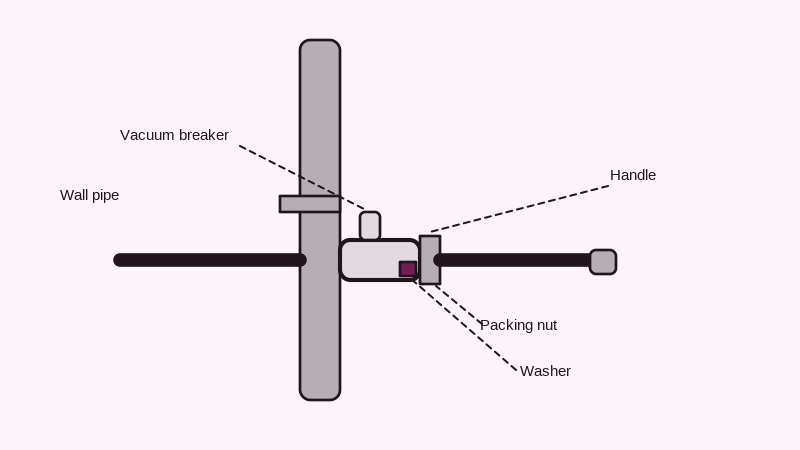
First, follow the water back to where it begins. Dampness around the handle stem usually comes from the packing nut or a stem O-ring, whereas a dripping spout points to a tired washer. Water showing in the wall cavity or under the floor means the trouble sits in the pipe or fitting behind the faucet, and that job belongs to a plumber. Other repairs of this kind sit in our overview of sink, shower, faucet and disposal fixes. The Mission Point Plumbing home page lists the remaining work we arrange.
Where is my outdoor faucet actually leaking from?
Look in three places: beneath the handle, at the spout, and where the pipe passes through the house wall. A wet stem suggests worn packing. A spout that drips with the faucet closed means the washer or seat has tired. Water in the wall or crawl space implicates the supply pipe, which needs a plumber.
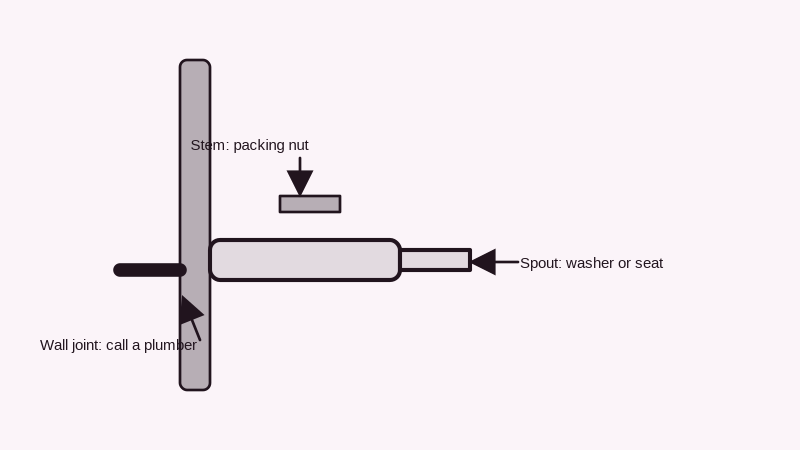
Disconnect the hose and dry everything off. Open the faucet all the way and study the stem, then close it and watch the spout for roughly a minute.
Stem leak while on. Either the packing nut has loosened or the packing is worn out. Turning the nut a quarter with a wrench is often enough. If not, renew the packing or the stem O-ring.
Spout drip while off. The washer at the tip of the stem has worn, or the seat is pitted. Fitting a new washer normally cures it, sometimes with some dressing of the seat as well.
Water from the vacuum breaker on top. Many newer faucets carry an anti-siphon device with a small cap or vent. Some water escaping from the vent while the faucet runs, particularly with a hose attached, can be normal. Dripping from it while the faucet is shut means replacement.
Water on the wall or inside. A stain on the interior wall, soaked insulation or a damp crawl space puts the leak behind the faucet. Do not ignore it. Close the water at the faucet's own valve if it has one, or at the house main, and get a plumber.
Inspect the hose as well. A hose that stays attached can leak at the coupling, and the washer inside the hose end may be worn. It is a cheap repair, yet easy to mistake for a faucet fault.
Leaks cost the average home more than 9,300 gallons each year, according to the EPA. A spigot that drips only while a hose is attached contributes to that figure.
How do I stop a drip at the handle or spout?
Close the supply, leave the faucet open so it drains, and snug the packing nut up slightly. If that fails, remove the handle, then the nut, and fit fresh packing or a new washer. Choose parts that match your faucet, reassemble it, then bring the water back gradually. A new washer cures many handle leaks and drips.
The steps:
- Turn off the water. Many homes have an indoor shutoff near where the pipe comes in. If you cannot find it, use the house main. Leave the faucet open so it drains.
- Try tightening the packing nut. It sits behind the handle. A clockwise nudge of about a quarter turn may end a handle leak. Do not overtighten.
- Remove the handle. Take out the center screw, or pry off a cap first.
- Undo the packing nut, then draw the stem out by turning it the way you would to open the faucet.
- Renew the packing. Some faucets use a rubber washer and others graphite string. Take the old piece along to the shop so you can match it.
- Renew the washer at the end of the stem, held by a brass screw, and change the O-ring on the stem as well.
- Check the seat within the valve body. If it feels rough or pitted, smooth it with a seat dressing tool or replace the whole faucet.
- Put it back together in reverse order and open the water slowly, watching for drips at the handle and spout.
Frost-free faucets have a long stem with the washer set deep inside the wall. The parts are the same, but a complete replacement stem assembly may be easier. Very old faucets may have corroded brass, and a new faucet is often the wiser buy.
Related cases are in the guides on repairing a leaky exterior faucet and stopping a faucet leak outside, while repairing a dripping indoor faucet handles indoor ones.
What if the leak is behind the wall?
A wall leak comes from a damaged pipe, a loose connection or a cracked faucet body behind the siding. Shut off the supply, keep people away from standing water, and get a plumber. Water in a wall harms framing and insulation and can stay hidden for weeks. Caulking the outside and hoping will not work.
Warning signs include a damp patch on the interior wall along the pipe's path, a higher water bill, the sound of water moving when everything is off, or soft ground under the faucet. To investigate, use the guides to an unexplained high water bill and telling if a pipe has burst. If water seems to well up from the ground, see spotting a pipe burst underground.
In north Valley houses from the 1950s to the 1970s, outdoor faucets often tie into older galvanized or copper lines, and corroded joints can fail when disturbed. If the faucet wobbles, or the pipe behind it moves as you turn the handle, stop. Forcing it risks snapping the pipe inside the wall.
Pressure matters too. High pressure wears seals out sooner, and when several fixtures leak, a regulator may be missing or failing. The page on locating the water pressure regulator helps you find it.
When does an outdoor faucet need a professional?
Bring in a plumber when the shutoff cannot be found, the faucet will not come apart, a fresh washer leaves the drip in place, the wall is the source, the pipe wobbles, or the faucet body is cracked. The plumber replaces the faucet and checks the pipe. Attach a photo to the quote form.
Replacing an old faucet is often the sensible route. The plumber can fit a frost-free or standard bibb, a new vacuum breaker, or an indoor shutoff valve so you can isolate it later. Ask for a written quote with the faucet, any valve and the labor each on its own line.
Permit work has to go to a contractor who has a California license. A simple faucet swap usually needs none, yet if pipes inside the wall are being replaced, ask the plumber whether one applies. Not every permit rule has been verified here, so for a home inside the city, check with the Los Angeles Department of Building and Safety.
Common questions
How much time does fixing an outdoor faucet take?
Snugging a packing nut takes minutes, and replacing a washer or the packing generally stays under an hour. Frost-free stems are slower. A wall leak takes longer, and the plumber may have to open it up. Ask the plumber to write down the expected duration.
What should I ask a plumber ahead of an outdoor faucet job?
Find out whether the quote is written, whether it includes a new faucet and a shutoff valve, how a hidden wall leak would be tested, and how the job changes should the pipe prove corroded. Permitted work in California needs a contractor license, so request the license number at the outset.
Does someone need to be home for an outdoor faucet repair?
Yes. An adult needs to be present when the plumber arrives, to show the faucet and the shutoff, and once more at the finish to inspect the completed work. Water to the house or the faucet is off for a brief spell. If you cannot attend, agree on side yard access in writing.
Why does my spigot only leak with the hose attached?
The hose may be leaking at its own coupling, the vacuum breaker may be venting, or worn packing may let pressure force water out whenever the faucet is open. Detach the hose and test. If it still drips with the handle open and no hose, the packing needs work.
Does a leaking spigot make the water bill climb?
It can, especially when nobody notices. A faucet dribbling into a planter, or a hose emptying onto a lawn, can squander plenty of water across several weeks. Read your meter with every tap closed. If the dial keeps turning, a leak exists somewhere, and an outdoor faucet is a frequent culprit.