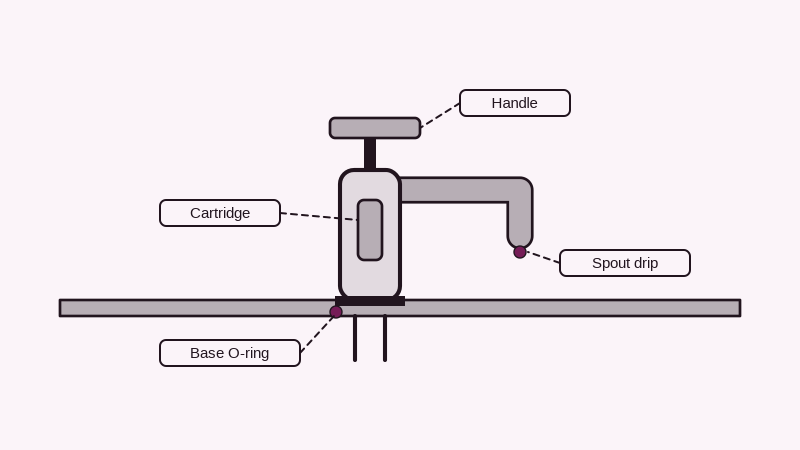
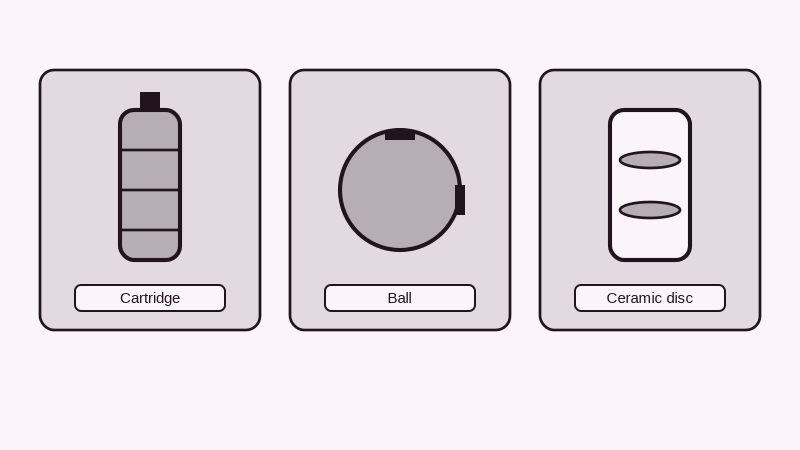
Under the lever, this style of faucet hides one of three mechanisms: cartridge, ball or ceramic disc. Symptoms include a spout that drips, water pooling around the base, or a handle that feels stiff, loose or noisy. Once you know the mechanism, the part and the steps follow. For broader fixture help, read the kitchen and bath repair guide.
Many kitchens in Sylmar and the neighboring Valley areas have a faucet of unknown age whose label wore off long ago. Small details on the handle and spout usually reveal the make and style, and a photo helps at the parts counter.
How do I tell which single-handle design I have?
Take the handle off and look inside. A small brass cylinder with a stem means a cartridge. If a slotted, rounded ball of metal or plastic sits beneath a cap, you have a ball-type faucet. Two flat ceramic discs inside a cylinder make it a disc faucet. The handle shape and brand name narrow it further.
Most handles hide a set screw under a small cap, in a hex socket on the side or behind the lever. First close both supply valves beneath the sink, and run the faucet briefly to release the pressure.
When the maker is a mystery, photograph the faucet before dismantling it and carry the worn part into a store. Match sizes and spline counts exactly, because a look-alike part that is off by a notch will leak.
How do I repair a faucet with a worn cartridge?
Take off the handle, then either pull the clip that holds the cartridge or loosen the nut. Draw the cartridge out by its stem, noting its orientation. Put in an identical model, smear the new O-rings lightly with plumber's grease and seat it facing the original way. Reassemble and test, opening the water slowly.
A cartridge that will not budge comes out more easily with a puller made for that brand than with pliers. Never lever a plastic cartridge with a screwdriver, as the faucet body can crack.
While the valve body is open, look into it. Rinse out sand and mineral flakes ahead of fitting the replacement. A rough or pitted body hints that the whole faucet is nearly worn out.
How is a dripping ball-type faucet rebuilt?
A ball faucet contains a rotating ball, an adjusting ring, and a pair of rubber seats, each backed by a spring. When the handle weeps at its base, tighten the ring a little; when the spout drips, replace the seats, springs and the O-rings below the spout. Rebuild kits include all of them.
Lift off the handle, cap, cam and ball, noting the small slot that lines up with a pin. Use a small screwdriver to lever out the tired seats along with their springs, press in the new ones and reassemble in reverse order. Replace the ball too if it is scratched or corroded.
For this design, a rebuild kit is the cheapest route. The O-rings where the spout swivels are the second place it leaks, so renew them now and grease them before the spout slides back on.
What stops a ceramic disc faucet from dripping?
Ceramic disc cartridges rarely wear out, so a drip usually means either the rubber seals on the underside of the cartridge have failed or sediment is coating the disc faces. Remove the cartridge, rinse the discs and replace the seals. If a disc is cracked, the whole cartridge must be replaced.
Handle the discs gently. They are precision ground, and a scratch lets water through. Keep them wet and clean, and stay away from harsh abrasives.
Mineral scale is the main enemy here, so hard water areas see more of this. We have no hardness figure for your street; look in your utility's yearly water quality report, and read hard water scale prevention for ways to slow the buildup.
What causes moisture around the bottom or top of the faucet?
A damp base on a single-handle faucet comes from worn O-rings around the spout or the cartridge body. Lift the spout off, replace those rings and coat them with grease. Moisture up at the handle suggests a loose cap or a worn cartridge seal, and gentle tightening can sometimes cure it.
On a pull-out or pull-down model, inspect the hose connection as well. A leak under the sink while the sprayer runs often starts at that connection, or from the weight of the hose, and tightening the quick-connect fitting fixes it.
A puddle under the sink can trace back to the supply lines instead of the faucet, so read tracking down a drip below the sink.
Should I mend this faucet or swap in a new one?
Mend it while parts are available and the finish still looks good. Replace it when corrosion has reached the body, parts are discontinued, or it has already needed two repairs. A new faucet comes with fresh seals and a warranty, and installs in an hour or two together with new supply lines.
The cost turns on the faucet you choose, so no number appears here. Plumber faucet replacement cost explains in words what moves the price, and plumber faucet install cost covers installation.
When replacing, pick a faucet with the same number of holes as your sink, and change the supply lines at the same time.
When does a plumber need to step in?
Bring in a plumber when the shutoff valves refuse to close, the faucet has fused to the sink, the source of the water in the cabinet stays hidden, or your own repair does not hold. A single visit can cover new shutoff valves and the faucet together, saving a second trip.
California requires a contractor license once a job passes a small-value threshold, and for any permitted work, so ask to see it and verify it with the state licensing board.
Submit the quote form and a plumber from nearby visits your home. Other guides begin at Mission Point Plumbing. Getting the quote on paper before work starts lets you compare more than one.
Common questions
How long will fixing a single-handle faucet take?
Swapping a cartridge or seals takes roughly thirty to sixty minutes once the correct part is in hand. Finding that part can take longer than the repair. Replacing the entire faucet runs one to two hours. When the plumber arrives with parts for your model, one visit can typically finish it.
What should I ask a person I am thinking of hiring for faucet work?
Find out if they intend to repair or replace, if parts and new supply lines are in the quote, the length of the water shutoff, and the warranty that applies. Request the contractor license and look it up with the state licensing board. Have the scope put down on paper.
Must someone be present for the faucet repair?
A responsible adult should let the plumber in, point out the faucet and agree on repair or replacement. Water goes off briefly. Clear the cupboard below the sink before the visit. You need not watch every step, but stay reachable and test the faucet together at the end.
Why does my single-handle faucet drip only on hot?
Dripping from the hot side often means a worn seal or a port clogged with scale, since hot water leaves minerals behind faster. The cartridge or discs need cleaning or replacing. If only hot is affected, the hot inlet may also hold debris. Flush the line after you refit the part.