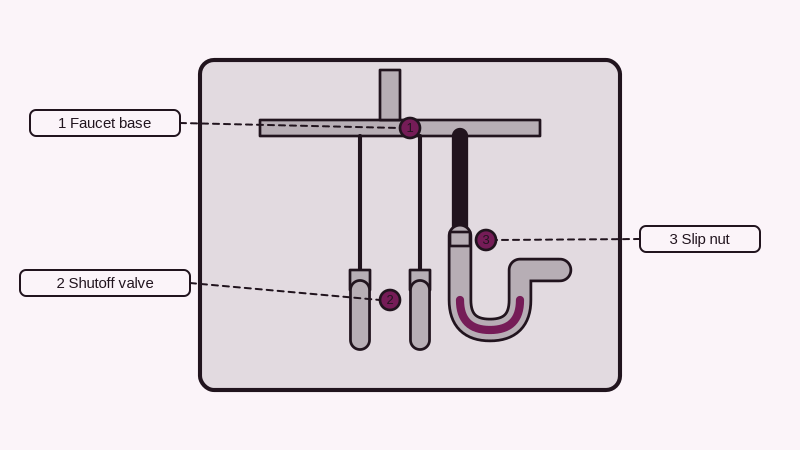
Towel every pipe dry, place a dry paper towel or a bowl in the cabinet, then open the tap and wait for the first drop. The leak nearly always sits at a joint rather than mid-pipe. For leaks that involve the disposal, the unit next to the sink, see the page on garbage disposal repair.
The space beneath a sink holds four groups of parts: two supply hoses carrying water up to the faucet, the shutoff valves, the drain trap, and the disposal or drain tailpiece. Each fails for its own reason, so learning which is wet keeps you from buying the wrong replacement.
Where is the sink cabinet leak coming from?
Dry every pipe, valve and fitting, then run the water for a few seconds at a time while holding a dry paper towel to each joint in turn. Paper darkens where the leak is. Test the supply hoses and valves with the faucet running, then the drain parts by filling the basin and letting it empty.
A leak seen only while the sink empties comes from the trap, tailpiece or strainer beneath the basin. One seen when the faucet runs comes from a supply hose, a shutoff valve or the faucet itself. Water that drips off the underside of the faucet body also ends up in the cabinet.
A flashlight and a small mirror let you see the backs of pipes, and emptying the cabinet means nothing hides a slow drip by soaking it up. A musty smell and stains across the cabinet floor show the leak has gone on for a while.
How do I cure a dripping slip nut or P-trap?
Tighten the trap's slip nut by hand about a quarter turn and test again. If it still drips, undo it, look at the rubber washer for cracks or flat spots, replace it, and seat the joint squarely before snugging up. Overtightening cracks plastic threads, so stop at snug.
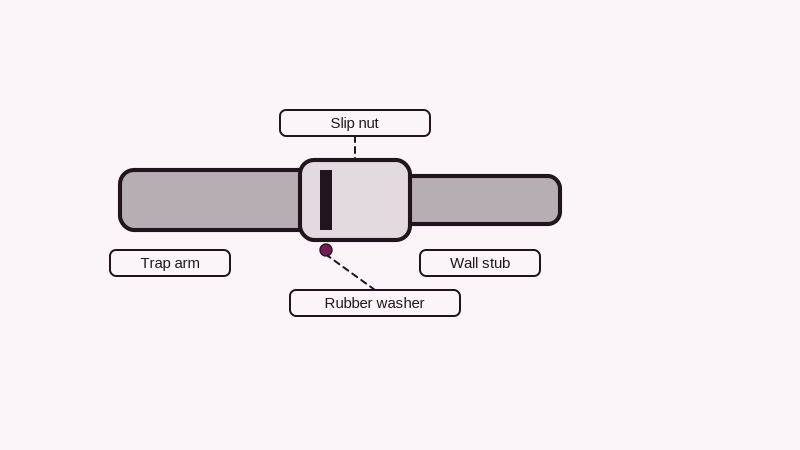
Set a bucket beneath the trap first, as it holds water. Take the trap apart, rinse out the sludge and check pipe ends for cracks or burrs. A warped or cracked plastic trap costs little to replace as a full kit.
Misalignment is the usual culprit. When the trap does not line up with the wall stub, the nut will never seal, so loosen the joints slightly, shift the pipe and retighten. For taking the trap apart safely, see unclogging a kitchen sink.
What is the fix for a bad supply hose or shutoff valve?
Close the valve beneath the sink, then look over the braided hose for kinks, corroded nuts or drips at either end. Replace a faulty hose with a new braided one of matching size and length, tighten by hand, and add a small wrench turn. A valve that drips at the stem often needs replacing outright.
When the valve will not shut, close the main water valve and have a plumber change it instead of forcing it. Old multi-turn valves seize with mineral deposits and can snap, flooding the cabinet.
Put in new supply hoses whenever a faucet is changed, because rubber washers harden with age. In houses from the 1950s to the 1970s, the original chrome-plated shutoffs may be decades old and worth swapping while you are down there.
Could the faucet itself be the source?
Water running down the faucet body or gathering at its base points to a worn O-ring, cartridge or seat, not the pipe. New seals or a new cartridge cures it, and the steps depend on the faucet design. The faucet guides on this site cover each type.
For single-lever models, see fixing a leaky single-handle faucet, and fixing a leaky sink faucet gives the general method. Photograph the faucet and write down its model number so replacement parts match.
If a faucet is old, corroded or part of a set whose parts are gone, a new one is often easier than a repair. A new fixture goes in with fresh supply hoses.
Can tape, epoxy or a clamp seal a leaking pipe?
Plumber's tape (Teflon tape) seals threaded joints, not slip joints. Epoxy putty and repair clamps may hold a metal pinhole for a short time, but only as temporary help. Use them just to hold the water until the pipe is replaced, never on pipe that is badly corroded.
Tape goes on the male threads, wound in the direction the nut turns on. Slip nuts seal using a washer, so tape does nothing for them. When copper or steel pipe is pitting, a clamp might hold briefly, but the pipe is near the end of its life.
For a leak in plastic pipe, the standard repair swaps out the damaged section using a coupling, because glue on wet pipe seldom holds. The page on repairing a leak in plastic pipe covers it.
How do I handle damp damage beneath the sink?
Dry the cabinet and the wall behind within a day or two, using towels, a fan and a dehumidifier, and take out anything soaked. A swollen particleboard floor, a musty smell or visible mold suggests the damage is bigger than it appears. A swollen base usually has to be cut out and replaced.
At an upstairs sink, look at the ceiling below. A stain there means the water traveled beyond the cabinet. The guide to a leaking ceiling lists what to do.
Mold can begin within days on wet materials. If the area is large, or someone in the house has breathing trouble, ask a professional about drying and testing. Keep photos and receipts to explain the damage to an insurer if asked.
At what point do I stop and call a plumber?
Stop when the shutoff valve will not close, the pipe is corroded or cracked, water seeps out of the wall, the leak comes back after your repair, or the cabinet and wall are soaked. Stop too if the line carries gas or runs near wiring. Those are plumber jobs.
Gas piping is regulated, and in California gas work, like anything needing a permit, calls for a contractor license. On smelling gas, leave the building, contact your gas utility from outdoors, and dial 911 if anyone is at risk.
For an under-sink leak you cannot cure, ask for a quote and your details go to a local plumber, who then visits the house. More plumbing help is at Mission Point Plumbing. Getting quotes on paper before any work starts is the sensible approach. For a slow drain on the same sink, see the causes of a slow sink drain.
Common questions
How many minutes does an under-sink leak repair take?
Snugging a slip nut or replacing a washer takes about ten minutes, while a new supply hose or trap needs thirty minutes to an hour. A shutoff valve takes longer if the main has to be turned off. A plumber often completes a plain leak in under an hour, with extra time to dry the area and test.
Which questions should I put to a plumber about a sink leak?
Ask how the source will be located, whether the quote includes replacing worn valves and supply hoses, how long the water will be off, and what a repeat visit costs if it leaks again. Ask to see the contractor license, and check it with the state licensing board before the work begins.
Must I be at home for the visit?
Yes, an adult should be present to open the cabinet and point out where water shows up. The visit is typically short. Beforehand, empty the space beneath the sink and put cleaning products where children and pets cannot reach, so the plumber has a clear view of every part and can start work immediately.
Why does the cabinet get wet only when the dishwasher runs?
The dishwasher drain hose joins the sink drain or the disposal, and a loose clamp or a blockage at that joint sends water into the cabinet. Inspect the hose clamp and the disposal's dishwasher inlet. If a knockout plug was never removed, the dishwasher cannot drain and may back up into the sink.