Three routes prevent scale: take the hardness minerals out before the water gets to your pipes, change how the minerals behave, or lower the heat and evaporation that make them settle. Only a softener on the incoming line takes them out entirely. This page shows how to read your own numbers and match a fix to them; the water softener hub goes deeper on equipment.
What keeps limescale from forming in the first place?
Begin with the conditions that deposit it. Scale is mostly calcium carbonate, which comes out of solution when hard water gets hot or dries on a surface. Lower the water heater setting to a safe warm temperature, wipe down glass and fixtures after use, and treat the water at the source if hardness is high.
Heat quietly does the damage. The USGS says heated hard water can leave solid calcium carbonate behind, shortening equipment life, pushing up heating costs and choking pipes. A tank heater suffers first because sediment settles on the tank bottom, right above the burner. Draining a few gallons yearly clears loose grit, and anode rod replacement is a related upkeep job.
On the outside, dry spots matter. Squeegee a shower door and wipe a faucet and the film never gets a chance to harden. It sounds fussy, and it works.
Which units measure hardness: ppm, gpg or mg/L?
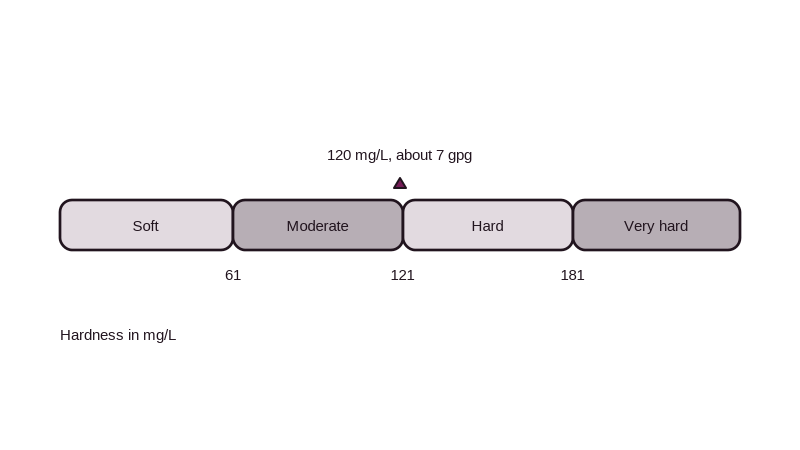
Hardness counts the calcium and magnesium dissolved in water. Here ppm and mg/L amount to the same figure, whereas grains per gallon (gpg) is an American unit worth about 17.1 mg/L per grain. The USGS sorts water into bands: soft under 61 mg/L, moderately hard at 61 to 120, hard at 121 to 180, and very hard above that.
To translate: divide a ppm figure by 17.1 to get gpg. A reading of 120 mg/L, for instance, is about 7 gpg. Retail test strips tend to show gpg or ppm, so check the unit on the packet before comparing.
A pH reading is something else. pH measures acidity on a scale where 7 is neutral, and says little about hardness. Water can be neutral and very hard, or slightly acidic and soft. Likewise, a "rating scale" on a brochure is only the manufacturer's labeling of the same hardness bands, so ask for the underlying number.
Your tap is the best source. LADWP publishes a Drinking Water Quality Report each year covering the Valley areas it serves, and its supply is a blend of sources, so readings can differ by street. Pull up the latest report, or test a glass from your own tap, instead of trusting a blanket claim about Los Angeles water.
When does scale call for a plumber?
Think about one when flow has faded at several fixtures, the tank rumbles, a tankless unit flags a scale fault, or the pipes are old enough that cleaning may expose weak spots. A plumber can test hardness, flush the heater, and suggest a softener or filter that suits your layout.
Enter the symptoms in the request a quote form, and a local plumbing business receives them. New to the site? Mission Point Plumbing is the starting page.
Old galvanized pipe with heavy scale is a special case. Cleaning may do little, and the plumber might recommend replacement instead; see galvanized pipe replacement.
Where does the buildup on my fixtures come from?
Groundwater picks up calcium and magnesium on its way through soil and rock. Warm that water, boil it, or let it evaporate, and the minerals drop out and grip whatever is nearby: kettle, showerhead, pipe wall, heater tank. Harder water simply grows the crust sooner.
Flow shapes where it appears. Narrow openings such as aerators and showerhead nozzles clog first, because a thin crust matters more there. Hot-water lines scale faster than cold ones. Tankless heaters have small passages that scale readily, which is why they ask for periodic flushing; the Rinnai tankless repair page mentions this problem as well.
Appliances give early notice. A dishwasher that leaves cloudy glasses, a kettle with a white lining, and a showerhead whose spray veers sideways all signal heavy hardness well before any pipe fails.
Are anti-scale conditioners worth considering?
Evidence is mixed. Template-assisted or "anti-scale" conditioners leave the calcium in the water and try to alter its crystals so they ride along rather than stick. Some owners report less crust; independent proof is patchy. An ion-exchange softener pulls the minerals out, which is the established route, though it brings salt use and brine discharge.
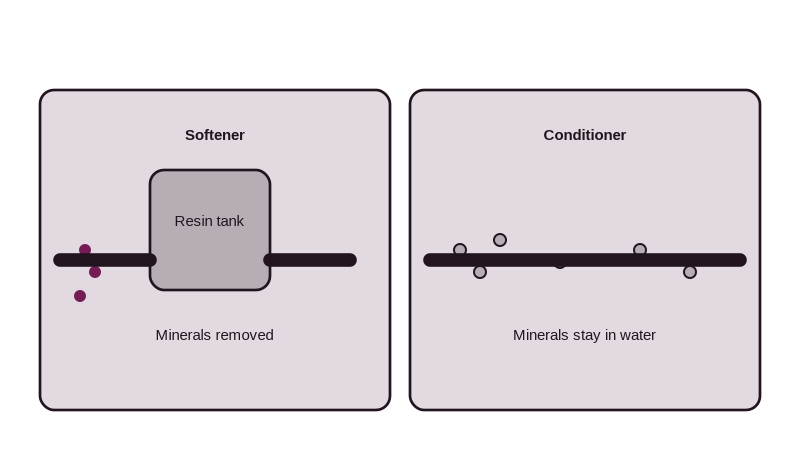
Magnetic or electronic descalers that clamp on a pipe sit at the doubtful end of the market, and independent support for them is thin. Be skeptical of any product that promises to remove all scale without changing the water.
Whole-house options therefore split into two groups: a softener, which treats the minerals, or point-of-use measures such as a cartridge filter at a single tap. A reverse osmosis unit at the kitchen sink treats drinking water only. The hub compares them, while softener installation pricing shows how quotes are assembled, with no figures printed.
Tempted to fit one yourself? The DIY softener guide lays out the job and where it stops being DIY.
Common questions
Is hard water harmful to drink?
Typically not. Hardness minerals are a different matter from contaminants, and the usual complaints are practical: crust, weak lather, spotted glasses. A real health worry belongs with your doctor and the utility's own quality report, since a plumber cannot answer it.
Does scale really wear out pipes and appliances?
It can. Over the years it narrows pipes, blankets heating surfaces so they labor harder, and jams valves and aerators. The pace varies with the hardness of the water and how often it is heated, and the water heater is usually the first costly casualty.
How often does the tank need flushing?
Many makers recommend yearly, but the manual for your specific model is the better guide, and harder water argues for more. If the tank rumbles or is very old, ask a plumber before loosening a drain valve that might not reseal, since a drain valve that refuses to close again can leave the tank empty.
Will vinegar clear scale without hurting fixtures?
White vinegar loosens light scale on chrome, glass and many plastics, yet it can mar natural stone, some finishes and rubber seals when left too long. Try a hidden spot, keep soaks short, rinse well, and keep it away from bleach. Full steps are in removing hard water scale.