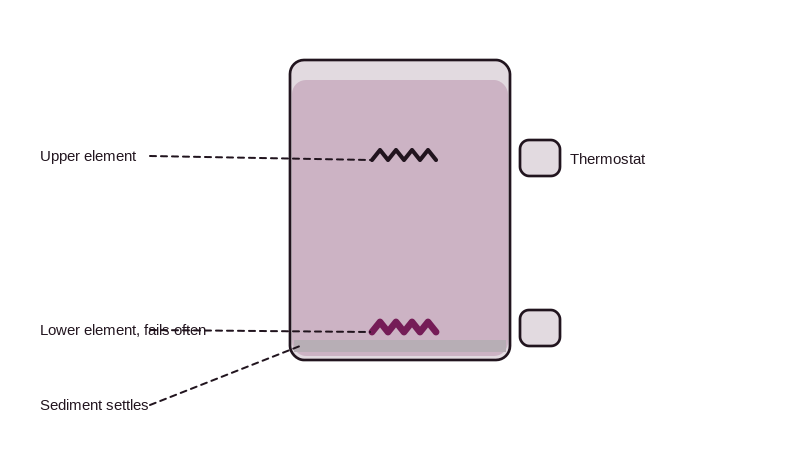
An electric tank water heater has two heating elements, an upper and a lower, and either can burn out or be coated with mineral scale. Replacing a bad element restores hot water for far less than a new tank, provided the tank itself is sound. If you are comparing options, begin with water heater repair, then come back here for the element question.
Many homes in Sylmar and the north Valley run on gas, and a gas water heater has no element, so the advice here covers electric tanks and some electric tankless units only. Look at the label stuck to the heater: if it shows a gas inlet and a vent, skip to the thermocouple and pilot checks instead.
Does the upper or the lower element burn out first?
Usually the lower one, because sediment settles on the tank floor and buries it, which causes overheating and burnout. A dead lower element leaves you with a smaller supply of hot water; a dead upper element means no hot water, or only a little.
The two work in sequence. The upper element heats the top of the tank first, then hands over to the lower one for the remainder. That is why a dead upper element makes the whole tank feel cold, while a dead lower element appears as hot water that runs out quickly.
Scale from hard water speeds this up, so check hardness in your utility's yearly water quality report. Sylmar gets no figure here, because water sources differ by street and a measured number matters more than a guess.
How can I tell the element is at fault?
Signs of a failed element: water that runs short fast, water that stays lukewarm, or no hot water despite the breaker being on. A tripped breaker, a reset button that pops out or a hissing, rumbling tank also points to elements or sediment.
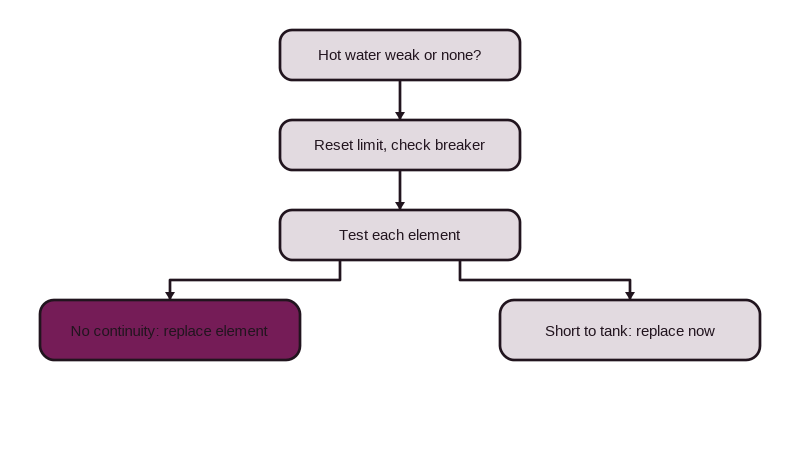
Rule out simpler causes first. Reset the high-limit button on the thermostat, check the breaker and look at the shutoff on the cold inlet. The no hot water page lists the order to check.
Only a meter can confirm an element is bad. A plumber or electrician tests each element for continuity and for a short to ground. No continuity on the meter shows the element has burned out. A short to the tank means replace it right away.
Can I change a heater element myself?
Possible, if you are comfortable around electricity and a heavy tank of hot water, but the risks are real. The breaker has to be off, a voltage tester must confirm the power is gone, the tank needs draining below the element and the socket must fit. If any of that is unfamiliar, hire a plumber.
Water and electricity together kill. Never touch wiring without testing it first, and never power the heater when the tank is empty, since a dry element burns out in seconds.
If the heater leaks around the element flange or the tank is badly corroded, a fresh element cannot cure that. Read about leaks at the heater before you spend money on parts.
What does the replacement involve?
The job is: power off and tested, cold water off, tank drained below the element, element unscrewed with an element wrench, a new gasket and the matching element fitted, the tank refilled with air bled from a hot tap, then power restored once the tank is full.
Match the element to the heater. The wattage and voltage must agree between the old element's markings and the label, and a low-density element lasts longer in scale-prone water than a standard one, as some makers state. Look for the style the manufacturer lists for your model.
Flush the tank at the same time. Draining sediment protects the new element. If the tank bottom is heavy with scale, expect flushing to take longer. With the heater open, ask the plumber to look over the relief valve and the sediment-protecting anode rod, because failed elements often come with other wear.
When is a new heater smarter than a new element?
A new heater beats a new element when the tank leaks, has rusted through or is old enough that several parts are giving out. A tank with a record of repeated trouble that is close to the end of its life is a poor place to spend repair money. Water heater failures often come in clusters, with a bad element, then a weeping valve, then a leaking seam.
Compare in writing. Ask the plumber what a new element costs against a new heater, including permit and haul-away, and how long the heater is likely to last in your home. No figure is published here. For the question of age, see water heater replacement timing.
Think about the type of heater too. If you are leaning toward a tankless unit, our guide to tank versus tankless shows the tradeoffs. Some electric tankless units use heating elements as well, and those are replaced by a plumber with the right parts.
What about gas water heaters, which have no elements?
A gas water heater heats with a burner at the bottom, so there is no element to replace. Typical faults: a pilot that keeps blowing out, a bad thermocouple, a dirty burner or a gas control valve. Gas work is regulated, so let a plumber handle it.
If you smell gas, leave the switches alone; exit the building, contact your gas utility from outside and use 911 if there is danger. The thermocouple replacement page explains the usual pilot problem.
Lighting a pilot is normally a homeowner task if the label says so, but work on gas piping or the gas valve belongs to a contractor holding the proper California license. California also requires a contractor license for any job that needs a permit.
How do I get a plumber for an element job?
Describe the heater type, the symptoms and whatever you have already tried. A plumber who knows the model can arrive with the right element and gasket the first time. Ask for the contractor license number along with a written quote; the old element is yours to keep if you want to see why it failed. Some Heating Air Conditioning companies also service water heaters, so ask which trade is coming.
Send a quote request and a local plumber takes the job and visits. To see everything the service covers, go to Mission Point Plumbing. When only one sink lacks hot water, see no hot water at the kitchen sink, since that is often a fixture problem.
Common questions
How long does an element swap take?
A plumber usually needs about an hour for one element once the tank is drained, and a bit more for two or for a flush. Draining and refilling add time. A first visit may be needed to test the elements and bring the right parts, so ask whether the repair can be done on that visit.
What should I ask before hiring someone to change an element?
Ask whether both elements and the thermostat get tested first, whether the quote includes the parts and flush, and whether the tank is worth repairing. Request a look at the contractor license, then confirm it with the state licensing board. Get the scope on paper before work begins.
Does anyone need to be home during the repair?
Yes, an adult should be present to give access to the heater, usually in a garage or closet, and to approve the plan after testing. Waiting beside the plumber is not required, but you should be reachable, and you should check the hot water once the work is done.
Do both elements need replacing together?
Not always. A plumber tests each one and replaces only what has failed. Some owners replace both on an older heater, because the second may be nearly worn out, and the extra part adds little to a visit with the tank already open. Let the plumber make the recommendation.