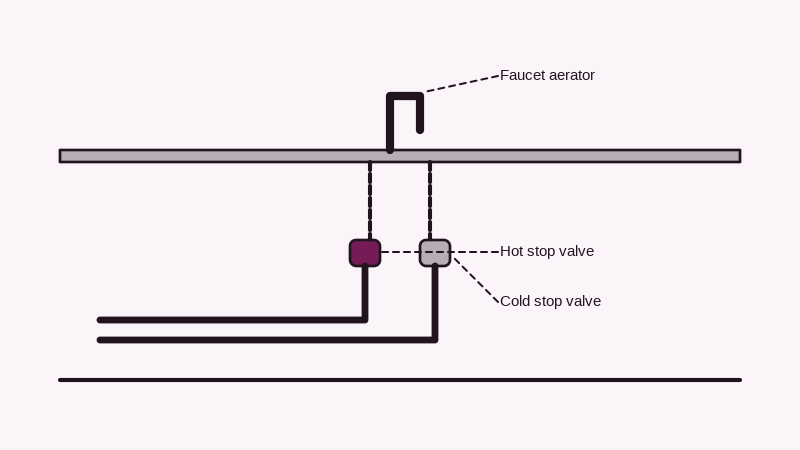
If just the kitchen sink runs cold while the rest of the house is fine, the problem usually lies somewhere between the main hot line and that one faucet: a stop valve that is closed or failing, a clogged aerator, a worn cartridge, a kinked or blocked supply line, or crossed connections. The heater is an unlikely cause. When the whole house runs cold, start with our water heater repair page, and see the Mission Point Plumbing front page for other services.
Why is only the kitchen sink cold?
The cause is nearly always local to the sink: a stop valve closed or failing, a clogged aerator, a worn faucet cartridge, a blocked or kinked supply line, or hot and cold lines swapped in error. Try the other taps first. If they run hot, the heater is healthy and the trouble sits in the kitchen.
Match what you see to a type of fault.
Cold water only, normal pressure. The faucet may be mixing incorrectly, or the hot supply is closed or blocked while cold flows. Check both stop valves under the sink. A hot stop valve left partly closed after an earlier repair is a very common cause.
Weak hot water, normal cold. Suspect a clogged aerator at the spout, a clogged inlet screen or a partly blocked hot supply line. Unscrew the aerator and look for grit or white scale flakes.
Hot water that takes a while. In a long house, hot water needs time to travel from the heater to a faraway kitchen. That is not a fault, though it can feel like one. A cool run of pipe in an uninsulated wall lengthens the wait.
Cold on the hot side only after a repair or move. If someone recently replaced the faucet, supply lines or a stop valve, the lines may be crossed. Hot is usually on the left.
Odd water at the kitchen sink and no hot at the dishwasher. Both connect to the same hot stop valve or a shared line. A shared symptom points to that valve or the line behind it.
In the older tract homes of the north Valley, built between the 1950s and 1970s, stop valves under the sink may be old, stiff and corroded. Forcing a seized one can break it and start a leak, so go gently. If a valve will not turn, leave it and ask a plumber.
What can I check myself?
Look at the two stop valves under the sink and at the aerator, and see whether both handles or the lever behave the same way. Then try other taps to rule out the heater. If a valve is stiff or drips when turned, stop. Leave it to a plumber, because forcing an old stop valve often makes a small job larger.
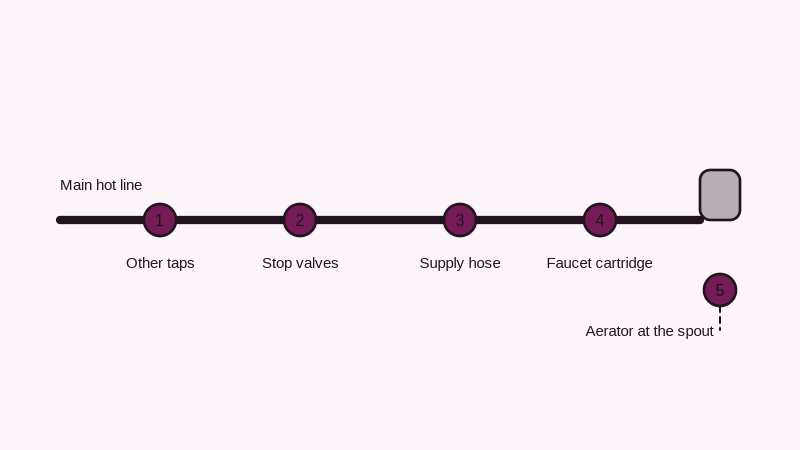
A straightforward sequence.
- Test another tap. Run the nearest bathroom tap on hot. If it gets hot, the heater and main line are working.
- Look under the sink. Locate the two stop valves. Their handles should line up with the pipe when open. Open the hot one slowly if it is partly closed. Put a towel or small bucket beneath.
- Check the aerator. Unscrew it from the spout tip, rinse it and clear out grit. Mineral scale is a frequent cause. Your supplier's annual report shows how hard your water is.
- Inspect the faucet. One that runs hot in one handle position and cold in another may have a worn cartridge. Our guides to fixing a leaky kitchen faucet and fixing a leaky faucet in general cover cartridges and washers.
- Check the hoses. Flexible supply lines can kink behind a cabinet or clog inside. Do not pull hard on them.
- See what shares the line. If the dishwasher is cold too, suspect the shared hot supply.
If you smell gas, touch nothing electrical, leave the building and use 911 or your gas utility from outdoors. That is rare with a sink problem but matters if the heater shares the cupboard.
If a shower or other fixtures also misbehave, our pages on a shower with no hot water and low hot water pressure look at the wider causes. And if the heater runs yet the house still lacks hot water at times, read the page on a heater that runs without producing hot water next.
When is it time to bring in a plumber?
Do so if a valve is seized or leaking, a supply line is damaged or blocked, the faucet needs a new cartridge or replacement, or cleaning the aerator and checking valves does not bring back hot water. Submit symptoms and photos of the sink cabinet through the quote form.
A local plumber can test both lines with a gauge, replace stop valves and supply lines, swap the faucet or its cartridge and check whether hot and cold were crossed. Replacing stop valves and lines is small work, and swapping a faucet is quick, but each should be quoted in writing. Our guide on faucet replacement costs explains the price drivers without giving figures.
If the plumber traces the fault elsewhere, such as a pipe blockage in the wall or a crossed line behind the cabinet, the quote may grow. Ask for the cause in writing and for the reason wall access is needed.
Before the visit, clear out the cabinet under the sink and photograph the valves and lines. It speeds up diagnosis. Tenants should tell the landlord, since many rental repairs are the landlord's to arrange, and keep a record of when the problem was reported.
Common questions
How long does it take to fix no hot water at the kitchen sink?
A stop valve, aerator or supply line fix is typically quick, often within an hour of arrival once the part is on hand. A faucet cartridge or replacement takes somewhat longer. A fault inside a wall, or one needing a new line, takes longer still. The quote should say how long the plumber expects to be on site.
What should I ask before I hire someone for this?
Ask whether diagnosis is included, whether the quote is itemized on paper, whether new valves and lines are part of it, and how the plumber will locate the cause. Request the contractor license number, since California requires one for permitted work. Also ask whether the cabinet and floor will be protected.
Do I need to be home for the visit?
Yes. Someone should be there to show the plumber the sink, open the cabinet and test the hot water once the work is done. The plumber may close water to the sink or the house for a short time. Away that day? Agree on access and scope in writing beforehand.
Could the dishwasher cause no hot water at the sink?
Not normally, though in many kitchens it shares the hot supply with the sink. A faulty shared stop valve or a blocked line feeding both can cut hot water to each. A dishwasher that washes in cold water is a clue, so mention it. The plumber can check the shared parts quickly.
Why is the hot water slow to arrive at the kitchen sink?
Hot water has to push the cold water already in the pipe out first, and a long run takes time. In larger homes, or those with the heater far from the kitchen, a delay is normal. A very long wait, or one that has worsened, may point to scale or a partly closed valve.