A Noritz tankless water heater that stops working needs its cause identified before anything is replaced. Common reasons: an error code from a vent, flame, flow or sensor fault; trouble with the gas or power supply; mineral buildup inside the heat exchanger; a blocked inlet filter; or too little water flow to ignite the unit. This page sits alongside the wider water heater repair guide.
How do I read a Noritz error code?
A Noritz unit shows a code on its display when it detects a fault. The code points to a group of causes, such as ignition, flame, venting, water flow or temperature sensors, and the exact meaning is in your model's manual. Write down the code before resetting anything, because a reset clears it.
We do not reproduce a table of codes here, since they differ by model and generation, and a wrong list is worse than none. Find the model number on the label and read the manual for your own unit, or hand the model and code to the plumber.
How to use a code:
- Photograph the display, or write the code down.
- Note when it appears: at start, partway through a shower, or after a long run.
- Reset the unit once by turning the power off and on, as the manual says.
- If the code returns, stop and send it to a plumber with the model number.
A code that returns right away usually means the cause is still there. Repeated resets only waste time and, with a gas fault, can matter for safety.
Why is my Noritz tankless heater giving no hot water?
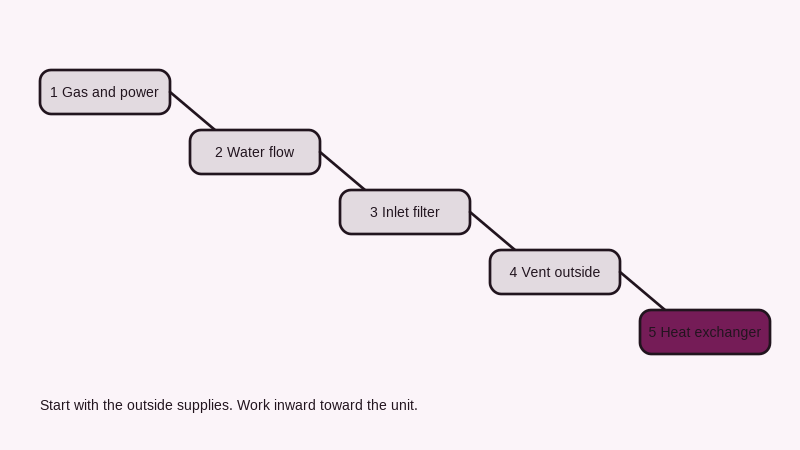
The usual causes are a closed gas or water valve, a lost power supply, a clogged inlet screen, scale that chokes the heat exchanger, a vent problem, a flow below the threshold needed for ignition, or a fault in a sensor or the board. Work from the outside in: supplies first, then the unit.
Take each in turn.
Supplies. Make sure the gas valve at the unit is open, the water valves are open, and the power outlet or breaker is on. After an outage, a unit may need a power reset.
Minimum flow. A tankless unit fires only when enough water flows through it. Opening a tap just slightly may not trigger it. If a shower valve is a little open or a showerhead is badly clogged, the unit may shut off. Test at a tap on full.
Inlet filter. Many units have a small screen where the cold water enters. Debris after plumbing work can block it. A plumber can clean it.
Scale. Minerals in the water form a crust inside the heat exchanger. Check LADWP's yearly drinking water quality report, or your own district's, for the hardness of your supply, as sources differ by street. Units often need periodic flushing, and the manual says how often.
Venting. The unit needs air and an unobstructed vent, and a bird nest, a blockage or a loose joint can shut it down. This is not a place for experiments, since exhaust gases can be dangerous.
Cross-connections. Hot water that arrives lukewarm can come from a crossover in a plumbing fixture, such as a worn shower or sink valve, which sends cold into the hot line. This one is often mistaken for a heater fault. The shower with no hot water page covers it.
For the all-brands overview, read the no hot water checklist.
What can I check myself on a tankless heater?
Safe checks: the gas valve, the water valves, the power, the display code, whether other taps behave the same, the outdoor vent terminal for visible blockage, and the area for leaks. Do not open the casing, test gas lines, or alter the vent. If gas is ever in the air, exit the building first, then contact 911 or your gas utility from outside.
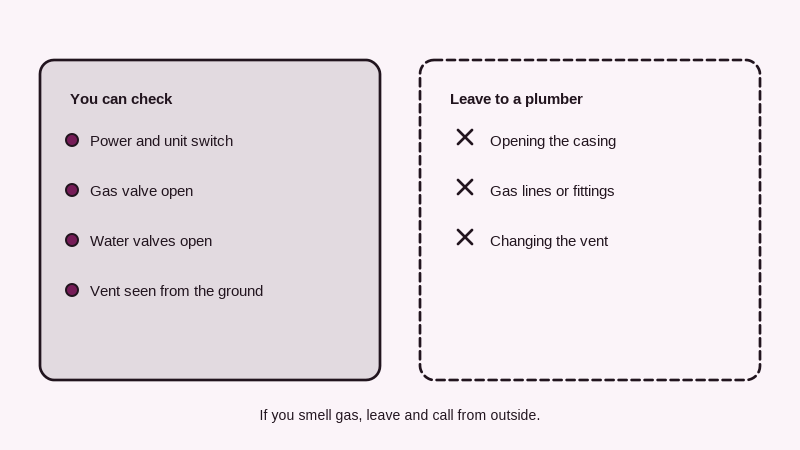
A short list of safe checks:
- power outlet or breaker on, and the unit's switch on
- gas shutoff open on the supply line, if you can see it
- cold water inlet open, and hot outlet not leaking
- code on the display recorded
- a tap opened fully, to test the minimum flow
- vent terminal outside not blocked by leaves or nests, looking only from the ground
Do not take the cover off. Water, gas and high voltage sit in the same box. Do not run the unit with a blocked vent or a smell of gas.
If the unit leaks, close its water supply and cut the power. Leaks from inside the case suggest a failed heat exchanger or fitting, and need a plumber.
How does a plumber go about repairing a Noritz tankless heater?
The plumber starts from the code, then checks gas pressure, power, water flow and the vent, cleans the inlet filter, flushes scale from the heat exchanger when the manual calls for it, and replaces the failed part: a sensor, igniter, fan, board or heat exchanger. The visit ends with a test at several flows.
Expect a written quote ahead of the work that names the fault found, the part and the labor. If the fault is a heat exchanger or a control board on an older unit, ask for a replacement quote too, so you can compare. What moves a replacement quote is explained in tankless replacement quote factors.
Descaling is a service you can ask about at any visit. If you are in a house where the unit has not been flushed since it went in, mention it. Brand names differ on how often they advise it, so go by the manual.
Gas piping, venting and permit-related work belong to a contractor with the correct California license. The state wants a contractor license once a job crosses a small dollar threshold, and any permit job needs one whatever its size. Search for the license on the CSLB website, and ask whether a permit applies. Inside the City of Los Angeles the permit office is the Department of Building and Safety. We cannot say what applies to your address.
Other brands have their own pages: Rinnai, Navien and Rheem. The principles are similar, but codes and parts are not.
When does a Noritz unit deserve replacement instead of repair?
Replace it if the heat exchanger itself has failed, if the repair would swallow a large part of a new unit's price, if the same faults keep returning, or if the unit is old and parts are hard to find. Setting a written repair quote next to a written replacement quote lets you decide with figures in front of you.
Tankless units are built to last, but the water, the installation and the care they get change that. Have the plumber describe what turned up when the unit was opened: heavy scale, corroded fittings, a cracked exchanger. If the cause was neglect, such as no flushing, a new unit will have the same fate without a different habit.
If you are weighing a change of brand or type, see tank versus tankless, and for the installation side, gas tankless installation.
To send a request, use the quote form and include the model number, the display code, a picture of the label and your observations. Requests are looked at on weekdays, 9am to 5pm. Start at Mission Point Plumbing for other services.
Common questions
What causes a Noritz tankless water heater to stop heating?
Typical causes: a closed gas or water valve, a trickle too slight to ignite the burner, a clogged inlet screen, a scaled-up heat exchanger, a blocked vent, or a failed sensor or board. The display code helps narrow it. Write the code and model number down for the plumber.
How do I reset a Noritz tankless water heater?
Most units reset after the power is cut briefly and restored, as the manual describes. Try it once. If the identical code comes back, a reset cannot clear the fault, so stop and pass the details to a plumber instead of resetting again and again.
How often should a tankless heater be flushed?
The manual sets the interval, and it depends on your water. Read the hardness in LADWP's annual water quality report, or your district's, since it varies. Many plumbers suggest asking about descaling at least once a year if scale is a concern. Your own manual has the final say.
Is a Noritz repair a DIY job?
Checking the valves, the power and the code is fine. Opening the casing, working on gas, changing the vent or handling the control board is not. Gas, venting and electrical work have legal and safety limits, and anything needing a permit must be handled by a contractor with the correct California license.
Why does a Noritz heater alternate between scalding and cold?
A temperature that swings can come from a sensor fault, a flow that is too low or fluctuating, a crossed supply in a shower valve or scale in the exchanger. Test at several taps. If only one is off, the fixture is the suspect. A plumber can measure the output and adjust or replace the part.