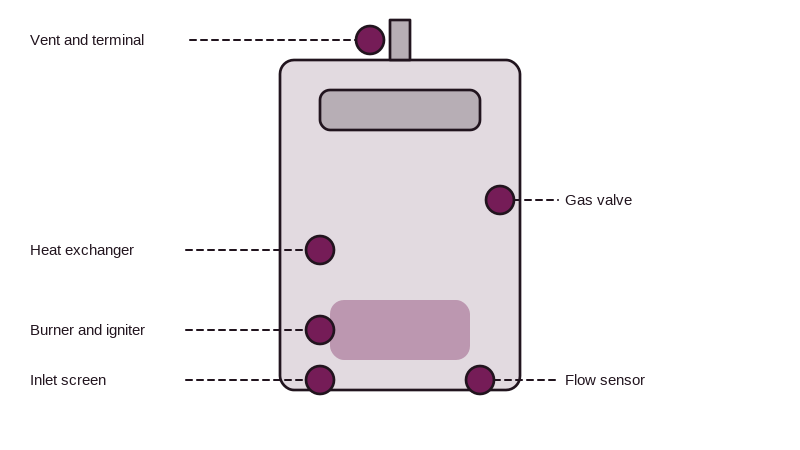
Almost every Rinnai complaint boils down to one of six things: no light at the burner, a flame that drops out, a restricted vent, scale clogging the heat exchanger, a dead sensor, or flow too weak to wake the unit. A number on the screen usually narrows the list. We take them in that order here, within our wider water heater repair section.
How do you read a Rinnai error code?
The number points at the subsystem that complained. Codes like 11 and 12 are commonly linked to ignition and flame trouble, and 10 to air or venting, yet meanings shift between model series. Your unit's manual carries the true table, so use any list online as a hint and verify against the booklet before buying anything.
Jot down the code plus the model and serial numbers printed on the unit's label. Add context: a gas outage, a power flicker, a marathon shower, or a new gas appliance sharing the line. Any plumber can put each detail to use, and so can the maker's support desk.
Plenty of faults vanish after a reset. Switch the unit off with the remote, wait a full minute, then restart it. If the identical number comes straight back, the problem is genuine. An occasional code, by contrast, can mean a marginal sensor, a gust in the vent or a gas supply that sags while the furnace runs.
What makes the water go lukewarm or swing hot and cold?
Usual suspects: scale on the heat exchanger, thin gas supply, flow so weak the burner never fires, a tired sensor, or cross-flow between hot and cold pipes. Because a tankless unit will not fire below a minimum flow, a half-open tap can give lukewarm water while the burner idles off.
Scale heads the list in older units serving hard-water streets. The USGS says heated hard water can drop calcium carbonate that chokes passages and dulls efficiency. Makers advise periodic descaling flushes, sooner where water is hard; reading your water explains how to learn your own hardness.
Test the plain stuff first. Is the gas valve fully open? Is the inlet screen clean? Does every tap misbehave, or just one? A lone fixture with feeble flow often has a clogged aerator rather than a heater problem.
Cross-flow is sneakier: a worn mixing cartridge or single-handle fixture lets cold water leak into the hot line and fools the unit. A plumber hunts for that with a few simple tests.
What can an owner safely check?
You can reset the unit, confirm power and gas valve are on, rinse the inlet screen, clear nests or debris from vent terminations, and run a descaling flush if your manual shows one. Gas piping, burner parts, valves and the vent itself are for a contractor.
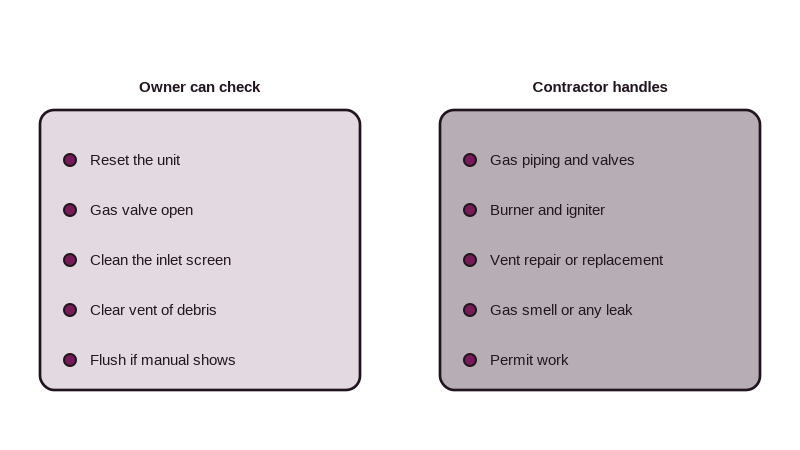
Law and common sense agree here. Gas piping, plus anything under permit, is reserved in California for contractors holding a state license, and tankless units depend on correctly sized lines and vents. If gas is in the air, get outside without touching any switches, then reach SoCalGas at 1-800-427-2200, or 911 if anyone is in danger.
A descaling flush usually circulates a mild acid via a small pump, linked by hoses to the unit's service valves. Units with isolation valves make this simple. Without them, a plumber may fit valves first, which pays off at every later service.
Leave breathing room around the heater. Venting and combustion air need clearance, so keep paint, cleaners and boxes away from it.
Which Rinnai problems belong to a plumber?
Pass these to a plumber: a code that keeps coming back after resetting, no ignition, flame loss, a surging burner, any leak, a damaged vent or a gas odor. A plumber can read the codes, measure gas pressure and venting, descale properly, and judge whether a part or the whole unit is the sensible spend.
Other brands fail in similar ways: Navien, Rheem and Noritz pages show the overlap, useful when a switch is on your mind. Broader reading sits under instant water heater repair, and Rinnai installation covers replacement planning.
Put the symptoms, model and code into the request a quote form, and it travels to a plumbing business in your area. Mission Point Plumbing explains how requests move. Thinking of leaving a tank behind? Tank versus tankless lays out the trade.
What should you expect when a plumber visits?
Expect a few minutes of questions, then a read of the code history, a visual check of the vent and gas connection, a water flow test at the unit and, where scale is suspected, a flush. The plumber then names the fault and the likely fix before opening anything major.
Have the manual, the label details and any past service notes handy. Tell the plumber about recent changes: a new roof vent cap, a remodel near the unit, a second appliance added to the gas line. These details often crack a puzzle faster than any meter.
If parts are needed, a Rinnai board, igniter or sensor may have to be ordered, which can turn a one-visit job into two. Early on, ask if the plumber stocks common parts and if the quote includes the return trip.
Common questions
What lifespan can a Rinnai tankless unit reach?
Makers describe long service lives for tankless units, often longer than a tank heater, but real results depend on water hardness, upkeep and workload. Regular descaling and clear venting matter most. Read your manual and warranty terms rather than trusting a general figure.
Does a Rinnai want servicing every year?
Most makers recommend routine servicing: a scale-clearing flush, a look at the inlet filter and a venting check. In hard-water areas it matters more. Plumbers handle this work, and skipping it often explains lukewarm water and error codes on the unit.
How far can an owner go with a Rinnai repair?
Reset it, clean the inlet screen and vent terminals, and flush it if the manual describes how. Jobs on gas, burner, valves and vent should go to a contractor who holds a California license, since errors there are dangerous and can affect warranty terms. If unsure, stop and ask.
Is an older Rinnai worth repairing?
Often, if the repair is minor and the heat exchanger is sound. A failed board or exchanger on a very old unit can tip things toward replacement. Request a clear diagnosis, then compare it with a replacement scope before deciding.