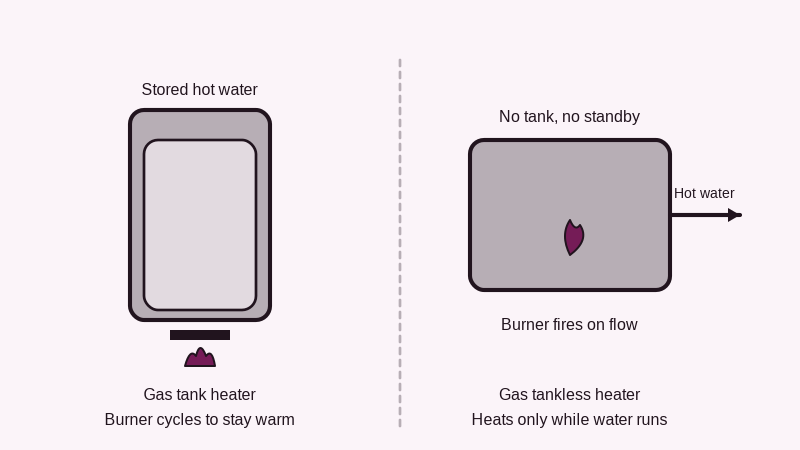
A gas tankless unit fires a large burner only while hot water is flowing, so it has no standby loss and can supply hot water without limit, but it needs a bigger gas supply and a more involved vent. A gas tank unit lights a smaller burner now and then to keep a reservoir warm, which makes it simpler and usually easier to install, at the cost of standby heat loss and a finite supply. Your gas pipe, vent route and habits decide which fits. For repair and replacement in general, see our water heater page.
This page leaves numbers out. Instead of one saving figure, you get the factors behind it, so you can test them against your own bill.
What do you gain and lose with each gas heater type?
Tankless gives endless hot water at a capped flow, frees floor space and avoids standby loss, but costs more to install and needs a larger gas line, vent changes and a yearly flush. A tank is simpler, cheaper to install and serves several taps together until its supply runs out, but it wastes heat and eventually rusts through.
The two compared in a table:
| Point | Gas tankless | Gas tank |
|---|---|---|
| Hot water availability | Nonstop, but capped by flow rate | Capped by tank size, then slow to recover |
| Standby heat loss | None | Some, around the clock |
| Gas supply | Often a bigger pipe and more meter capacity | The existing line often works |
| Venting | Condensing models use plastic vent | Metal flue or power vent |
| Footprint | Small, hangs on a wall | Large, stands on the floor |
| Upkeep | Descaling flush every year | Flush and anode rod checks |
| Typical expected life | Generally longer | Generally shorter |
Neither type wins in every house. For a small household with a compact garage, tankless often fits well. A big family with simultaneous showers and a tight gas supply may want a larger tank or a high-capacity tankless. How a gas tankless is installed covers the work in detail.
What energy savings can I expect from gas tankless?
Savings follow your hot water use. Low-use households gain more in percentage terms because tankless avoids standby loss, while heavy users see a narrower gap. To estimate, compare the rated efficiency on each model's EnergyGuide label with your own gas rate and daily use, then set the saving against the higher installed price.
Reason it through rather than chasing a single figure: standby loss is the heat a tank gives off through its walls every hour of the day. A tank in a heated garage loses less than one in a cold attic or open carport. Tankless avoids that, but it must warm cold incoming water in winter, which burns more fuel.
High-efficiency and condensing tanks exist too and narrow the gap. Get the efficiency number for the specific tank you are comparing, not an average one. Put both options on one sheet: model, efficiency, your gas rate and your estimated daily use.
Does tankless force a gas line upgrade?
Frequently. A gas tankless burner draws more gas at once than a tank burner, so the pipe size, run length and meter capacity must cope with the new unit plus everything else on the line, such as the furnace, stove and dryer. The plumber measures the line and sizes it from the manufacturer's table. Gas piping is regulated work for a contractor holding a California license.
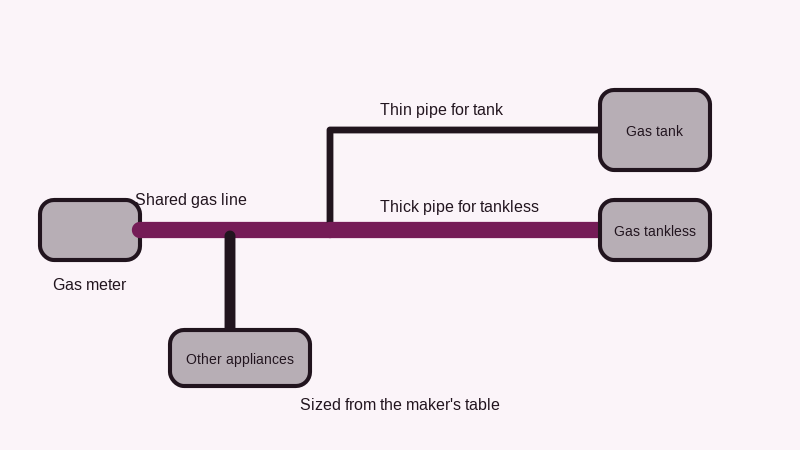
Older tract homes built in the 1950s to 1970s across Sylmar, Pacoima, Arleta and Mission Hills often have a short, narrow line feeding a garage tank heater. Going tankless can mean a larger pipe all the way back to the meter. That is a major reason for the higher install quote and worth raising early.
If your street has no gas service, ask about electric options instead. Your bill names your gas supplier; SoCalGas serves much of Southern California where service exists. If you ever smell gas, leave the building and reach 911 or your gas utility from outdoors. The page on the gas shutoff valve and earthquakes explains why you should know where your shutoff is.
Where do venting and air quality rules fit in?
Gas heaters must vent exhaust safely outdoors. A tank heater commonly uses a metal flue; a condensing tankless runs plastic vent through a wall or roof with set clearances. Poor venting can put carbon monoxide inside the house. On rules, the South Coast AQMD board chose in June 2025 not to amend Rules 1111 and 1121, so that process will not produce a zero-NOx mandate for water heaters.
The decision today therefore comes down to your own house. Rule 1111, as amended in 2023, stays in effect. Ask whoever quotes to confirm the model meets current local requirements.
Keep a carbon monoxide alarm near sleeping areas. Inspect gas appliances and vents if the alarm sounds or you notice soot, rust on the flue or a pilot that keeps going out.
When is a tank still the sensible pick?
A tank suits a tight budget, a gas line that cannot easily be upgraded, a wish to finish the swap in a few hours, a large household with many simultaneous showers, or plans to move out before long. A high-efficiency tank also narrows the running-cost gap.
In many rentals, replacing the tank is the practical choice for a landlord because it is a quick, like-for-like job. In Panorama City, Reseda and Canoga Park, where renting is common, that is often what happens. Tenants should report problems to the owner in writing.
Check the age of your current heater before deciding. Our guide to how often a heater needs replacing lists the warning signs. If the tank is leaking, repair is no longer the question.
How do the installation costs compare?
A tank swap is generally the smaller job, since the gas, vent and water connections already exist. A tankless installation adds a larger gas line, a vent, a condensate drain, power, mounting and often service valves. With no dollar figures here, use the tankless cost page to see the items, and compare the same lines on each quote.
Hard water adds a running cost to tankless: scale in the heat exchanger needs a yearly flush, and with a very hard supply a softener may deserve consideration. See LADWP's annual Drinking Water Quality Report, or your own district's, for hardness by supply. When you are ready, send a request and ask for both options to be priced.
Common questions
How long does switching from a tank to gas tankless take?
Typically a full day, sometimes two, since gas, vent and drain work come with the swap. A tank-for-tank job often takes a few hours. The plumber should give a time window and say when hot water will be off, so you can plan showers and laundry around it.
What do I ask before hiring an installer?
Ask for the model, rated flow, gas input, vent plan, condensate drain, permit handling and warranty on parts and labor. Ask whether the plumber holds a California contractor license you can verify on the state board's site, and whether the gas line size has been confirmed for your house.
Does an adult need to be home during installation?
An adult should be there to show the old heater, the gas shutoff and the planned location, approve changes to the quote and watch the new unit run. Clear the area around the heater beforehand, and mention pets, since gas and vent work keeps doors open.
Can tankless run short of hot water?
Not the way a tank does, though it can fall short if too many fixtures run together beyond the unit's flow rating. The cure is proper sizing at the quote stage. Tell the plumber your household size and number of bathrooms so the unit is matched to real use.
Is a gas tankless heater noisy, or hot to the touch?
The fan and burner sound much like a furnace while running, and the unit is usually wall mounted, so the noise depends on placement. The vent can get warm; the maker lists clearances. Ask where the unit and vent will go.
See the broader tank versus tankless guide for a second view, or return to Mission Point Plumbing.