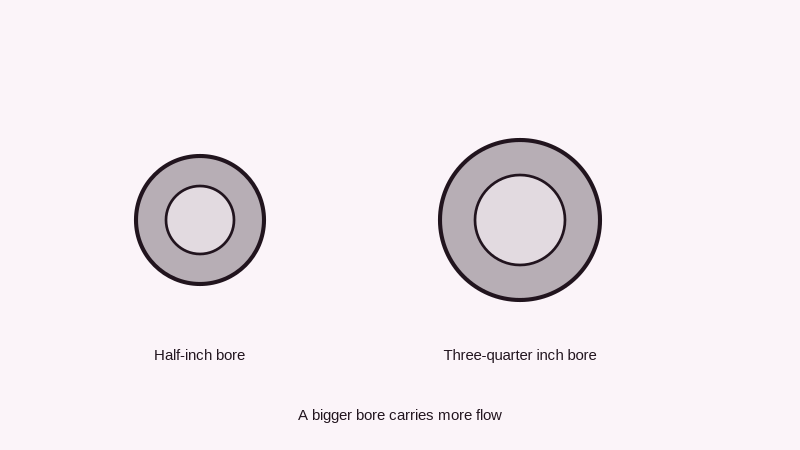
When people search this term, "1/2" refers to a pipe size. A half-inch regulator is built to thread or solder onto half-inch water pipe, and the valve ought to fit the pipe directly instead of being forced in through adapters. In many houses the main supply exceeds half an inch, so a half-inch unit tends to suit a smaller branch. If you are still diagnosing, begin with the broader low water pressure guide.
What does the 1/2 on a pressure regulator mean?
It gives the nominal size of the pipe connection, so the valve is meant to attach to half-inch pipe. It is no pressure rating, and it says nothing certain about how much water the valve passes. Nominal sizes are labels, not exact measurements, so check the pipe and the connection type, such as threaded, soldered or push-fit, before buying.
To read the pipe: copper is often stamped or carries a printed size, plastic tubing bears printed text, and a plumber can confirm with a tape or gauge in seconds. Threaded ends on the valve must match the thread type of the fittings, since a mismatch leaks.
Keep the connection size separate from the pressure setting. The setting is an independent adjustment on the valve, described in the water line regulator guide.
Is a half-inch regulator enough for the entire house?
Usually not, because the main line entering a house tends to be larger, and a smaller valve can hold back flow, producing a weak shower when several fixtures run. A half-inch unit suits a single branch, an irrigation line or a short feed to one appliance better. The plumber sizes the valve to the main line and the demand.
Why size matters: a valve restricts flow by design, and an undersized one chokes it at peak use. Pressure may hold at one tap yet collapse when the dishwasher and shower run together. Houses built from the 1950s to the 1970s across the north Valley can have mixed pipe sizes after decades of repairs, so measure instead of assuming.
If the whole-house supply is the question, the whole-house regulator page is the better place to start.
Where is a half-inch regulator the right fit?
It belongs on a branch needing its own pressure cap: an outdoor line, a drip irrigation feed, a single appliance such as the washing machine supply, or a bathroom group on a separate branch. In those spots it protects one run and does not affect the rest of the house. Whether the branch layout allows it is a question for the plumber.
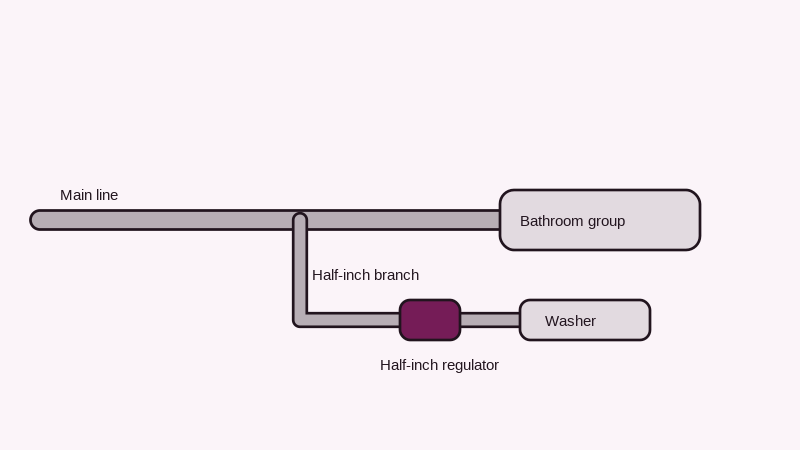
Typical uses:
- A hose or irrigation feed needing lower pressure than the house
- A small branch serving one bathroom or appliance
- A localized fix where only one area sees high pressure
For the washing machine case in particular, see washing machine pressure regulator.
How do I match the connection type?
Check three things: pipe size, pipe material and the end type on the valve. Threaded ends need matching thread standards, soldered ends suit copper and need a torch, and push-fit or compression ends suit certain pipe types and install more easily but not everywhere. If unsure, a plumber can fit the proper union or adapter.
Unions on both ends ease future replacement, since the valve can be unthreaded without cutting pipe. Request them if you are paying for the install anyway.
Never force a fitting that will not thread smoothly. Cross-threading ruins both parts and leaks under pressure.
Does a half-inch regulator need a permit or a plumber?
That depends on where it goes. Work on the main line normally calls for a plumber, and a permit may apply. Within the City of Los Angeles, permits are issued by the Department of Building and Safety, and the rule for replacing a regulator is unconfirmed here, so ask them or the plumber. A branch regulator on an easy-to-reach line is simpler but still means closing the water and testing.
LADWP serves most of these neighborhoods, and its water comes from a changing blend of sources. The fitting stays the same, though how quickly scale forms on the valve could shift.
To arrange a visit, send the quote form and a nearby plumber will be sent to size it. Service areas are listed on the Mission Point Plumbing front page. Costs appear in water pressure regulator cost.
What happens when the regulator is the wrong match?
An undersized valve starves fixtures at peak use, and wrong threads leak at the joint. A regulator fitted backward fails to regulate, because most carry an arrow on the body showing flow direction. Skipping a gauge leaves the setting a guess, which is how some houses end up with trickling showers or bursting hoses.
After any installation, run several taps together, check each connection for drips and note the gauge reading. If the reading climbs while nothing runs, the valve is not holding and needs rechecking.
Common questions
How long does installing a half-inch regulator take?
Where the branch line is easy to reach, expect a short job of around an hour, including shutting the water off and testing. A main line, corroded fittings or soldering add time. The written quote should give a time window and say when water will be off, so you can plan around the gap.
What should I ask before I hire a plumber to size a regulator?
Ask how the plumber will measure the pipe and the pressure, which size and connection is proposed and why, whether unions are included, and who deals with any permit. Look up the contractor's classification on the state licensing board's website, and ask for the findings in writing.
Can I use a half-inch regulator on a three-quarter-inch pipe?
Only with adapters, and the valve may then hold back flow when several fixtures run together. A regulator sized to the pipe it joins is the better choice. If a plumber suggests stepping down, ask what that does to flow at peak use.
What pressure should I set?
The right setting depends on the manufacturer's range and what your fixtures tolerate, and a gauge is the way to set it. No number is given here because none could be confirmed from an official source, so have the plumber take a gauge reading and name the target range.
Does someone need to be at the house during sizing?
An adult should be there to show the pipe, point out the shutoff and approve the work, because water is interrupted while the valve goes in. Tenants should tell the landlord first. Mention parking, pets and any locked utility area when you book.