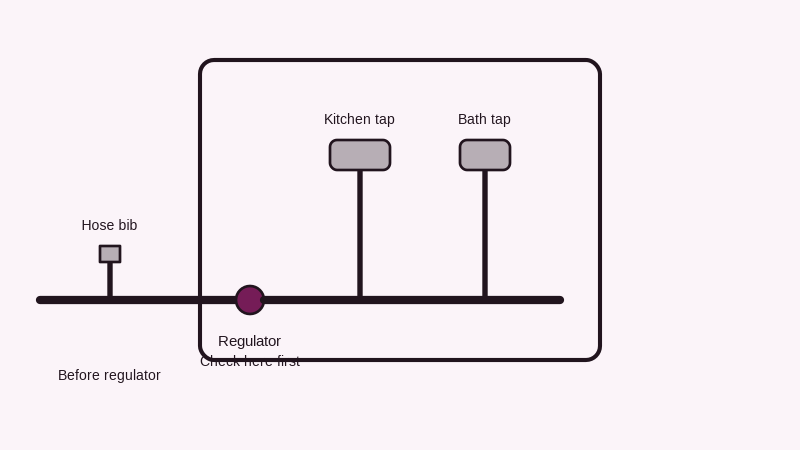
A sudden pressure loss at home usually traces to a main or meter valve left partway shut, a regulator that gave out, a leaking supply line, a utility repair or shutdown nearby, or a clogged fixture or pipe. Which one it is depends on whether all the taps are weak or only some. The low water pressure guide covers the broader subject, and this page deals with the sudden case.
Are all the taps weak, or only one?
Try several taps, hot and cold, upstairs and down. When every one is weak, the fault lies on the supply side: the street, the meter, the main shutoff, the pressure regulator or the main line. If a single tap is weak, the problem is local, typically a clogged aerator, cartridge or supply stop at that fixture.
A short test routine:
- Open the cold taps in the kitchen and bathroom, then a hose bib outside.
- Repeat with hot water.
- Run a shower and flush a toilet, and watch how each fills.
- Note which ones are weak.
How to read the results:
- All weak, hot and cold: supply side. Start with the main shutoff, then the regulator, then the street and the line.
- Only hot weak: the water heater, its valve or the hot pipes. See low hot water pressure.
- Only one fixture: the fixture itself. See a weak kitchen sink.
- Weak indoors, strong at the hose bib: often the regulator or a restriction inside, which the next question covers.
If pressure is down throughout the house and the meter keeps turning with everything off, suspect a leak. Run the meter test described in spotting a burst pipe underground.
Who do I contact when pressure drops?
Begin with your water supplier if neighbors report the same problem. If only your house is affected, send a request for a plumber, since regulators, valves and supply lines call for a contractor with the proper California license. The plumber reads the pressure on a gauge, finds the restriction and hands over a written quote before starting.
Describe the problem in the quote form: which taps are weak, whether it began suddenly, whether hose bibs are strong, any noise or leaks, and your meter test result. Requests are read on weekdays between 9am and 5pm. No emergency line exists here, so when water is flooding, shut the main valve before anything else.
California requires a contractor license when a job passes a small-job dollar threshold, and for any job needing a permit as well. A license can be verified on the CSLB website. The cap on deposits is 10 percent of the contract price, or a fixed ceiling if that is lower. For what a regulator job involves, see the regulator cost factors.
Go back to Mission Point Plumbing for the other services on offer.
Might the street, a repair or a leak be responsible?
Yes. A water main repair, a utility shutdown or a broken line near the meter can lower pressure for a whole block. Ask a neighbor and check your supplier's outage notices. If neighbors are fine and the meter runs with every tap closed, the leak is on your property or on the pipe running between the meter and the house.
According to its water quality report, LADWP supplies the City of Los Angeles neighborhoods in this area. The City of San Fernando runs its own water department, and La Crescenta is served by a separate district, so look at your bill to see who to contact. Asking your supplier settles whether the problem is outside.
Hillside homes see more pressure variation. Houses on the terraces in upper Sylmar sit at different elevations on one system, and pressure at a high-lying house may be lower to begin with. A change from your normal matters more than the number itself. For a reading, attach a pressure gauge to a hose bib; a plumber can take one too.
By the EPA's estimate, the average home loses over 9,300 gallons of water yearly to leaks, and a hidden supply leak can cut pressure while also pushing up your bill. If your bill has jumped, read a rising bill with nothing visibly leaking.
Signs of a break: wet soil near the meter, the sound of rushing water, a meter dial that moves while all taps are shut. Close the main valve, then send the details to a plumber.
Can cold weather lower water pressure?
It can, when a pipe freezes, but freezing is rare in Sylmar and the north Valley, so cold is an unlikely cause here. Low pressure in cold or wet weather more often comes from a leak that has opened, a failed regulator, or a change in demand on the street. Rule out the other causes first.
When a pipe has frozen, the sign is no water or a trickle at one fixture, with an exposed or uninsulated pipe nearby, such as on an outside wall or a hose bib line. In the foothill areas, like Sunland, Tujunga and La Crescenta, nights can be colder than on the valley floor, so exposed lines deserve a look. Never use open flame to thaw a pipe.
Demand changes with the season as well. When it is hot, neighbors irrigate and street pressure dips at peak hours. If the low pressure follows the time of day, it probably comes from the street. Check the flow in the early morning.
For a sudden drop in cold weather, check what you would at any other time: meter test, regulator, valves and fixtures.
What causes weak flow indoors when the outdoor tap is fine?
A strong hose bib paired with weak indoor taps means something between the line and the indoor fixtures is choking the flow: a valve that is half closed, a failing pressure regulator, a stretch of clogged or corroded pipe, or a blocked filter or softener. Some outdoor lines branch off before the regulator, so they can seem stronger.
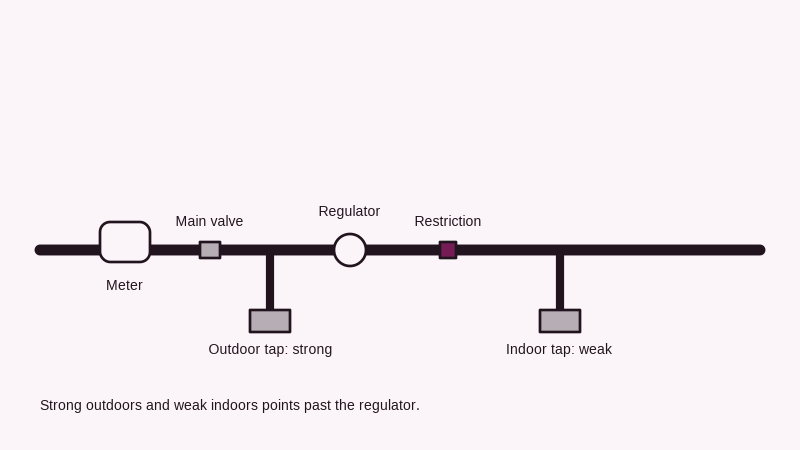
Look at the usual suspects.
Pressure regulator. Look for a brass valve shaped like a bell, fitted to the main line close to the point of entry. A failing regulator can drop pressure suddenly. The page on where the pressure regulator is located shows how to find it, and pressure regulator replacement explains the repair.
Valves. The main shutoff may be only partly open, especially after someone worked on the plumbing, a meter reader visited or a repair was made. A gate valve can also fail inside its handle so that it will not open fully. Open it all the way, slowly.
Filter or softener. A whole-house filter that needs a new cartridge, or a softener stuck in regeneration, chokes the flow. Look for a bypass valve.
Old pipe. Galvanized steel narrows as rust builds up over decades, and pressure falls gradually, not suddenly, but a loose chip of scale can block it all at once. Many tract homes in the north Valley were built between the 1950s and the 1970s, and some still have galvanized lines. See replacing galvanized pipe.
A banging sound in the pipes, known as water hammer, can accompany a failing regulator. See water hammer.
Common questions
What made my water pressure fall so suddenly?
Common causes: a failed regulator, a half-closed valve, a supply leak, utility work or a clogged filter. Check whether all taps are weak and whether neighbors are affected, and do the meter test with every tap shut. The results point toward the street, the valves or a leak.
Can a leak reduce water pressure?
Yes. When a supply line leaks, water escapes before reaching your taps, which lowers pressure, and it also raises your bill. A meter dial that moves while everything is off suggests you have one. Close the main and bring in a plumber to locate it.
How do I measure the water pressure in my house?
Fit a pressure gauge to an outdoor hose bib, halt all other water use and read the dial. Take readings at different times of day. A plumber can do this too. Do not rely on feel alone, because a gauge gives a number you can compare over time.
Does low pressure damage plumbing?
Low pressure alone rarely does harm, though its cause might. A leak can flood, a failing regulator can later let pressure spike, and a clogged line may mean old pipe. Watch for banging pipes or leaks, and have the cause found.
Is it necessary to replace the regulator?
If it has failed, yes. Signs include pressure running too low or too high, banging pipes and an aging regulator. A plumber can check it on a gauge and say whether it is the cause. Readings taken before and after the swap show whether it made a difference. See pressure regulator replacement for what the work involves.