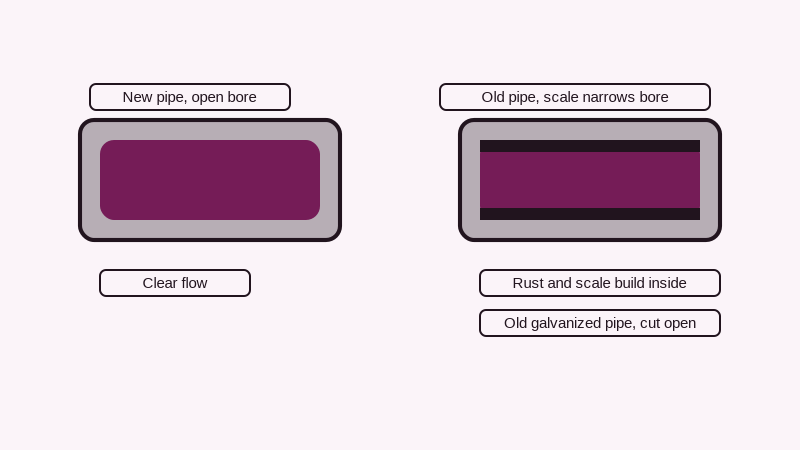
Four things account for most bursts: metal that has corroded from the inside, water pressure set higher than the pipes can comfortably hold, freezing, and movement in the ground or the structure. Joints and fittings fail more often than straight pipe, and a leak that nobody noticed usually comes first. Below, the causes are ranked by how often they turn up in north Valley houses. Prefer the overview of how requests get handled? Visit Mission Point Plumbing.
What actually wears a pipe down until it fails?
Corrosion is the most common cause in older houses, followed by excess pressure, freezing, shifting ground and worn joints. Most of these work slowly: a pipe thins from inside, a fitting weakens, and one ordinary pressure surge finishes it. The burst feels sudden, though the failure was decades in the making.
Metal is the first suspect in a tract house from the 1950s to the 1970s. Galvanized steel rusts inward, shrinking the bore until deposits and weakness meet. Copper can develop pinholes where water chemistry or flow speed eats at it. Both can look fine outside while the wall is thin within.
Pressure comes next. Supply pressure set too high leans on every fitting, hardest at joints, braided hoses and the heater connections. One regulator by the main shields them all, which is why whole-house pressure regulators belong in any burst-prevention talk.
Then there are the physical factors: tree roots against a service line, a heavy vehicle over a shallow pipe, a settling slab, an earthquake. The 1971 San Fernando earthquake left Sylmar residents without water and gas, and the 1994 Northridge quake started fires that burned over 70 homes, so structural movement is part of local history, not just theory.
Why would frost matter in Los Angeles at all?
Water expands as it turns to ice. A sealed pipe cannot absorb that, so the ice squeezes the water trapped behind it, and the pressure splits the pipe, often somewhere other than where the ice sits. The split usually reveals itself when the ice thaws and flow resumes.
The valley floor seldom stays below freezing for long, so frost damage is a rarer story in these neighborhoods than back east. Foothill pockets are different: upper Sylmar's terraces climb from roughly 1,100 to 1,700 feet, and Sunland and Tujunga sit higher still. On a clear, still night an uninsulated line along an exterior wall, in an attic or at a hose bib can drop below freezing.
Prevention is cheap. Cover outdoor spigots, insulate exposed runs and let a faucet trickle on the coldest nights. The full checklist is under preventing burst pipes.
Thawing needs patience. Coax a frozen line open with a damp, warm rag, or low heat from a dryer, never a flame, and leave the tap open so meltwater has an exit. If a section has already split, close the main before the ice melts.
Do pipes really burst in the heat of summer?
They do, and in this climate summer failures probably outnumber frozen ones. The causes are pressure surges, heat-driven expansion in a closed system, corrosion that finally gives way, irrigation lines that crack, and stress from soil that dries and shrinks around a pipe. Water heaters running hot can also push pressure up.
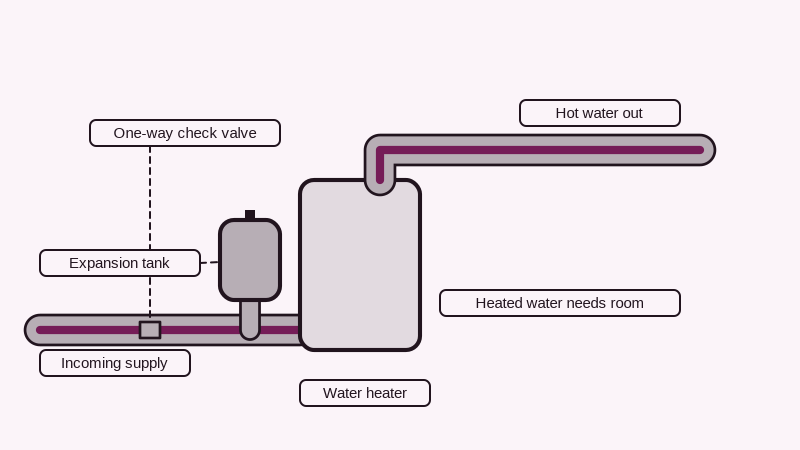
Closed systems are the trap. When a one-way valve sits on the incoming line, the extra volume from a heating tank has no way back out, and pressure creeps up each cycle. An expansion tank gives it room, so a plumber swapping a heater may raise the subject; see expansion tank replacement.
Slopes add physics. Static pressure climbs the further a house sits below the supply source, so a lower-lying lot can show high readings with nothing faulty at all. A regulator keeps that in range.
Which warning signs come before a burst?
Look for stained or bubbling paint, a musty smell, damp spots on walls and floors, a water meter that creeps while the house is quiet, falling pressure and banging pipes. Each can mean a slow leak, and a slow leak can precede a split, so find the source before it fails outright.
A one-hour experiment settles it. With nothing in the house using water, jot down the meter reading, leave, and compare when you are back. If the figure has moved, water is slipping away somewhere. To put it in perspective, the EPA says the average household loses more than 9,300 gallons of water a year through leaks.
Ceilings talk too. Look for a tan ring, a bulge, or a drip under a bathroom. Ceiling leak signs shows each in turn, while a stain with no plumbing overhead is the subject of water spots with no leak.
A leak hidden in a concrete floor is a different challenge; read slab leak detection and repair. Acoustic and pressure testing can locate it so less of the house gets opened, and leak detection costs describes how that work is priced.
What happens next if you suspect a burst?
Turn off the house supply, let the pipes empty through a downstairs faucet, snap some photos, and move plugs and cords out of the damp. Then submit the request a quote form, which a local plumber business picks up; what comes after is explained in how a job runs.
Should the water refuse to stop, reach your water utility (LADWP in most City of Los Angeles neighborhoods up here), or contact 911 when power or flooding is dangerous. Requests on this site are looked at weekdays, 9am to 5pm, so it is no emergency line.
Common questions
Are older pipes the usual casualties?
Mostly, since metal thins and joints tire with age. New pipe still fails when pressure runs high or a joint was badly made, though. Galvanized steel and certain older plastics are well-known weak spots. Age combined with pressure is worse than either, and a plumber can test for both.
Does a burst always flood the house in one go?
Rarely. Plenty begin as a spray or seep inside a wall and run for days unnoticed. Others open up in a crawl space or beneath concrete and surface later as a strange water bill. Look for stains, soft drywall, musty odors and a meter that never rests.
Can a weeping pipe be mended ahead of a burst?
Often, and cheaper than waiting. A failing section or corroded fitting can be replaced, and where corrosion is widespread, new pipe for the whole run may be the saner plan. Ask for an inspection or leak test first so the scope matches the real fault.
What does sudden low pressure point to?
Usually a break or leak further along the line, a valve that is only partly open, a regulator that has worn out, or a problem upstream at the utility. Ask a neighbor if theirs is down too, and repeat the meter experiment above; if the reading moves, assume a leak.