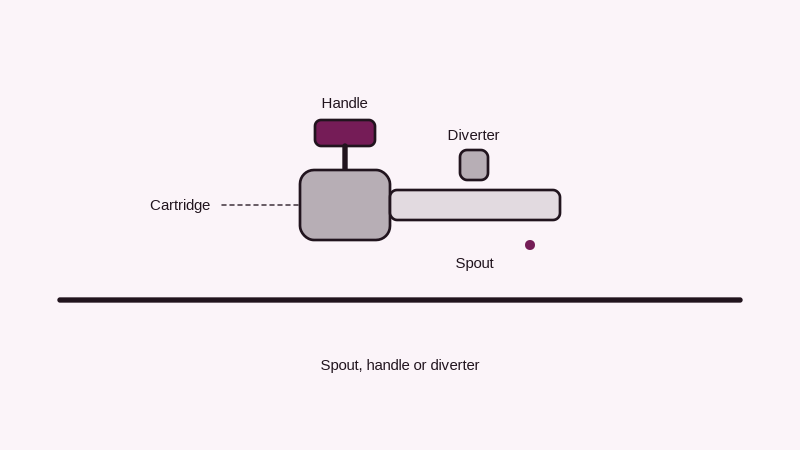
Begin by pinning down where the water shows up. A spout that drips with the faucet closed points to a worn washer, seat or cartridge within the valve. Dampness at the handle means tired packing or a failing O-ring. Water still pouring from the spout once the shower diverter is lifted shows that the diverter has worn. A wet wall or ceiling under the bath indicates a leaking connection, which is plumber territory. This guide sits within the wider sink, shower and disposal topics and leaves out anything the law restricts to contractors.
Before touching anything, shut off the water. Many tubs have no stop valve of their own, so you may need to close the main. Put a plug in the drain so a dropped screw cannot disappear.
Where exactly is my tub faucet leaking?
Note where the moisture sits: the spout, the handle, the base of the spout or a damp wall. A dripping spout points to the valve seat or cartridge. A leaking handle means the packing or a stem O-ring has given out. Where the spout meets the wall, suspect that connection. A damp wall or ceiling suggests a failed supply fitting or a faulty shower valve.
Try a quick test: dry the faucet, let the tub run for a minute, switch it off and watch for the first bead. If the shower head sprays while the tub is filling, the diverter is not sealing. Drips that appear only on hot mean the hot side is failing.
A sink-side drip follows the same logic, covered in how to fix a leaky bathroom faucet. One more rule of thumb: if only one handle is involved, the fault is on that side. A single-handle valve has one cartridge and so one source, whereas two handles mean two. See the guides to a two-handle leaky faucet and a single-handle leaky faucet.
How do I repair a spout that drips?
Close the water supply, then lift off the handle by prying up its cap and removing the screw beneath. Next unscrew the trim and then the stem or cartridge. A two-handle faucet needs a new rubber washer and seat, while a single-handle one needs an identical cartridge. Put everything back in reverse order, reopen the water slowly and test. Bring the worn part to the store so the replacement matches.
Compression faucet routine:
- Plug the drain and shut off the water.
- Pop off the decorative cap and take out the screw beneath it.
- Pull the handle free, then unthread the escutcheon.
- Unscrew the packing nut and lift the stem out.
- Fit a new washer on the stem end, and change the seat as well if the old one feels rough.
- Reassemble and let the water return to a trickle.
If the stem will not unscrew, the valve body is stuck or corroded. Stop there and consult a plumber, since forcing it may crack a pipe inside the wall.
Cartridge faucets depend on the brand. Note the make on the escutcheon and sketch the shape of the old cartridge. A wrong one will leak.
What if water leaks around the handle?
A leak at the handle usually traces to worn packing or a perished stem O-ring. Remove the handle and turn the packing nut roughly a quarter turn. If seepage continues, install an O-ring or packing washer of identical size, lightly greased. Avoid overtightening, since the handle has to turn freely.
If tightening achieves nothing, check the stem for scoring or corrosion; a damaged stem is replaced whole. Old brass stems in 1950s to 1970s houses may be worn smooth after decades. In hard water areas, mineral buildup can lock a stem in place, and soaking the removed parts in vinegar helps.
To judge hardness, read the annual Drinking Water Quality Report from LADWP or your own district. Scale shortens the life of washers and cartridges. For safe ways to clean fixtures, see removing hard water scale.
Why does the tub spout keep running when the shower is on?
Suspect the diverter, the small valve or pull-up knob that routes water up to the showerhead. As it wears, some flow keeps escaping through the spout. A spout-mounted diverter, raised by a knob on top, is the easiest kind to replace: unscrew the spout and fit a new one. An in-wall diverter needs a plumber.
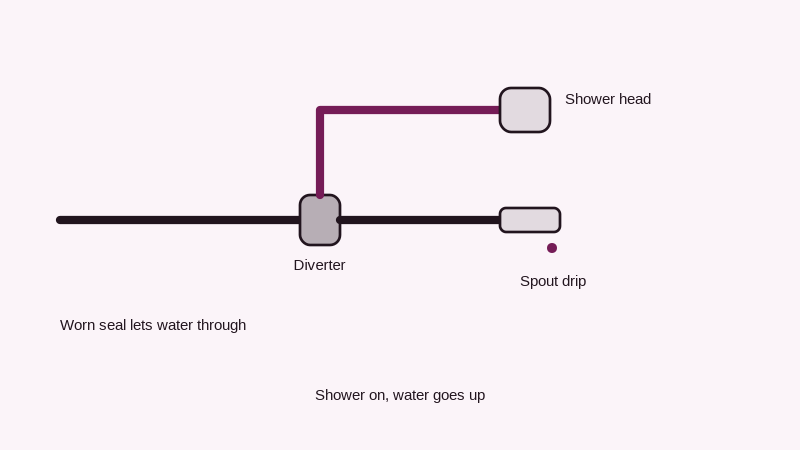
Feel beneath the spout for a tiny set screw, or turn the spout counterclockwise. Many slip-on spouts hold on with a set screw, removed with an Allen key. Before shopping, measure the pipe length and note the thread and spout type. A threaded spout needs Teflon tape around its threads.
When the diverter is part of a wall valve, replacing it means opening the wall around the trim. A plumber can do that and inspect the rest of the valve in the same visit. For the shower side, see the page on a leaky shower faucet.
Is a dripping tub faucet really wasting water?
Yes. A steady drip adds up across a day and then a month. EPA data show household leaks averaging upward of 9,300 gallons annually, and dripping fixtures are a common source. A hot drip wastes energy too. Next to the lost water and the staining, the repair is cheap.
Look for a rust or mineral streak in the tub where the drip lands, and compare recent water bills. If the drip refuses to stop, shut the main before leaving home for a long stretch, and arrange a visit.
When should a plumber take over?
Hand it over if the shutoff will not close, the stem or cartridge will not budge, water has reached the wall or ceiling, the pipes are old corroded galvanized steel, or the drip survived your repair. Replacing the valve body means opening the wall. Gas or permit work falls to a contractor who has a California license.
Water coming through the ceiling under a bathroom signals a bigger leak. Read about a shower or tub leak to see what that involves. Use the quote form to share the faucet make, the symptom, photos and what you tried. Mission Point Plumbing forwards the details to a nearby plumbing company, which sends someone to inspect and write the quote. Messages get read on weekdays from 9am to 5pm.
Renters ought to notify the landlord in writing. California makes the owner responsible for plumbing repairs in the building, which matters in renter-heavy areas such as Panorama City. Every other service on offer is listed back on Mission Point Plumbing.
Common questions
How much time should fixing a tub faucet take?
Changing a washer or cartridge can be done in about an hour, sometimes less, provided the supply is shut and the right part is ready. A stuck stem, corroded valve or wall leak adds time. The plumber should offer a time window and say whether the scope changes once the valve is opened.
What should I ask a plumber before work starts?
Request a written quote that itemizes parts, labor and any wall access, plus what a warranty covers. Verify the contractor license with California's state board using its online lookup, and ask what happens should the drip come back, before you agree to let work begin.
Must someone be home while the faucet is repaired?
Yes. An adult should be home to show the bathroom, the shutoff and the symptom, sign off on any change to the quote and see the faucet working at the end. Clear the tub area and take items off its edge beforehand so there is space to work.
Can I keep using the tub while the faucet drips?
Mostly yes, though an ignored drip can stain the tub and waste water. If water is escaping within the wall or ceiling, stop using that bath and close its supply. Moisture trapped behind a wall can damage framing and encourage mold, so it is worth acting quickly.
Why is the faucet dripping again after I fixed it?
Usual reasons are a washer or cartridge that is the wrong match, a scratched seat, an overtightened stem or a part not fully seated. Take the part out and compare it against the original. If it still drips after a second attempt, have a plumber inspect the valve body.