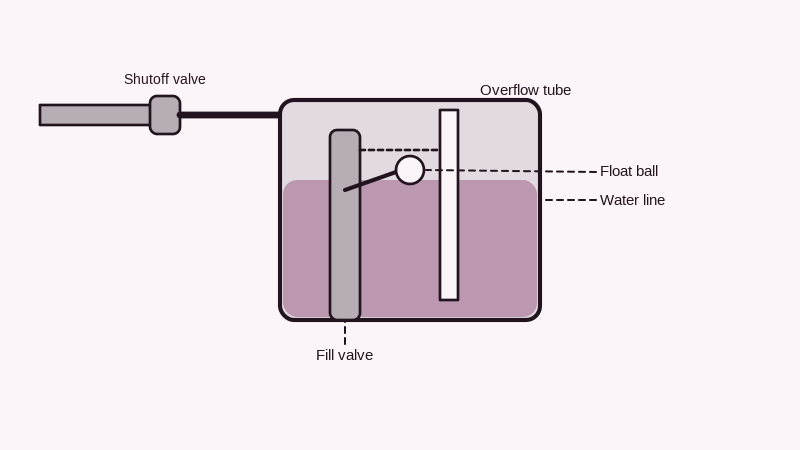
In most toilets the fill valve is the upright stem-and-float unit at the tank's left side. When it jams, ages or stops sealing, water trickles in constantly or the tank refills sluggishly. Across most California homes the swap is a modest job needing ordinary tools. Rather hand it off? The quote form reaches local plumbers, and the Mission Point home page links related guides.
What are the warning signs of a failing fill valve?
Common symptoms are a hiss after flushing, water trickling down the overflow tube, a tank that refills slowly, a toilet that refills itself every few minutes, and a squeal or knock during filling. Lift the lid: if water pours into the overflow pipe, the valve has stopped shutting off.
Run these checks in this order:
- Remove the tank lid and observe the water level once the flush ends.
- If water creeps above the line marked on the overflow pipe, the valve leaks through.
- When the level stays low yet the flapper seems fine, the valve may be gummed up or stuck.
- If the tank drains by itself and nothing hisses at the top, suspect the flapper.
A slow refill may also stem from a half-open supply valve or a clogged screen at the valve inlet. To find silent leaks, the EPA recommends a dye test: add food coloring to the tank, wait about ten minutes, and see whether color reaches the bowl, which points to a leaking flapper or seat. See also toilet keeps running.
What do I need to buy or bring?
Gather a bucket, a sponge or towel, an adjustable wrench or pliers, and a replacement fill valve matching your tank. Most universal valves suit common tanks and adjust in height. Carry the old valve to the shop, or photograph it, and replace the supply line as well if it looks old or crusty.
Shopping notes:
- Choose a valve that lists your tank style and adjusts to its height.
- A fresh braided supply line is inexpensive insurance against a burst connector down the road.
- Should the tank be coming off anyway, also renew the bolts and gaskets that join tank and bowl.
- Check whether yours is a one-piece model or a very small tank; some require one particular valve.
What are the steps to swap the fill valve?
Shut the supply valve, flush until the tank is nearly empty, and sponge out what remains. Disconnect the supply line, remove the nut beneath the tank, then lift out the old valve. Set the new one at the right height, snug the nut by hand with a slight extra turn, reconnect the line and refill. Then look for drips and set the level.
Here are the steps:
- Rotate the wall shutoff clockwise until snug.
- Hold the flush handle down until nearly all water is gone, then sponge up the remainder.
- Place the bucket beneath the tank and undo the coupling nut joining supply line and valve.
- Undo the locknut beneath the tank and slide the valve out.
- Insert the new valve with its base on the tank floor and adjust the height per the manufacturer's instructions.
- Tighten the locknut by hand, then add one small extra turn; excess force cracks porcelain.
- Reattach the supply line and clip the refill tube onto the overflow tube.
- Slowly open the shutoff and inspect every joint for drips.
Quit if the tank wobbles or the shutoff refuses to close. A seized shutoff calls for a plumber, as does cracked porcelain. Replacing a toilet shutoff valve deals with that part.
How do I adjust the water level and stop hissing?
Adjust the float so the water stops about an inch below the top of the overflow tube, or at the fill line the manufacturer marks in the tank. Flush, see where the level settles, and keep tweaking until it holds. If the level sits too high, water spills down the overflow and is wasted.
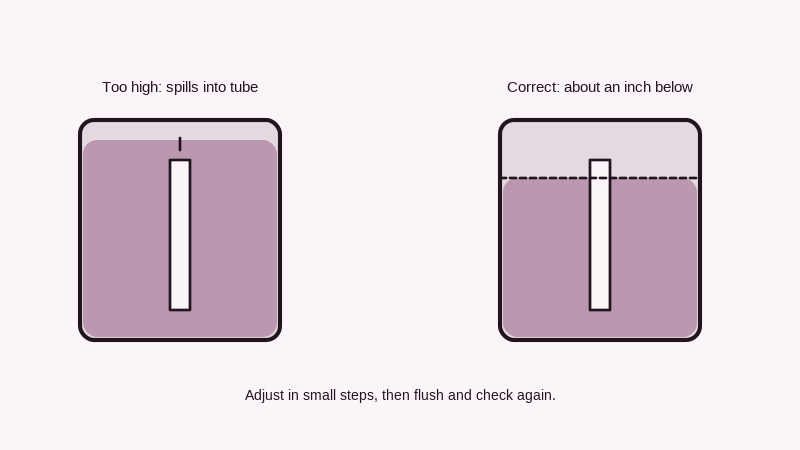
Most valves adjust via a screw on top or a clip that slides along the rod; turn a little at a time. If hissing persists with the level correct, debris may sit beneath the seal. Remove the cap and let water run into a cup to flush it out, following the manufacturer's directions. Still hissing? The new valve might be defective, or house pressure might be high. If noise comes from all the fixtures, read about water pressure regulators.
Is the flapper or a gasket actually to blame?
A worn flapper or flush valve gasket lets tank water seep into the bowl, so the fill valve has to keep topping up the tank, and the symptoms look alike. Replace the flapper if it is warped, sticky or hard, and replace the gasket if water weeps around the base of the flush valve or the tank-to-bowl bolts.
Quick tests:
- Push the flapper down firmly; if the running stops, replace it.
- Dry the tank's underside and look for droplets at the bolts, a sign of a tired tank-to-bowl gasket.
- A chain that is too short props the flapper open, while one with excess slack may snag beneath it.
These parts cost little, but older ones can be an odd size. Bring the old part along when shopping, or see toilet flapper repair and overflow tube repair.
What should I do when a supply line or tank splits open?
A burst supply line is the toilet fault that cannot wait. Shut the wall valve, falling back on the main if the shutoff fails, then mop up. Swap out a cracked braided or plastic line, a split tank or a cracked bowl. When water emerges from the wall or floor instead of the toilet, handle it as a pipe leak.
Signs that a line is nearly done include rust on the connector, a damp spot beneath the nut, a bulging braided sleeve and water stains on the floor. Replace such a line before it fails. If flooring has soaked, dry it quickly and check the ceiling below for a stain. For leaks that do not begin at the toilet, see spotting a burst pipe.
When should a plumber take over?
Bring in a plumber if the shutoff will not close, the supply pipe inside the wall leaks, the tank or bowl is cracked, house water pressure runs unusually high, or the toilet keeps running after a new valve. Jobs that need a permit are restricted to California contractors.
During the visit, the plumber also checks the wax seal, the flange and the supply line. For other toilet trouble, toilet repair covers flush problems.
Common questions
How long does it take to replace a fill valve?
Under an hour for most replacements, provided the new part and the tools are at hand. Allow extra time if the shutoff is stuck, the nuts are corroded or the supply line also needs replacing. Plan on that toilet being out of use for a short while.
Is it safe to swap the valve with the water still on?
No. Since the tank refills through the valve, close the wall shutoff first. If that shutoff will not turn off, close the main and have a plumber do the replacement. Never force a stuck valve, as it can snap and flood the bathroom floor.
Is it worth replacing the flapper in the same visit?
Usually. A worn fill valve tends to come with a worn flapper, and both parts are inexpensive. Replacing the pair together saves a second round of troubleshooting and a second trip to shut off the water. Once finished, check the length of the chain.
Why does the toilet still fill slowly with the new valve?
Make sure the shutoff is fully open, the supply line has no kink, the inlet screen on the valve is clean and the height is correct. Low pressure in the house could also be the reason. If every fixture runs slowly, the toilet itself is not the cause.
Does a running toilet really waste a lot of water?
It does. The EPA reports that an average home loses more than 9,300 gallons yearly to leaks, and a running toilet is one of the usual causes. A silent leak never appears on the floor, only on the bill, so fixing the cause stops that loss.