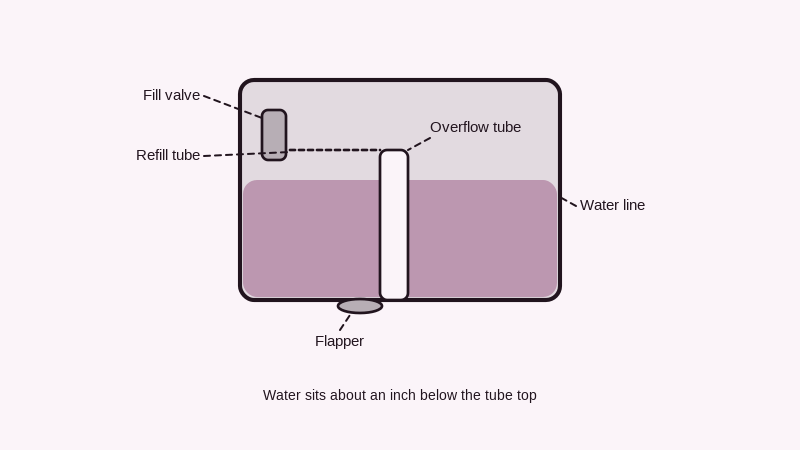
Before any fix, work out whether the tube is even the culprit. Usually the water is set too high and spills over the top, and you correct that by adjusting the fill valve. A cracked tube, or one of the wrong height, gets replaced during a flush valve repair. The home page at Mission Point Plumbing lists other jobs we arrange.
What is the overflow tube in a toilet for?
The open vertical pipe stands in the middle of the tank next to the flapper. If the fill valve fails to close, surplus water runs down that pipe into the bowl rather than onto the floor. That is its whole job: keeping a stuck valve from flooding the bathroom.
A small flexible refill tube from the fill valve clips onto the top of the overflow tube and trickles water into it to refill the bowl after a flush. People often puzzle over that tube, yet it is meant to be there.
On many toilets the overflow tube is part of the flush valve, a single piece that also holds the flapper seat at the bottom. A cracked tube normally calls for a new flush valve, so a "tube repair" often turns into a flush valve replacement.
Hissing, or a toilet that runs while water goes down the tube, tells you the level is too high or the fill valve will not close. A toilet that leaks into the bowl while the water stays below the top of the tube is usually a flapper problem. Work out which one you have before buying parts.
When does the overflow tube itself need replacing?
Replace the tube when it is cracked, split, corroded, loose in the tank bottom, or set at the wrong height for the new fill valve. Most are replaced together with the flush valve, which is a single assembly. That means draining the tank, taking it out of the bowl or at least off the tank bolts and fitting a new seal.
Signs the tube is at fault: water pours out of a visible crack, the toilet runs even with the level correctly set and a good flapper, there is mineral damage around the base of the tube, or the tube moves when you touch it.
Some people cut an overflow tube shorter to lower the level. That is a poor shortcut. A short tube changes where the safety overflow sits and can leave the flapper seat and tube out of step. If the water must be lower, adjust the fill valve.
A flush valve swap means draining the tank, disconnecting the supply line, removing the tank bolts, hoisting off the tank, changing the valve and resealing everything. Over-tightening can crack porcelain, so many homeowners hire a plumber. If the toilet is old, ask whether a new toilet makes more sense. The page on flush repair may help with that decision.
Toilets in 1950s to 1970s north Valley homes can be older than the replacement parts on the shelf, and tanks sometimes have a style of flush valve that is hard to match. Carry the old part along, or send photos and the brand and model from inside the tank.
When is it time to bring in a plumber?
Do it if the tube is cracked, the running continues after the level and valve are right, the tank must be lifted off, the base leaks, or you rent and the owner has to approve the work. A single visit can cover the flush valve, the supply valve and the connections.
Describe in your request what you found: where the water goes, the level, what you tried, the brand if legible, and photos of the tank interior. Say whether the valve beneath the toilet works, since a seized one adds work. See toilet shutoff valve repair.
A contractor license is required in California when a job exceeds a small-job dollar threshold, and for any job involving a permit. Look the license up on the CSLB site, and ask for the quote in writing ahead of the work. Requests arriving through the quote form are reviewed on weekdays between 9am and 5pm.
How do I lower the water level so it stops spilling over?
Use the fill valve's adjustment to bring the level down; depending on the type, that means a screw at the top, a rod-mounted clip or a float you slide along the shaft. Flush and confirm the water stops roughly an inch short of the tube's rim. Small changes work best, so adjust a little and flush again.
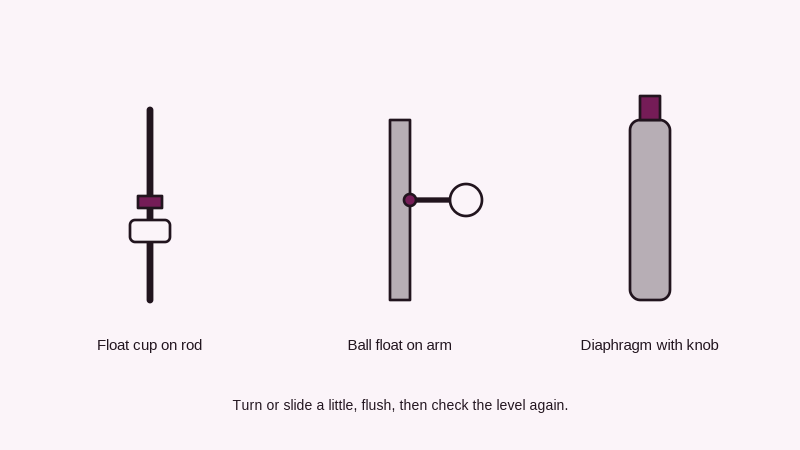
By type of fill valve:
- Float cup on a rod. Pinch the clip and move the cup lower on the rod, or turn the adjustment screw on top.
- Ball float on an arm. Bend the arm slightly downward, or turn the screw at the valve.
- Diaphragm style. Turn the adjustment screw or knob at the valve's top counterclockwise to lower it, following the instructions that came with it.
When a lower level does not end the flow, the fill valve itself may be worn or dirty. Debris can stop the seal closing. Close the water at the toilet's supply valve, flush, then clean or replace the valve. See fixing a toilet fill valve and inlet valve repair for the steps.
Also check the small refill tube. It should end above the water line, resting on the lip of the overflow tube, and not pushed down inside it. If it dips under the water, it can siphon and cause a run. Trim or reposition it.
If the toilet still runs, work through toilet keeps running or toilet won't stop running, which list other causes.
How do I tell whether water is going down the overflow tube?
Lift off the tank lid and watch. Water pouring into the open top of the tube means the level is too high or the valve will not shut off. If the level sits well below the tube and the toilet still runs, the flapper is the culprit. A few drops of food coloring in the tank will confirm it.
The sequence:
- Lift the lid and set it down gently.
- Check the water level. Most tanks have a mark, and the usual rule is a level roughly an inch under the tube top, though the tank's own mark or manual wins.
- Flush and watch the fill. When the tank is full, the valve should stop.
- If water keeps trickling into the tube, the valve is failing to close or the level is set too high.
- If the water is below the tube top and the toilet still runs, stir in some food coloring and leave the tank alone for about ten minutes, no flushing. Color in the bowl means the flapper leaks, which the EPA says is a common silent leak.
The EPA advises inspecting toilet flappers from time to time and replacing them at least every five years. A running toilet can use a great deal of water, and the EPA puts average household losses at more than 9,300 gallons a year.
Puddles around the base are a different problem, covered by plumber for toilet leak.
Common questions
What does it mean when water flows into the overflow tube?
Two causes are possible: the level is high enough that water spills over the top, or the fill valve never closes. Lower the level with the valve's adjustment, then flush and observe. If water keeps entering the tube, the fill valve is worn or dirty, and cleaning or replacing it should stop the flow.
What is the right water level relative to the overflow tube?
Many tanks carry a water line marked inside, and many guides put the target near an inch short of the top of the tube. Follow your tank's own mark or the manual. Too high wastes water through the tube, and too low can weaken the flush. Adjust in small steps and flush each time.
Can I cut the overflow tube shorter?
It is not a good idea. The tube is a safety overflow and part of the flush valve, and cutting it changes where overflow starts and can upset the flapper seat. The correct fix for a high water level is to adjust the fill valve. If the tube is the wrong height for a new valve, replace the flush valve.
What is the small tube that goes into the overflow tube?
That is the refill line coming off the fill valve. After every flush it routes a small stream down the overflow tube into the bowl so the trap fills again. It should clip to the top of the tube and stay above the water level. Pushed down inside, it can siphon water and keep the toilet running.
Is a running toilet worth fixing right away?
Yes. Water drains away day and night while a toilet runs, and the EPA estimates leaks cost a typical household over 9,300 gallons per year. Adjusting the level, or swapping the flapper or fill valve, is often a simple repair. Start with the dye test to learn which part is failing.