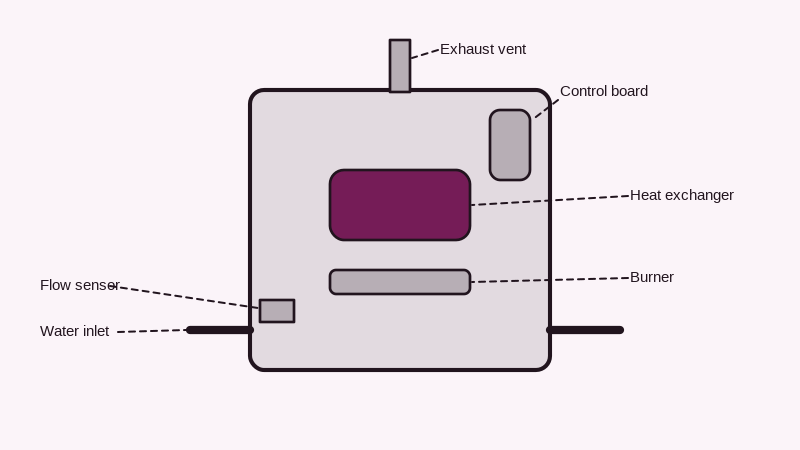
On this page, instant water heater repair means fixing a tankless unit, the kind that heats water only while a tap is open. When one stops giving hot water, the fault nearly always lies in one of five places: the water flow, the gas or power supply, a sensor, the vent, or scale inside the heat exchanger. For the wider picture on tanks and tankless units, start at our water heaters page. The Mission Point Plumbing home page lists the rest of what we arrange.
What does repairing an instant heater involve at home?
The task is to find out why a tankless unit is not heating and fix the part that failed. There is no tank, so hot water is made on demand, and faults show up as cold water, water that goes cold partway through, an error code or a unit that will not start. A plumber reads the code and tests the likely cause. A few checks are yours to do.
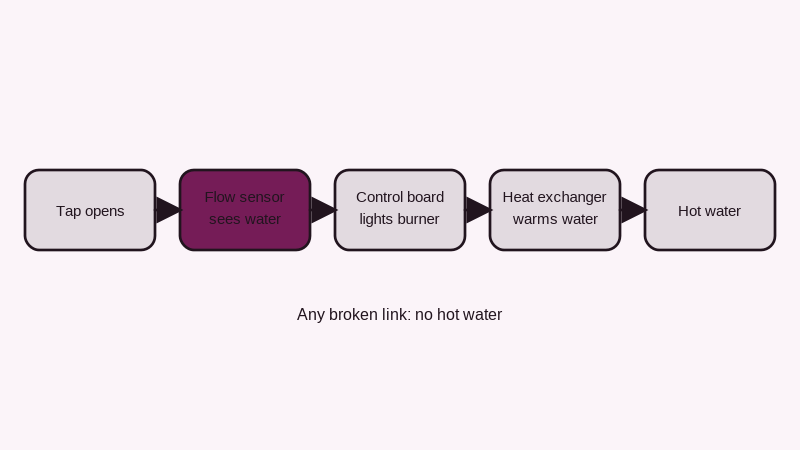
An instant, tankless or on-demand heater contains a burner (gas) or elements (electric), a heat exchanger, a water flow sensor, a control board and, on gas models, a vent. When a tap opens, the flow sensor tells the board to light the burner. Anything that breaks that chain, from low flow to a dirty flame sensor, ends the hot water.
In north Valley homes, tankless units are often chosen to free garage or closet space or to cut energy bills. Their water comes from a blend of sources that differs by street, according to LADWP's published reporting, and the minerals in it build up inside the heat exchanger over time. For hardness where you live, read LADWP's yearly Drinking Water Quality Report, or your own district's. We state no hardness figure here because we have not verified one.
The most common faults, roughly in order:
Scale in the heat exchanger. Minerals narrow the passages, so the unit overheats and shuts off or delivers less hot water. A descaling flush, done by the plumber or by you if the manual allows, often cures it. Many manufacturers advise flushing regularly.
Error codes. Every brand has a code list in the manual. A code for ignition failure, flame loss, overheating, a flow problem or a blocked exhaust points the plumber to the right part.
Low flow. Open one tap only a little and some units never fire, because the flow falls below their minimum. Clogged inlet filters or a half-closed valve do the same.
Cold water sandwich. You get hot water, then a slug of cold, then hot again. The unit shuts off briefly and restarts, and the cause is most often flow or a sensor.
Ventilation and gas supply. A blocked vent, a closed gas valve or a gas line too small for the unit can each cause shutdowns.
Brand pages go deeper: the Navien page, the Rinnai page, the Noritz page and the Rheem page.
What should I do first?
Begin by writing down the error code, plus the brand and model from the data plate. Check the basics: power on, gas valve open, inlet water valve open, filter clean. Then turn the unit off and on once. If the fault returns, stop and arrange a plumber. Never open sealed parts, vents or gas connections yourself.
Here is a safe checklist to run through before you send a request.
- Does any other tap run hot? If a bathroom tap works and the kitchen one does not, the unit is probably fine and the fault is a tap, a cartridge or a crossed line. Our page on no hot water at the kitchen sink explains.
- Is the unit displaying a code or a light? Look it up in the manual, which often says whether the user can reset it.
- Is it electric? Check the breaker. Many electric tankless models need large breakers, and a tripped one looks like a dead unit.
- Is it gas? See whether other gas appliances work. If none do, the supply may be the issue, and you should stop trying to light anything.
- Do you smell gas? Leave the building at once and contact 911 or your gas utility from outside. Operate no switches. Gas piping and connections are regulated work and belong to a contractor with the right California license.
- Has the unit been flushed in the last year? If not, scale is a likely cause.
If the water is scalding, lower the temperature setting. Tankless units can deliver very hot water quickly, so check the setting before anyone showers.
Our guide on why you might have no hot water has a broader checklist, tank models included.
At what point do I ask for a plumber?
Ask for one when the unit shows a code that comes back after a reset, when you smell gas, when water leaks from the unit or its connections, when the flame keeps going out, or when descaling is needed and you lack the equipment. Put the brand, model, code and what you tried into the quote form.
A plumber from nearby can test the flame sensor, inspect the exhaust, flush the heat exchanger with the right pump and descaler, and replace a flow sensor or board if required. Some repairs need brand-specific parts. If the unit is old and the part is costly, ask for a replacement quote too. Our pages on tankless replacement cost and tankless installation cost explain the drivers without quoting figures.
Comparing tankless with a tank before you decide to replace? Tank versus tankless sets out the trade-offs. For a gas model, our gas tankless installation page gives a plain account of the gas side.
Common questions
How much time does an instant heater repair need?
A descaling flush or sensor swap often fits within a single visit of about two hours. A repair that needs a special part can take longer if the plumber has to order it. A venting or gas fix may need an inspection. The written quote should say how long the visit is expected to last.
What do I ask before hiring someone for a tankless repair?
Ask whether the plumber has worked on your brand, whether the quote is written and itemized, what the diagnosis covers, whether parts are new and whether gas or electrical work is involved. California requires a contractor license for any job that needs a permit, so ask for the license number. Ask what happens if the part is unavailable.
Must I be at home during the repair?
Someone should be there to open access to the unit and shutoff valves, and to confirm hot water at the taps when the work ends. The plumber may need to cut power, water or gas for a while. If you cannot attend, settle the details beforehand and send a trusted adult in your place.
Is it worth repairing a tankless heater?
Often yes, because many tankless units are built to last, and common faults such as scale or a sensor cost little to fix compared with replacement. It stops making sense when the heat exchanger itself is damaged, or the unit is old and failing in several places. Ask the plumber to quote repair and replacement together.
Can scale harm a tankless water heater?
Yes. Mineral scale narrows heat exchanger passages, causing overheating, error codes and lower flow. Flushing regularly, as the maker advises, helps prevent it. If your water is on the hard side, a yearly check is worthwhile. Read your water supplier's quality report for your area, and ask the plumber about a flush schedule.