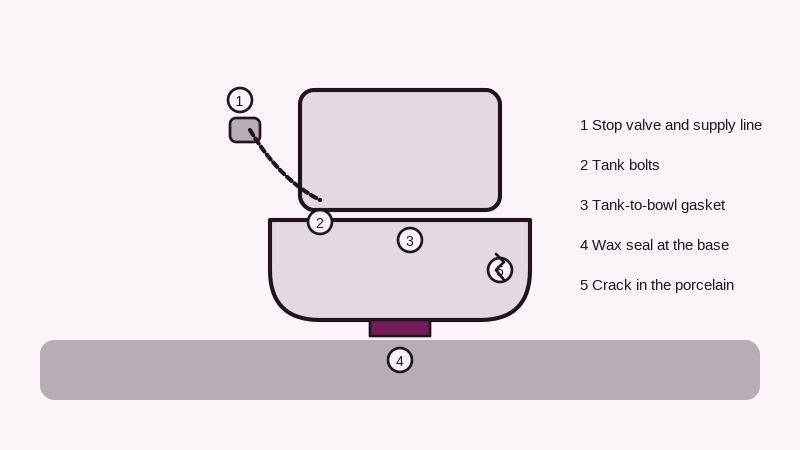
The plumber who takes this job works out where the water is getting out, most often the supply connection, the tank-to-bowl bolts, the seal beneath the bowl or a crack, and then repairs or replaces that part. Begin by rotating the toilet's stop valve clockwise so no fresh water arrives. After that, describe what you see in the quote form. Other jobs arranged for homes across the north San Fernando Valley are listed on the Mission Point Plumbing home page.
Where is the toilet leak coming from?
Five sources account for most cases: the supply line and stop valve, the tank bolts, the tank-to-bowl gasket, the base seal (the wax ring) and a crack in the porcelain. The place where the water appears gives it away. Water at the wall suggests the supply, drips beneath the tank suggest the bolts, and a puddle around the base suggests the seal.
Dry the toilet, supply line and floor with a towel, then lay strips of toilet paper around the base and the connections. Wait, flush once and see which strip gets wet first. That easy test narrows things down.
Water at the wall or under the tank on the left. The stop valve or flexible supply line is leaking. Tighten the nuts no more than a quarter turn. A cracked or corroded line has to be replaced, and a seized stop valve is best left to a plumber.
Drips from under the tank. The tank bolts and their rubber washers are worn, or the big gasket between tank and bowl has failed. Replace the washers and gasket, or the bolts.
Water around the base when you flush. The wax ring or a rubber seal has failed, or the toilet has come loose. A toilet that rocks is often the first warning. If the floor around it feels soft or the vinyl lifts, water may have damaged what is underneath.
Sweating tank. Moisture on the outside of the tank on warm days is condensation, not a leak. Wipe it off. In a cold room, fitting an insulating tank liner or a mixing valve can help.
Hairline crack, in the bowl or tank. A crack means a new bowl or tank, because repair compounds do not last.
Water in the bowl draining away. That is not a floor leak but a running toilet. See toilets that keep running and toilet flappers for that one; a running toilet can waste a lot of water. According to the EPA, typical household leaks lose more than 9,300 gallons of water each year.
What is the first thing to do when a toilet begins to leak?
Rotate the stop valve at the back clockwise to cut off the water, mop the floor and keep towels around the base. Do not flush. When the valve will not close, shut the main water valve to the house instead. For an upstairs toilet, check the ceiling below. Once that is done, send the details to a plumber.
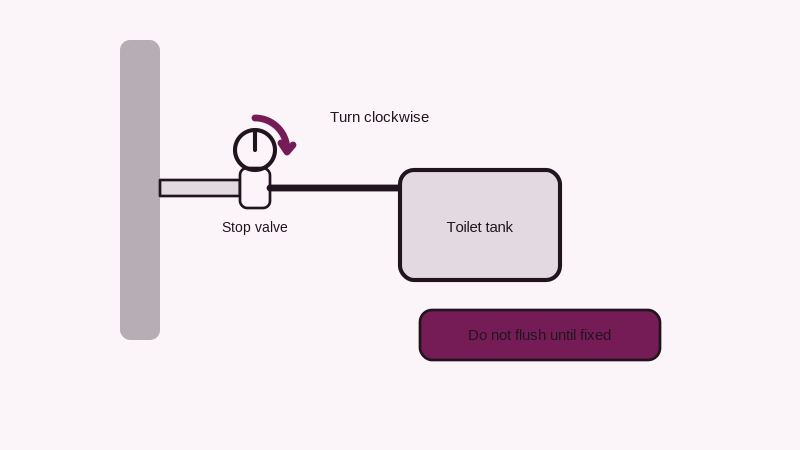
Follow this order:
- Twist the stop valve behind the toilet clockwise as far as it goes.
- Should it refuse to turn, or water keep arriving, close the main shutoff for the whole house. Find it before you need it.
- Mop and dry the floor. Standing water can soak into flooring, subfloor and walls.
- Ventilate the bathroom and move rugs and cardboard out of the way.
- With an upstairs leak, check the ceiling underneath for stains; signs are described under water leaking through a ceiling.
- Photograph the leak and any damage, since the pictures help the plumber and, if needed, an insurance claim.
Leave any outlets the water touched alone. Cut that circuit at the panel solely when it is safe to reach, and ask an electrician. Do not use the toilet again until it is fixed.
Which toilet leaks are fine to fix on my own?
Tightening a loose supply nut, swapping a flexible supply line, replacing tank bolt washers and changing a worn flapper are all within reach. Stop if the stop valve is seized, the base seal has failed or the bowl is cracked. Those jobs involve a heavy fixture and a sewer seal, and a poorly done one leaks again, often out of sight.
Easy repairs to attempt: close the stop valve, flush so the tank empties and sponge out what is left. For a supply line, undo the nuts, fit a new braided line cut to the proper length, and snug the nuts finger tight plus one more quarter turn. For the tank bolts, loosen them from underneath and swap the rubber washers. Related pages cover a toilet fill valve, a toilet inlet valve and a toilet shut-off valve.
To change the wax ring, lift the toilet off the floor flange, scrape off the old wax and set the toilet back down. It is heavy, and the flange can be broken or rusted. A wobbly seat is a separate problem from a loose toilet, handled in fixing a loose toilet seat.
At what point do I need a plumber?
Request one when the source stays hidden, the stop valve is seized, water appears at the base, the floor feels soft, a crack shows, or the leak returns after your repair. Water that leaks unseen can rot a subfloor, so a plumber's visit costs less than the damage.
In many north Valley homes built from the 1950s to the 1970s, the shutoff valves and supply lines are original. They are often stiff, corroded or both. Forcing a seized valve can break it and make the leak worse. A plumber replaces valve and line together, which makes sense in an older house.
Replacing the toilet is sometimes a better choice than repairing it, especially for a cracked or very old one. The page on what replacing a toilet costs explains the price drivers in words. A toilet that is blocked as well as leaking is covered under help with a clogged toilet.
Hard water can leave scale on valves and stiffen them. LADWP supplies much of the north Valley, with water from a blend of sources that differs by street. Check LADWP's yearly Drinking Water Quality Report, or your own supplier's, for hardness. We have not verified a figure.
Common questions
How much time does a toilet leak repair take?
Fixing a supply line or bolt washer usually wraps up inside an hour, whereas a wax ring replacement can run an hour or two, since the toilet has to be lifted and set again. A damaged floor flange or rotten subfloor adds time. Have the expected duration written on the quote to plan the day.
Which questions go to a plumber before hiring for a toilet leak?
Confirm the quote is written and itemized, which part is replaced and why, whether new supply lines and stop valves come with it, and what happens if floor damage turns up. Where a permit is needed, check the license number with the Contractors State License Board.
Must I be present for the repair?
An adult needs to be there to point out the leak, open up the bathroom and confirm that the floor stays dry after a test flush. The plumber will shut off the water to the toilet, or the house, for a short time. If the day does not suit, rebook rather than leave the work unexplained.
Does a leaking toilet count as an emergency?
Sometimes. Floor water can ruin flooring and ceilings beneath, and a leak you cannot stop is urgent. Close the stop valve, or the main valve, and mop up. A slow drip is less urgent, yet it grows, so repair it soon. The details can go in through the quote form.
Will a leaking toilet raise my water bill?
A leak into the bowl, such as from a bad flapper, can waste water without any puddle, and the bill may climb. A floor leak wastes water too, though you spot it sooner. Drop a little food coloring into the tank and watch whether color reaches the bowl without flushing.