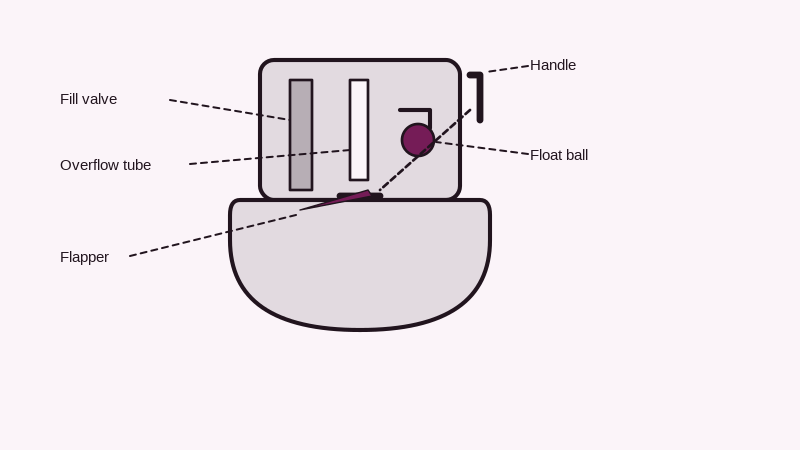
Remove the tank lid and observe for a minute. Water trickling into the overflow tube points to the fill valve or the float. If the tank refills itself every so often with no flush, the flapper is worn. A handle that sticks or hangs slack means a lever, chain or arm fault. Note which one you see, then read that section. Our home page links more toilet guides, and the quote form opens a request.
Which parts make a toilet run continuously?
Running means water keeps flowing, either from the tank down into the bowl or from the supply line up into the tank. Four culprits cover nearly every case: a tired flapper, a fill valve stuck open, a float adjusted too high, and a chain or handle that props the flapper up. Each one gives off a visible clue within about a minute.
Match what you observe to the likely cause:
- Water runs down the overflow tube: the float sits too high, or the fill valve is on its way out.
- The tank tops up now and then with no flush: the flapper leaks, which people call a ghost flush.
- After a flush the flapper will not drop back: the chain is too short or tangled, or the handle arm is jammed.
- A steady hiss while the level looks normal: the fill valve is worn or gritty.
Check, too, that the wall shutoff is wide open, because a partly closed valve slows refilling until it sounds like running. Toilet keeps running takes a different route through the same fault.
How do I check the flapper?
Close the wall valve to cut the water, then lift the flapper and wipe a finger across its seat. A flapper that feels slimy, warped, cracked or soft needs replacing. Clean off any crust or nick on the seat too. Switch the water back on and press the flapper down by hand; if the running stops, it was not sealing.
Chlorine, minerals and age break flappers down. Swapping one takes minutes, and because the part comes in several standard sizes, carry the worn one to the shop to compare. Keep a link or two of slack in the chain, which lets the flapper seat completely. Toilet flapper repair goes further.
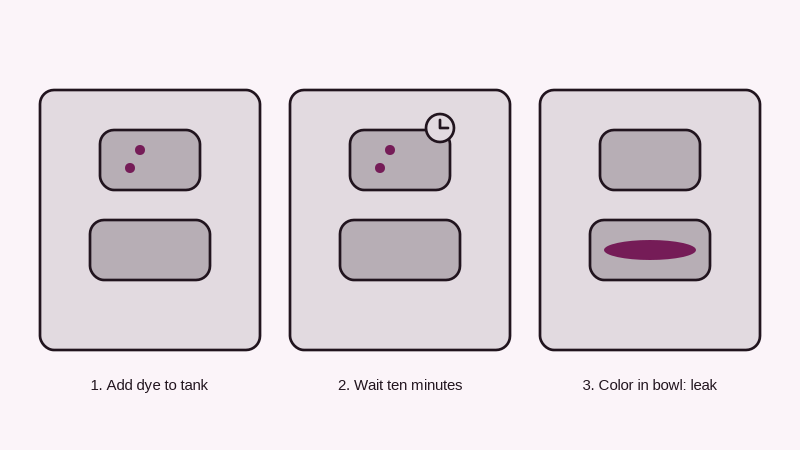
Silent leaks show up with a dye check. Add a little food coloring to the tank water, leave it roughly ten minutes without flushing, then look in the bowl. The EPA describes this test. Colored bowl water proves leakage past the flapper, and flushing straight away avoids stains.
What should I do when the fill valve or float misbehaves?
If water climbs to the rim of the overflow tube and keeps arriving, the valve is failing to shut. Lower the float until the level rests about an inch below the tube. When that adjustment makes no difference, grit may be lodged under the seal, or the valve is spent and must be replaced.
Cleaning the valve while a little water spurts into a cup often rinses out grit. Replacing it is a small job: shut the water, drain the tank, loosen the supply line and locknut, install the new valve and reattach. Full steps are in replacing the fill valve step by step. A cracked or loose overflow tube is covered in overflow tube repair.
What if the flush handle sticks or does nothing?
A handle that is loose, sticky or ineffective typically has a chain that came off or tangled, a worn arm or a slack mounting nut. Open the lid, see where the chain connects, hook it back at the right length and snug the handle nut. A cracked arm means replacing the full handle.
Go through it in order:
- Remove the lid and push the handle. Does the lever arm travel?
- When it travels but the flapper stays put, the chain is unhooked or overlong.
- When the handle feels dead, the nut inside the tank may have loosened. Hold it steady and tighten.
- For a sticky handle, clean the pivot and make sure the arm is not scraping the tank wall.
- Allow a link or two of play in the chain.
Many toilets use reverse-threaded handle nuts, so turn them the other way if they resist. If the issue is a weak flush rather than a failing handle, the cause differs: see toilet flush repair.
Will a toilet that keeps running push up my water bill?
Yes. Water slipping from tank to bowl flows day and night, quietly or noisily, and the meter counts every gallon. A leak that goes on for several days can lift the bill noticeably, though the amount depends on your rates and how large the leak is.
Across a typical home, leaks add up to more than 9,300 gallons of wasted water yearly, says the EPA, and toilets are a common source. To check whether the toilet is to blame, repeat the dye test, then try a meter test: note the reading, avoid using water for two hours, and read it again. If the dial moved and the toilet is your only suspect, shut its supply and test once more. A dial that stays put means you found it.
Bill high but no leak visible? Try why the bill runs so high and an unexplained high bill with no visible leak.
At what point should I hire a plumber?
Hire a plumber if the shutoff valve refuses to close, the tank or bowl is cracked, water seeps where the toilet meets the floor or wall, parts for an older model are no longer made, or it starts running again after a new flapper and valve. Pipework inside the wall also belongs to a plumber.
Trouble beyond the tank looks like a toilet that rocks, a damp floor around its base (from a failed wax seal or a supply line) or pressure so high that every fixture is noisy. Homes from the 1950s to the 1970s often still have the original shutoff valve, which can seize, so never force it. The plumber can replace it, and how a shutoff valve gets repaired explains the process.
Common questions
What causes a toilet to run briefly at random?
That short burst is a ghost flush. A flapper with a slight leak lets water creep out of the tank, so the fill valve tops it up again. Swap the flapper, clean the seat and look at the chain's slack. Should the burst persist, test the fill valve and examine the overflow tube for cracks.
Is it okay to leave a running toilet until the weekend?
For a day or two, closing the wall valve will stop it. Do not leave it running unattended, because it wastes water and pushes the bill up. A modest fix such as a new flapper is quick, so tackling it early costs little time or effort.
Can I fix a toilet that runs by myself?
Mostly, yes. Flappers, chains, floats and fill valves are standard parts that fit with basic hand tools, and a typical repair takes one short sitting. Hand it to a plumber if the wall valve is stuck open, the porcelain is cracked or water collects around the base.
How do I know which part to buy?
Inspect the old part and the tank brand, if one is printed there. Flappers come in standard sizes, so measure the flush valve opening or carry the old one into a store. Fill valves are often adjustable. When unsure, a photo helps the shop assistant pick the correct part.
Does a running toilet always mean there is a leak?
Almost always. Once the tank has refilled, any water that keeps moving is escaping somewhere, whether down past the flapper or into the overflow tube. Refilling after a flush is normal; water that keeps going by itself is not, and the cause needs tracing.