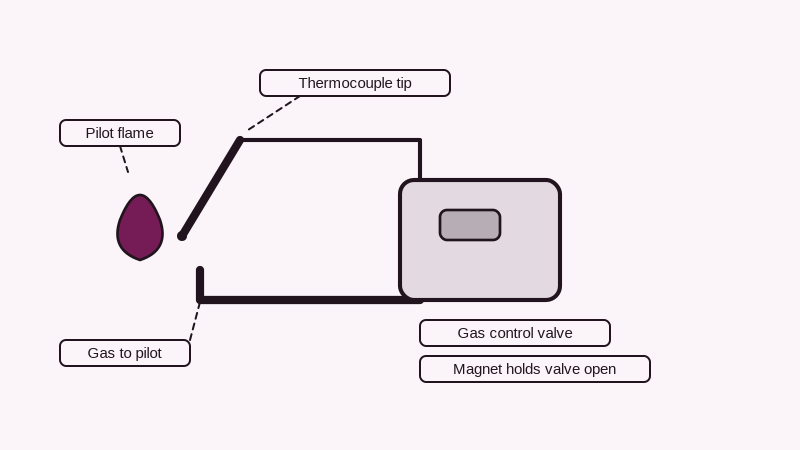
Picture the morning routine: you press the red button on the gas control, the pilot catches, you hold it down, count to sixty, let go, and the flame vanishes. That pattern almost always names the thermocouple, a short copper-tipped rod that sits inside the pilot's flame. Below: its job, a way to prove it is guilty, the swap itself, and the moment to stop. It belongs to our broader set of water heater repair guides.
What is a thermocouple and why does a gas heater need one?
It is a heat-driven switch that proves the pilot is alive. Heat on its tip makes a trickle of electricity, just enough to keep a small electromagnet inside the gas control energized. Lose the flame and the trickle stops; the magnet drops, the valve snaps shut, and raw fuel never floods the closet.
The tip lives in fire, so it ages. Soot, a weak flame, a draft down the flue or a tired control valve can all keep it from reaching the heat it needs. Of all the small parts on a tank heater, it is the one that most often explains an evening of cold showers.
Plenty of heaters have no such part. Newer gas tanks may light electronically or use a thermopile, and tankless models use an ignitor with a flame sensor instead of a lit pilot. A unit with a glowing ignition button or a display full of error codes is a different animal; for that family, see the page on Rinnai tankless heater faults.
When does a thermocouple job belong to a plumber?
Hand it over when the closet is cramped, the flame looks wrong after the new part, the pilot still quits, you notice any gas odor, or the control valve itself seems suspect. A plumber checks valve, venting and combustion air, then judges if the tank deserves more money.
Put the model, location and behavior into the request a quote form; photos of the label and of the burner area save a round of questions. For a tank that is dead and cannot wait, emergency heater repair shows what to expect, and Mission Point Plumbing explains how jobs are arranged.
Look around the tank as well. A blocked flue, paint cans stacked against it or poor airflow can defeat any new part, so keep the area clear.
Is swapping a thermocouple a reasonable DIY repair?
For many owners, yes. It unscrews from the gas control and slides free beside the pilot, and universal replacements are inexpensive. Gas piping, the control valve and the vent are different: California requires a contractor license for that work, and for any job that needs a permit, so pass those to a professional.
The sequence, briefly. Turn the control to off and wait for everything to cool. Shut the gas cock that feeds the heater. Take off the burner door. Back out the nut at the control, free the clip near the pilot, slide the old rod out and seat the new one so its tip sits in the flame. Snug the nut a quarter turn beyond finger tight, then relight as the tank's label instructs.
Brush soapy water over the fitting rather than striking a match near it; growing bubbles mean gas. Should you ever detect gas, move everyone outside, touch no switches, and reach SoCalGas at 1-800-427-2200 from outdoors, or use 911 if the danger is immediate.
A heater that is leaking, crusty at the burner or well into its second decade may not deserve new parts at all. In that case, weigh replacing the heater against repair, and read how long a heater typically lasts first.
What symptoms suggest a bad thermocouple?
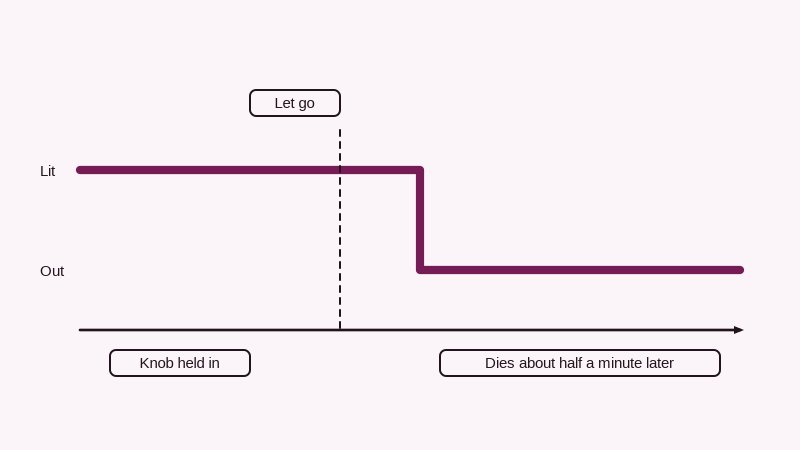
The giveaway: the pilot burns only while the knob is held in, then dies about half a minute after you let go. A lazy yellow flame, soot on the probe and hot water that comes in fits back this up. A strong blue pilot that still quits makes the probe the prime suspect.
Eliminate lookalikes first. A gust through the vent, a clogged pilot orifice, a dirty burner tray or a failing gas valve can mimic the same behavior. A quick clean of the pilot area costs nothing and sometimes ends the problem.
A multimeter set to millivolts can settle the question. Hold the pilot lit, clip the leads across the probe and read the number; a sound thermocouple gives a steady reading, and a weak one falls short. Makers publish their own thresholds, so use the manual for your model.
Unsure the pilot is even the issue? Our rundown of cold-shower causes lists the usual suspects, and another page handles the heater that fires but never warms.
Common questions
What is a typical thermocouple lifespan?
No fixed number applies. Some run for many years, while others die quickly when the pilot burns poorly or dirt accumulates. If a new one fails within months, look for the root cause rather than fitting another: a feeble flame, a draft, or a control valve that is wearing out.
Can a thermocouple and a thermopile be swapped for one another?
No. A thermocouple is a single junction giving a small voltage that holds the valve open. A thermopile stacks several junctions for a larger output that can drive controls. They look alike but behave differently, so buy the part that matches the heater's model number.
What if the thermocouple is left failing?
The pilot keeps quitting and hot water keeps disappearing. The shutoff is doing its job, but repeated relighting is a nuisance, and it carries some risk if gas lingers before a light. Treat constant pilot trouble as a cue to repair or replace instead of coping.
Does a tankless heater use one?
Rarely. Tankless units generally ignite electronically and watch the flame with a sensor, so an ignition or flame error implicates a different component altogether. A burner that never lights, or a display code about the flame, points to the sensor or ignitor rather than a probe. Brand pages such as Noritz tankless faults cover the typical failures.