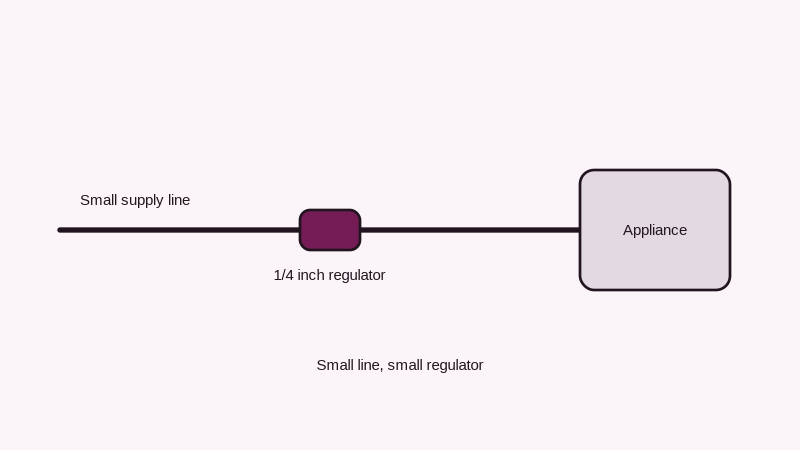
A quarter-inch water pressure regulator serves narrow, low-flow lines such as an ice maker feed, a drip line or a small treatment system. For the pipe feeding a house, which is much larger, it is far too small. If your whole home has pressure trouble, the fix is a full-size regulator at the main, covered under low water pressure in Sylmar. This page is about the small one.
What is a quarter-inch pressure regulator for?
Its job is to hold down pressure in a small line. Typical uses are the tubing to a refrigerator ice maker or water dispenser, a drip irrigation line, a small reverse osmosis or filter setup, or a lab or hobby line. The size refers to the connection and the flow it can pass, which is small.
Because the opening is narrow, the regulator can pass only a limited flow, which suits one small appliance. If you put it on a line that feeds several fixtures, flow drops hard and everything downstream feels weak. Check the maker's flow rating before using one. If the line is a pipe in the wall, ask a plumber, since sizing and the type of connection matter.
Can a quarter-inch regulator handle a whole house?
No. The main line into a house is normally much larger, and a quarter-inch regulator would restrict flow to a trickle. Whole-house regulators are sized to the main, commonly in the range of 3/4 inch to 1 inch, but the plumber confirms the size on your pipe.
One regulator on the main covers every fixture, the water heater and the washer together. Where house pressure runs high, read about whole-house pressure regulators. To find an existing one, read where the regulator is located. To judge the cost, our page on regulator cost drivers lists what to compare.
Which signs of high pressure send people looking for a regulator?
Typical signs: banging pipes, a toilet that keeps refilling, a dripping relief valve, appliances that wear out early, hoses that bulge and fixtures that spray. A gauge confirms it. Measure first, since each of these signs can have other causes too.
Screw a gauge onto an outdoor hose bib, open the valve with every other tap off, and read the dial. Check that number against the working range given in your water heater and washer manuals. Pressure can differ from house to house, and the Sylmar area is served mostly by LADWP from a blend of sources, so your own gauge is more useful than any general figure. For the noise problem on its own, read water hammer sound.
Where do small regulators go in a home?
Small regulators go close to the thing they protect, at the appliance, on the tubing or in the drip line, and most are brass or plastic with a screw adjustment or a preset value. They need the arrow on the body to point the way the water flows.
Examples are an ice maker line behind the fridge, a filter system under the sink or a garden drip kit at the hose bib. If the line is plastic tubing, the fitting type matters: compression, barbed or push-in. Match it to the tubing. If a leak develops at the fitting, shut off the supply and tighten or replace it. A kitchen line that has low flow for other reasons is covered in a weak kitchen sink.
What problems can a small regulator have?
It can clog with sediment, leak at the fittings, be installed backwards, be set too low or be undersized for the flow you need. A small regulator with a fine screen clogs easily if the line carries grit, and flow falls.
If flow drops after you add one, check the arrow, the setting and any screen, and clean it. If it was installed on the wrong line, remove it. A regulator is a wearing part and gives problems with age. When it is unclear whether the part or the street supply is to blame, a plumber measures pressure before and after it.
Does a plumber need to fit it, and what about permits?
Fitting a small regulator at an appliance is a hand-tool job for many owners. One on the main or inside a wall is plumbing work and may require a permit. In the City of Los Angeles the Department of Building and Safety issues permits, so confirm for your address.
California demands a contractor license once work passes a modest value, and every time a permit is needed. If you hire help, ask for the license number and a quote in writing. To arrange a visit, fill in the quote form at Mission Point Plumbing. Requests are read on weekdays, 9am to 5pm, then handed to a local plumber who visits.
What if my pressure is too low, not too high?
A regulator only reduces pressure, so it cannot fix a weak supply. Weak pressure has other sources: a half-closed valve, a clogged aerator, narrowed pipe, a leak, a regulator set too low or a problem in the street. Measure with a gauge, then work through the causes.
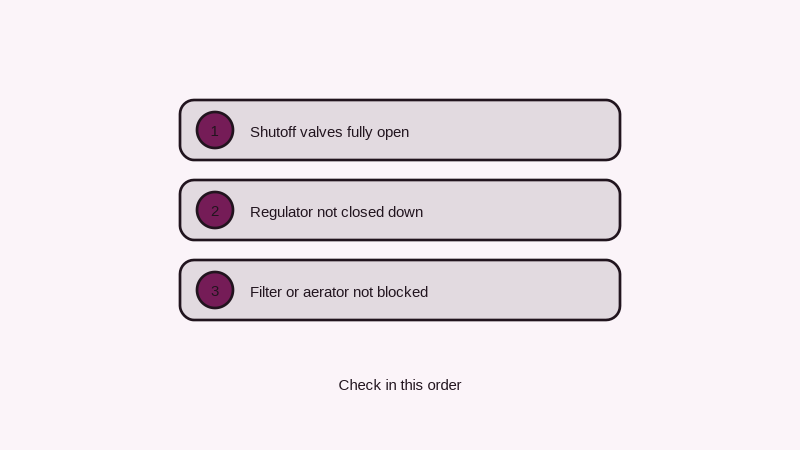
When weakness is house-wide, see sudden low water pressure. Older homes in Sylmar, Pacoima and Panorama City built between the 1950s and the 1970s may have galvanized lines that narrow. A plumber can test where pressure drops. If an existing regulator is set too low, the plumber adjusts it with a gauge, which is a quick fix.
Common questions
What size regulator does a house need?
Whole-house regulators are sized to the main line, so check the pipe size and the maker's flow rating. A plumber confirms the size. A quarter-inch unit is too small for a house, and an oversized one can be less accurate at low flow.
Is a quarter-inch regulator suitable for a washing machine?
Not a good idea. A washer needs more flow than a quarter-inch unit passes, and it will fill slowly. If washer pressure is a worry, check the house pressure and fix it at the main. See our page on washing machine regulators.
What does the arrow on a regulator mean?
The arrow shows the direction of water flow. Installing it backwards stops the regulator from working properly or restricts the flow. Check the arrow before you tighten the fittings, and read the maker's instructions that came in the box for any other marks.
How do I set a small regulator?
Many small regulators come preset, and some have an adjusting screw. Put a gauge in the line to set it, turning slowly and checking the dial after each small turn. If you have no gauge, leave it at the preset value rather than guessing. A plumber can set it correctly.
How long do small regulators last?
How long one lasts depends on your water and the part itself. Sediment and wear shorten its life, and makers publish their own guidance for each model. If flow drops or pressure creeps up, replace it, and keep the maker's paperwork for the warranty terms.