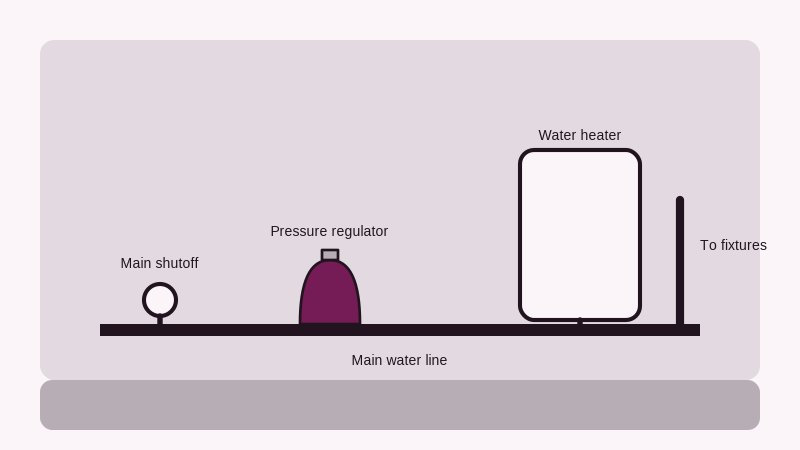
Examine the incoming supply pipe just downstream of the shutoff valve, at the spot where water enters the property. Typical places are a garage, a utility closet, under the floor or in an outdoor box. You are hunting for a brass fitting shaped like a bell, topped with a bolt or screw. If none appears, the house may have none. The wider picture is in water pressure and valves, and the front page of Mission Point Plumbing lists what else we arrange.
Where in my house is the pressure regulator hiding?
Trace the main water pipe back to its point of entry. The regulator is usually the first or second fitting after the main shutoff valve and ahead of any branch to the water heater or fixtures. Look along the garage wall, the outside wall near the hose bibb, a utility closet, under the floor or an outdoor meter box.
Follow the main supply. Begin by locating the main shutoff valve, which everyone in the household ought to be able to reach. Across many Los Angeles homes it sits on the front or side wall, beside the meter box, or in the garage. From there the pipe runs into the building, and the regulator tends to sit close by.
Garage. In many north Valley homes built in the 1950s to the 1970s, the water line comes in through the garage wall, with the water heater nearby. Scan low on that wall for a rounded brass dome between the main valve and the first branch.
Utility closet or laundry area. Where the heater and the main line are indoors, the regulator may share the closet, near the heater's cold inlet.
Crawl space. Houses on raised foundations may run the line under the floor. Be careful down there: dust, spiders and tight space. If the pipe is visible from the hatch, use a flashlight rather than crawling in.
Outdoors. The regulator may sit in a box by the meter or against the house wall, under a small cover. The water meter is not the regulator. The meter belongs to the utility and normally lies upstream of your connection, so leave it alone.
Hillside homes. Homes on terraces and slopes, such as those in upper Sylmar, may have the main line arrive at a different level from the street, so the regulator could be on a lower wall or in a lower basement-type space. Follow the line from the main shutoff.
Plenty of houses have no regulator. Whether yours does depends on its age and past work, and we cannot say for any address. If no bell-shaped valve appears, ask a plumber to look. What drives the price, should one be needed, is covered in water pressure regulator costs.
How do I recognize a pressure regulator when I see one?
Expect a brass valve shaped like a bell or dome, about the size of a fist or up to a small melon, set into a straight run of pipe. An adjustment screw or bolt crowns it, and an arrow marks the flow direction on the body. Some include a gauge connection. It is bulkier than an ordinary shutoff valve and rounder than a ball valve.
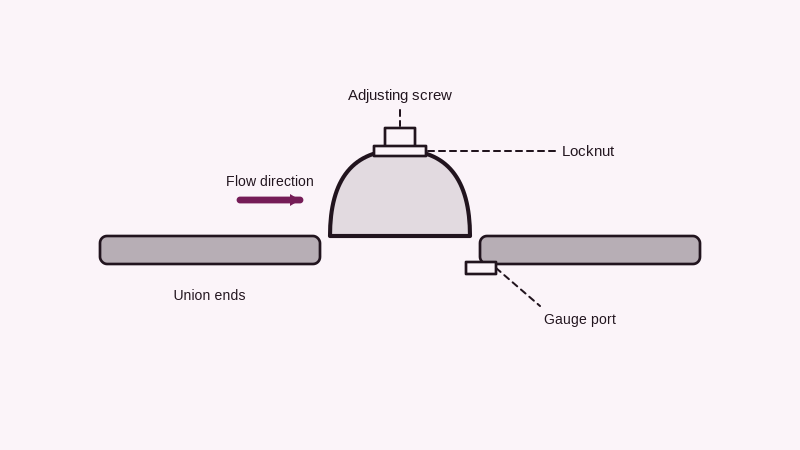
Features to spot:
- A dome or bell shape up top, with a threaded cap or bolt.
- A locknut sitting over the adjusting screw.
- An arrow molded on the housing that shows flow direction.
- A union or threaded joint at each end.
- Occasionally a small port for a pressure gauge.
Do not confuse it with the shutoff valve (a wheel or lever handle), the relief valve on the water heater (small, mounted on the tank), a backflow device (more complex, with test ports) or a thermal expansion tank (a small tank, usually on the cold line). A clearer picture is on the page about how a pressure regulator looks.
How can I check if my pressure runs high or low?
Attach a pressure gauge to an outdoor hose bibb with every tap closed and read the dial. A plumber can do this as well. Excess pressure shows up as pipes that bang, fixtures that drip and a relief valve that weeps. Too little shows up as feeble showers and slow filling. Ask the plumber to read and record the number.
Hardware stores sell hose bibb gauges cheaply. Thread one onto the faucet, stop other water use, open the faucet and read it. This page gives no target number since a code limit could not be verified; the maker's documents and the plumber's advice settle it. Your fixtures' normal range is something the plumber can tell you.
Pressure in the north Valley shifts with elevation and the supply system. Homes high on a slope often see less pressure than those in low spots, though sometimes the reverse holds. Abrupt changes deserve attention. Causes other than the regulator are covered in sudden low water pressure and weak hot water pressure. When just the shower is feeble, try low-pressure shower heads.
Can I adjust the regulator myself?
A homeowner can turn the adjusting screw found on some models a little while watching a gauge on the line. Even so, the setting should fit your fixtures and the maker's guidance, and a worn unit may not hold it. If in doubt, stop and consult a plumber, because too high a setting can strain pipes and the water heater.
To adjust, back off the locknut, turn the screw a small amount (clockwise raises pressure on most models, but read the maker's notes), check the gauge, then tighten the locknut again. Wait and read once more, since pressure can drift. Never force a stuck screw.
If water hammer, leaks or a dripping relief valve persist, the regulator may have failed. Replacement is a standard plumber job, and the plumber should read the pressure before and after. Related reading: replacing a water pressure regulator and whole-house regulators.
At what point should a plumber take over?
Hire one if no regulator turns up, the gauge shows a reading you doubt, pipes hammer or fixtures leak, the heater's relief valve drips, or the regulator itself leaks or is corroded. The plumber can find it, test it, adjust or replace it and say if you need one. Send the particulars with the quote form.
Under California rules, permitted work needs a contractor license, so ask for the license number. A plumber can explain whether the regulator sits where water enters the property and whether changing the main line is involved. Main line work belongs to a contractor, not to a DIY repair. We have not verified every permit rule for every address, so for a home in the City of Los Angeles, check with the Department of Building and Safety.
Common questions
What is the time needed to locate or swap a pressure regulator?
Tracking one down and testing it may take under an hour. A swap commonly runs one to two hours, more if fittings are corroded or access is poor. Water to the entire house is shut off during the swap. Look for a time estimate on the written quote.
Which questions come before a water pressure test?
Check whether the quote is in writing, includes a gauge reading, explains what that reading means for your fixtures, and states what is covered if a regulator must be replaced. Confirm the contractor license number before work begins, because permitted jobs need one. Ask who removes the old valve.
Do I have to be home for a pressure check?
Yes, to unlock the garage or meter box and the main shutoff, and to be there while the water is briefly shut off. If you cannot be present, agree on access in writing, and mention pets and locked gates to the plumber.
Is a regulator present in every house?
No. Plenty of houses have one and plenty do not, depending on age, the supply and earlier work. Lacking one is not automatically a fault, but high pressure damages fixtures. Measuring your pressure is the way a plumber learns whether adding one is worthwhile.
Is the regulator the same as the water meter?
No. The meter tallies the water you use and is owned by the water utility. The regulator is a valve that reduces and steadies pressure inside your home. The meter sits at the supply connection, usually at the property line, and the regulator is on your side downstream of it.