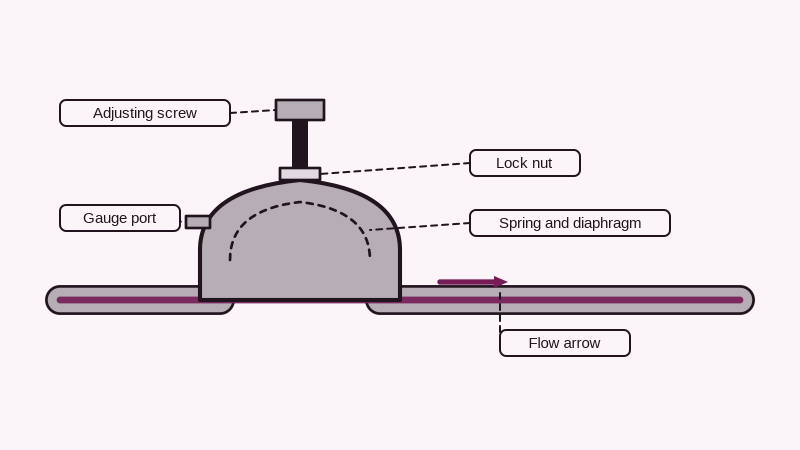
Picture a short, rounded brass valve in the shape of a dome or bell, about as big as a fist or a large grapefruit, with a screw and nut on top and a pipe joined to each side. That is a pressure regulator. It sits on the main water line close to where the line enters the house. If your taps run weak or too strong, the plumber for low water pressure page covers what to check next. To ask for a plumber, use the quote form.
First, what are you hunting for, and where?
Search along the main water line near its point of entry, often just beyond the main shutoff valve. Likely spots are the garage wall, a front or side exterior wall, a utility closet, a crawl space, or the area beside the water heater. Take a flashlight and look for a bell-shaped brass body with a screw on top.
Typical places to check, in the order most people find one:
- Next to the main shutoff valve, which often sits at the entry point.
- On the garage wall nearest the street.
- In a closet or utility area against an outside wall.
- Under the house or in a crawl space, on the incoming pipe.
- In a ground-level box or at the side of the house, where the line comes in outdoors.
Plenty of houses have none; whether yours does depends on street pressure and how the house was plumbed. If you find a valve, check the label. Many Sylmar homes were built between the 1950s and the 1970s, so a regulator may be an original that has never been replaced, or it may have been added at some point. Where regulators are usually found says more about that search.
What are the details to look for on a regulator?
The body is rounded and bell-like, in brass, with a threaded adjusting screw capped by a lock nut and a flow arrow cast or stamped into the side. The connections at each end match the pipe size, commonly three-quarter inch, though some are bigger. A few have a small port on top for a gauge.
Features you can check:
- Bell or dome shape. The wide upper part contains a spring and a diaphragm.
- Adjusting screw. A bolt head or plastic cap on top, with a lock nut, turned to change the setting.
- Flow arrow. An arrow on the body shows the direction of water. It matters when replacing one.
- Brass or bronze finish. Often dull gold, or green with age. Plastic bodies exist but are rarer.
- Pipe connections. Threaded, soldered or push-fit, depending on the pipe.
- Gauge port. Some models have a threaded port so a plumber can read pressure without a separate gauge.
If the label is still legible, it may give the maker, model and pressure range. Some carry a tag with a number. No number is given on this page, because the best setting depends on your fixtures and your house, so ask a plumber to read the gauge. See also 3/4 inch regulators, water line pressure regulators and water main pressure regulators for the common types.
How is a regulator different from the other brass parts by the main?
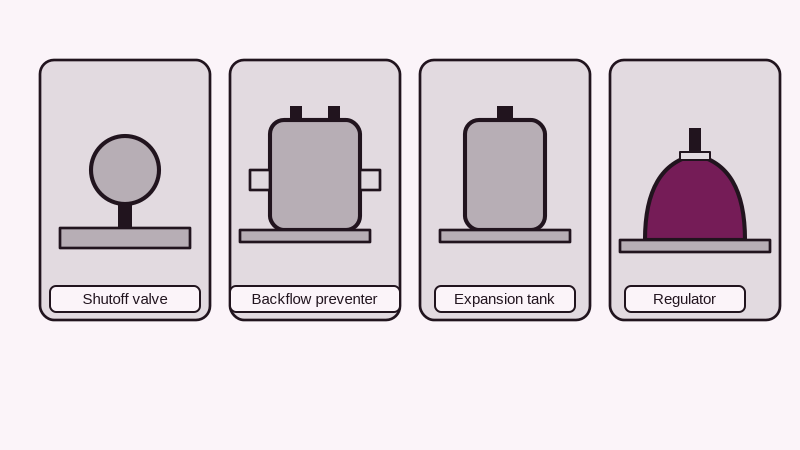
A regulator has a bell shape with an adjusting screw on top. A shutoff valve has a wheel or lever handle. A backflow device is larger and more complex, with test ports and a rounded body. An expansion tank looks like a squat balloon and normally sits by the water heater. Each does a different job.
Look-alikes and how to tell them apart:
- Main shutoff valve. A straight body with a round wheel or lever, and no bell or screw.
- Gate or ball valves. Straight bodies with handles.
- Backflow preventer. A bigger assembly with two shutoff valves and small test cocks. Common on irrigation lines. See backflow prevention testing.
- Expansion tank. A tank teed into the cold line near the water heater. If it has a tire-style valve, it is a tank. See replacing an expansion tank.
- Relief valve. A small lever valve on a water heater, with a pipe running down. A different job.
- Water meter. Owned by the utility, with a dial. According to its report, LADWP supplies the north Valley areas inside the City of Los Angeles; your bill names your supplier.
If you cannot decide, photograph it and let the plumber confirm. The picture also helps with your quote request.
How do I test whether the regulator works?
Thread a pressure gauge onto an outdoor hose bib or a laundry tap and note the reading with no water running, then open a tap and read it again. A steady number suggests the regulator is holding. A reading that drifts up overnight or swings widely points to a failing unit. Only a gauge gives a reliable answer.
Other clues that a regulator is failing:
- Weak pressure at every tap, with no valve closed.
- Pressure that starts high in the morning then drops with use, or the reverse.
- A hammering sound when a tap closes. See water hammer.
- A leak or crust around the bell.
- Fixtures or appliance hoses that fail early.
Gauges are cheap and screw onto a hose connection. No target number appears here, since the right setting depends on the labels on your fixtures and on the plumber's judgment, so have the plumber read it and write it down. To understand how a replacement is priced, read what drives water pressure regulator cost and regulator replacement.
What if I cannot find a regulator at all?
Not every house has one, and a house with fine pressure may not need one. If pressure is high or low, a plumber can check at the meter and advise whether to fit one. Searching the usual spots and photographing the main line helps, and a plumber can confirm quickly.
Steps:
- Follow the main line from the meter, or from the street side of the house, to where it enters, checking each spot above.
- Look in the garage, the utility spaces and any ground-level box.
- Photograph the main shutoff and nearby fittings.
- If you are still unsure, ask a plumber to look during a visit, or attach the photos to your request.
Whole-house units are covered at whole house water pressure regulators, and choosing the best home regulator explains how to pick one. As for terrain, homes in upper Sylmar on the Hubbard Street terraces sit on a slope that rises from about 1,100 to about 1,700 feet, according to Wikipedia, so elevation can change the pressure at a given house. See the upper Sylmar area page.
When does the regulator need a plumber?
Hire one if the regulator is missing from where it should be, the bell leaks or has corroded, the gauge shows pressure that is too high or too low, the reading creeps up overnight or the main shutoff will not close. Replacement is work on the main line, and a mistake can flood the house.
A plumber will:
- Read the gauge before the work and again after it.
- Inspect the regulator and shutoff valves.
- Fit a replacement of the right size, matching the flow arrow.
- Set the new pressure and test.
To ask for a plumber, send the quote form with the address, photos of the main line and what you notice. The request is passed to a local plumbing business, which then contacts you. This site shows no dollar figures. Someone reads form requests on weekdays from 9am to 5pm. For everything else we cover, start from the Mission Point Plumbing home page.
Common questions
Does every house have a pressure regulator?
No. Whether yours has one depends on street pressure and how the house was built, and some houses had one added later. If you cannot find one near the main, a plumber can measure the pressure with a gauge and say whether you need one.
Can I safely adjust the regulator myself?
Many have an adjusting screw on top, but without a gauge any change is guesswork, and a poor setting can strain fixtures or leave pressure too low. Turn in quarter steps with a gauge attached, or ask a plumber. If it does not respond, the regulator is probably worn.
What separates a regulator from an expansion tank?
A regulator is a valve fitted to the main line to reduce incoming pressure, while an expansion tank is a small tank by the water heater that absorbs the extra pressure from heated water. They often work as a pair, and they look different: a bell-shaped valve versus a tank.
What is the cap on top of the regulator for?
It usually covers the adjusting screw and lock nut that set the outlet pressure. Some regulators have a plain bolt head instead. Treat it as a setting control and do not remove it with the water on. A plumber can set it using a gauge on the line.
Is a leaking regulator an emergency?
Water dripping from the bell means the diaphragm or seal has failed, which needs a plumber soon, but it is not usually a flood. If water sprays or you cannot control it, shut the main valve, then see our emergency plumber page.