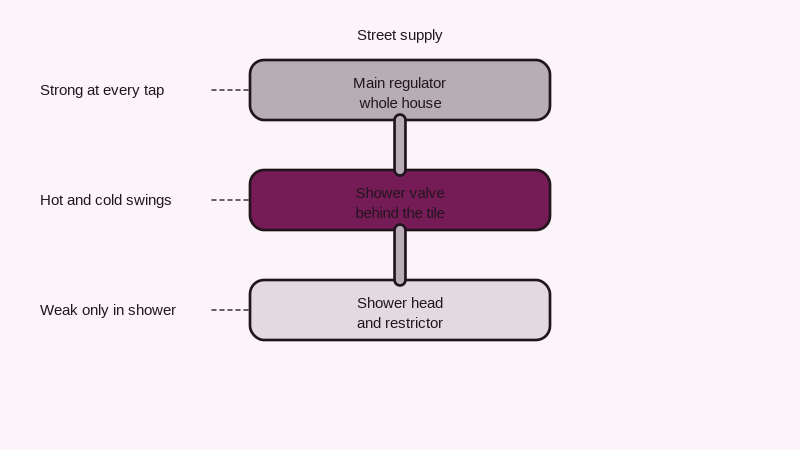
Ask about a regulator for the shower and you may hear three different answers, because the phrase covers three parts, and each cures a different problem. Harsh spray at every tap? Begin with the main regulator. Temperature that lurches between hot and cold whenever someone flushes points to the valve. A dribbling spray points to the head or a clog. This page is one branch of the sinks, faucets, showers and disposals group.
Before buying a part, test the rest of the house. When the shower alone is weak, a regulator is rarely to blame.
Which part sets shower pressure: regulator, valve or head?
The main regulator fixes the supply pressure across the entire house. Behind the tile, the shower valve blends hot with cold, and a balancing type cushions sudden swings in either supply. The shower head limits flow with a small restrictor and a spray pattern. Which one to change depends on whether the problem is everywhere, only in the shower, or only at the head.
A quick sort:
- Strong at every tap and the pipes bang: main regulator. See the water main regulator.
- Temperature jumps when another tap or toilet runs: shower valve or cartridge.
- Weak in the shower alone: clogged head, restrictor or failing cartridge.
- Weak everywhere: look at the main shutoff, the regulator and the supply.
Hot water side faults can also change what you feel. A weak hot side alone has its own page: low hot water pressure.
At what point do I need a plumber?
Arrange a visit once the gauge reads high or swings, the valve needs the wall opened, temperature swings scald, you find a leak, or you cannot tell which part failed. A nearby plumbing business visits the house, and the price reaches you in writing ahead of time.
In the quote form, describe how the shower behaves, whether the whole house is affected and what a gauge shows, and attach photos of the trim and showerhead. Forms are read Monday through Friday, nine to five. The following stages are described under how a job runs, and Mission Point Plumbing is always one click away.
Work needing a permit goes to a contractor holding a state license. If unsure, ask LADBS.
Why does my shower go hot and cold when someone flushes?
A sudden change in cold-water flow, such as a toilet filling, upsets a shower that mixes the two. A pressure-balancing valve or thermostatic valve is designed to handle that, and an older valve or a worn cartridge may not. A new cartridge or valve often cures it. If tile must come off, hand the work to a plumber.
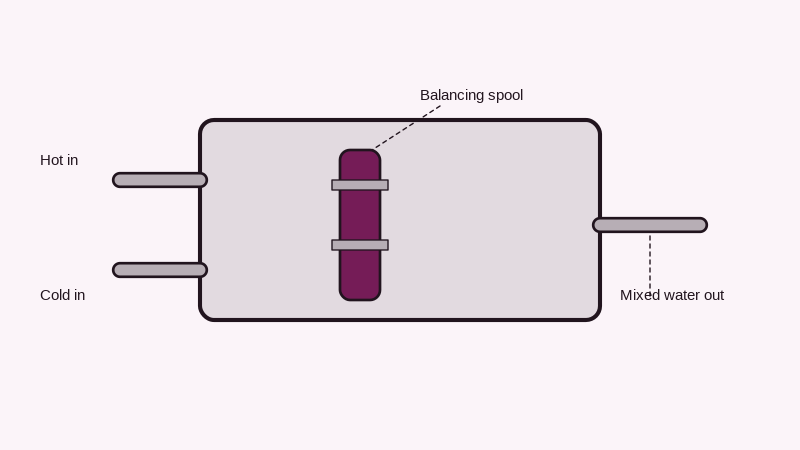
Older north Valley homes from the 1950s to the 1970s often have a simple two-handle or single-handle mixing valve with no balancing, and the shower reacts to every change in the house. Updating to a balanced valve is more than a part swap, since the tile around it may need to come off. Have the quote spell out where the wall opens and who closes it up.
Sudden hot bursts can scald. Set the water heater thermostat to a level that is safe for your household, and keep children and older people in mind. If a shower suddenly runs scalding, leave it and fix the valve.
Does the trouble lie in the shower or the whole house?
Thread a gauge onto an outdoor spigot, keep every fixture off, note the dial, and repeat later in the day. A steady reading suggests house pressure is fine and the issue is at the shower. A reading that climbs or swings suggests the regulator is failing. The gauge settles this before you buy parts.
According to the EPA, the typical household loses more than 9,300 gallons a year to leaks, and strong pressure worsens each drip. Check for dripping taps and a running toilet. Check LADWP's yearly Drinking Water Quality Report for service area details and your bill for who supplies your water. To find the bell-shaped valve itself, read where the regulator is located.
If the pressure is high at every tap, the next step is replacing the regulator. Write the numbers down and include them in your request.
What if the shower is weak even though pressure is fine?
A weak spray with good house pressure usually means a clogged shower head or arm, scale in the valve, a partly closed stop or a failing cartridge. Take the head off, let it sit in vinegar, poke out the arm and run the water bare to judge the flow. If flow is strong without the head, the head was the problem.
Still a trickle with no head fitted? Then the restriction sits in the valve or the bathroom supply line. Rust inside old galvanized pipe narrows the bore, which is a plumber's job. Hard water can also coat parts; cleaning steps are on removing hard water scale. A dripping handle is another repair altogether; see fixing a shower faucet leak and fixing a Delta shower faucet leak.
Water behind the shower wall is a different matter. Stains on the wall beside the shower or the ceiling under it belong on the shower leak page.
Is there a regulator for the shower head?
There are small inline regulators and flow restrictors that screw between the shower arm and the head, and they limit flow, not pressure. They suit a spray that is too strong or wasteful, but they do nothing for temperature swings and can make a weak shower weaker. A true pressure regulator belongs on the supply line, not at the head.
Many modern shower heads already have a flow restrictor. EPA WaterSense showerheads cap flow at 2.0 gallons a minute and are also checked for how the spray feels. If your shower is weak, removing a restrictor is a common trick, but it may break local water-saving rules and raise your bill. Our guide to the best shower heads for low pressure lists what to look for instead.
If you have a rental, check with the landlord before altering fixtures, and tell them about pressure problems in writing.
Common questions
How much time does shower work take at the house?
Swapping a cartridge or head can be done in under an hour. A main regulator swap usually fits within one to two hours. Opening a wall to replace a shower valve takes longer, and the wall must be patched. Expect a time window up front, along with a warning about anything the opened wall uncovers.
What matters most on the quote?
Insist on a quote that names the part, lists any wall opening and repair, and states the warranty on parts and labor. Verify the contractor's California license on the state board's website, and agree on who re-tiles before work starts, so the quote covers the full job.
Does an adult need to be home when the wall is opened?
An adult should show the shower, the main valve and the fault, approve any price change, and watch it run at the end. Clear belongings from the bathroom beforehand, and put towels and mats away, so the plumber has clear space to work around the opened wall.
Will a flow restrictor fix high pressure?
A restrictor throttles flow at the head only; the pipes behind it still carry full pressure. High pressure throughout calls for the regulator itself. A restrictor is only a tweak for the shower, so if every tap and appliance in the house is affected, ask about the regulator instead of the showerhead.
Can I remove the restrictor from my shower head?
You can on many models, but you may use more water and go against the head's rating. A head built for low-pressure houses is the cleaner answer. If the restrictor is not the issue, removing it will not help, so test flow without the head first.